




Mortal Remains
La Trahison des Clercs
Julien Benda deliberately made this title ambiguous, so I will translate it here "the malice of the experts." In an online New York Times article of February 5, 2020, titled "Draft Executive Order Would Give Trump a New Target: Modern Architectural Design," referring to a proposed executive order, "Making Federal Buildings Beautiful Again," which "favors classical design for buildings in Washington" and has "drawn opposition from architects," the authors quote Roger K. Lewis, an architect and professor emeritus of architecture at the University of Maryland: "At the most fundamental level it's a complete constraint on freedom of expression." Marion Smith, also an architect and chairman of the group promoting the proposed order, approves this constraint:
For too long architectural elites and bureaucrats have derided the idea of beauty, blatantly ignored public opinions on style, and have quietly spent taxpayer money constructing ugly, expensive, and inefficient buildings. . . . This executive order gives voice to the 99 percent—the ordinary American people who do not like what our government has been building.
I'm one of those. Do it with somebody else's money. Professor Lewis and his ilk speak with the expert's air of entitlement, as though such people had some kind of right to public monies to exercise their very expensive imaginations. If George Soros or Bill Gates or Jeff Bezos wants to build something expensive, ugly, and uncomfortable, nobody's stopping them. Let them buy a chunk of the Mojave and go at it.
I find it interesting how many people who claim to have a vital interest in the beauty of the natural world are interested in imposing the painfully artificial upon it ("abortion rights" are the most extreme example) and upon us, the less enlightened whose backwardness they punish by triumphantly forcing us to look at it or work in it. No one is saying that new architectural ideas are bad in themselves—only that they should receive no preferential options simply for being new—they must also be good. Classical styles are called classical because they have successfully survived the aesthetic tests of many generations not only of experts, but also of average people, which is a mighty point in their
favor.
At Michigan State University, where my wife and daughter went to college, it was the case, and still is, that the old central campus dormitories, built in the 1930s, are in high demand among the students,
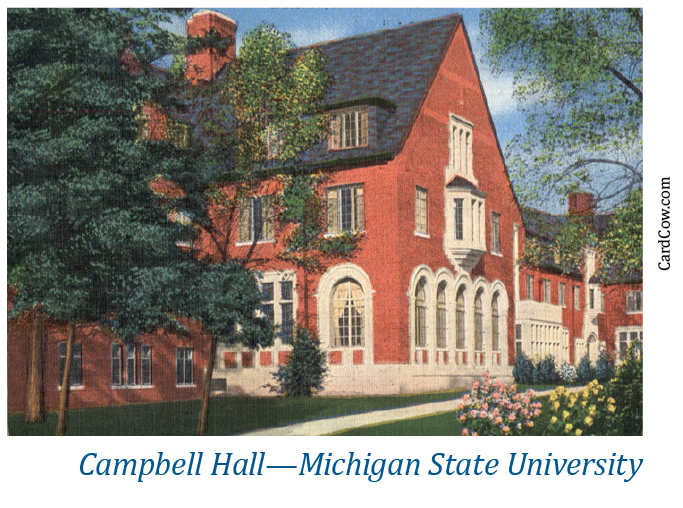
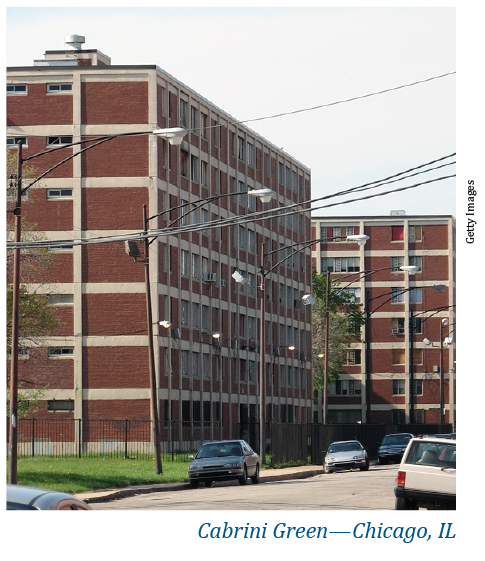
while few wish to live in the 1960s hives on the east end of campus,

clearly kin to the Cabrini-Green tenements in Chicago (demolished beginning in 1996).
And Michigan State has a huge campus upon which there is plenty of room to build anything—even without cutting into the faculty golf course. Closer to my home, in the 1960s (when else?) a progressive city council in Kenosha, Wisconsin, attempted to raze this Daniel Burnham library (one of three the famous architect designed)

to extend 60th Street, so people heading toward Lake Michigan—two blocks away—from the downtown area could get there without having to drive around five-acre Library Park. Before they could execute their designs, however, an ad hoc citizens' organization—doubtless all non-experts in progressive city planning—stopped the vandals, and Simmons Library still stands, as before, a local icon.
Anyone not aesthetically corrupted (I was going to say "retarded," but retardation implies an innocent basis in nature, while corruption of the senses does not) will be able to understand John Silber in The Architecture of the Absurd, where he notes that architectural modernism brings with it the profoundly inhuman. Its dark Satanic Experts can only be stopped by someone in a position of superior power who is able to treat ugliness as an enemy to be defeated and can shrug off being called nasty names by progressivists. Hence the appeal of the classical committee in Washington not to a deliberative body, highly susceptible to expert testimony, but to the embarrassingly common commoner who now happens to be President and doesn't much care what progressive authorities think.

S. M. Hutchens is a senior editor and longtime writer for Touchstone.
A Journal of Mere Christianity—Delivered to Your Door
- Essays on theology, culture, and the Church
- Contributors from across the Christian traditions

Six print issues (one year) of Touchstone, plus full online access and PDF downloads for only $39.95.

Get a one-year full-access subscription to the Touchstone online archives for only $19.95.
bulk subscriptions
Order Touchstone subscriptions in bulk and save $10 per sub! Each subscription includes 6 issues of Touchstone plus full online access to touchstonemag.com—including archives, videos, and pdf downloads of recent issues for only $29.95 each! Great for churches or study groups.
Transactions will be processed on a secure server.
more from the online archives

33.3—May/June 2020
on the Wisdom of the Good Doctor Edmund Pellegrino by Allen H. Roberts II
22.6—July/August 2009
on the Integration of Anger into the Virtuous Life by Leon J. Podles
calling all readers
Please Donate
"There are magazines worth reading but few worth saving . . . Touchstone is just such a magazine."
—Alice von Hildebrand
"Here we do not concede one square millimeter of territory to falsehood, folly, contemporary sentimentality, or fashion. We speak the truth, and let God be our judge. . . . Touchstone is the one committedly Christian conservative journal."
—Anthony Esolen, Touchstone senior editor
