




From Heavenly Harmony
Charles Villiers Stanford's Gifts
by Ken Myers
If you are fortunate enough to attend a church that still sings from a hymnal—an increasingly rare circumstance—you may have had the pleasure of singing the ancient text that begins, "I bind unto myself today the strong name of the Trinity." And if you've been paying attention, you know that the text of this triumphant hymn is attributed to St. Patrick.
According to an eleventh-century manuscript, St. Patrick composed the text as "a lorica [a prayer of protection; Latin for 'body armor'] of faith for the protection of body and soul against demons and man and vices." Tradition has it that St. Patrick and a group of fellow missionaries were making their way to a site in County Meath to preach the gospel, and that they knew in advance of potential violent opposition by forces loyal to the local Druid priests. Hence the need for spiritual armor. For this reason, the hymn is commonly known as "St. Patrick's Breastplate." In 1889, it was translated from Old Irish into modern English by Mrs. Cecil F. Alexander (1818–1895), the wife of a prominent Irish bishop.
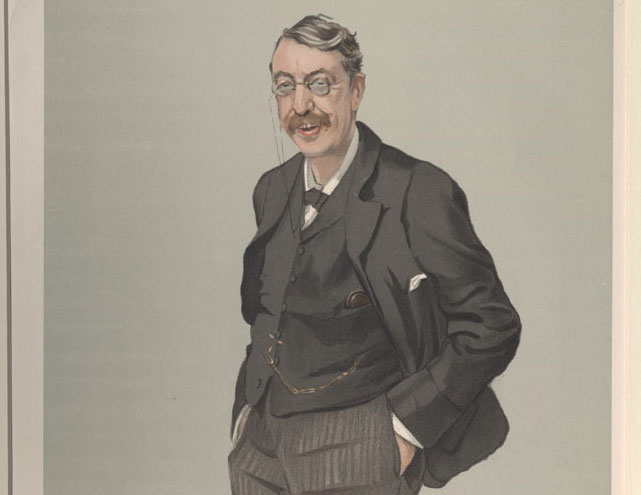
The tune to which Mrs. Alexander's metrical text is almost always sung is called St. Patrick. It is a traditional Irish melody that first appeared in print in 1902 in a collection of almost 1,600 Irish folksongs, edited by one of Ireland's most celebrated native composers, Charles Villiers Stanford (1852–1924). At the time, the tune apparently had no name, though it seems to have been used to sing portions of St. Bernard of Clairvaux's devotional poem Jesu dulcis memoria (part of which forms the modern hymn "Jesus, the very thought of Thee"). But Stanford—who had been teaching composition at Cambridge University since 1887 and had composed dozens of orchestral, choral, and chamber-music works—must have recognized something about the melody that made it a suitable partner for a venerable and powerful Irish devotional poem in need of a tune. Not only could this marriage work for congregational use; Stanford soon scored text and tune for choir, organ, brass, and percussion, including some very martial-sounding snare drums. The text is, after all, about spiritual warfare, and the presence of trumpets and drums accentuates the spirit of conflict.
This robust version of the hymn includes stanzas from the original poem that are not typically included in hymnals. The original sixth and seventh verses (of nine) enumerate the vast variety of things from which protection is required. For example:
Against all Satan's spells and wiles,
Against false words of heresy,
Against the knowledge that defiles,
Against the heart's idolatry.
Against the wizard's evil craft,
Against the death-wound and the burning,
The choking wave, the poisoned shaft,
Protect me, Christ, till thy returning.
Stanford's arrangement of St. Patrick's Breastplate is not well known, and thus is one of the welcome highlights of a 2017 album of his choral music performed by the choir of Trinity College, Cambridge, conducted by Stephen Layton. Trinity and Stanford had a long-standing connection: in 1873, Stanford was appointed organist for the college's choir while still an undergraduate, a post he held for 20 years. During that time, he composed a number of anthems and settings of the canticles used during the Morning Communion and evening services in the college.
Three Latin Motets
It was also during his years at Trinity that Stanford composed his Three Latin Motets (Op. 38, not published until much later), also included on this recent recording by the choir he once accompanied.
The best known of these three pieces for unaccompanied voices—Justorum animae—sets a text from the Book of Wisdom: "The souls of the just are in the hand of God, and the torment of malice shall not touch them: in the sight of the unwise they seemed to die, but they are in peace." For centuries, this text has been sung at the Offertory on the Feast of All Saints. Stanford's setting begins with a gentle, harmonically lush affirmation of God's protection of the righteous. Things get more animated when the torment of malice is referenced; Stanford exploits the percussive qualities of the Latin tormentum and builds to a dramatic climax on militiæ. But having given us a hint of the pains from which the souls of the just are protected, the choir returns to the lyrical and comforting soundscape with which the motet began, concluding with a steady confirmation of eternal rest as the choir repeats the words "in pace."
From an early age, Stanford was an admirer of the music of Schumann and Brahms; in 1876, he conducted one of the first performances of the Brahms Requiem in Britain. In the second of his Three Latin Motets—Cœlos ascendit hodie, a medieval text set by Stanford for double choir—one can hear affinities with the use of a cappella voices by both Brahms and Mendelssohn, especially in the briskly articulated "Alleluias" repeated throughout the work, and in the harmonies in the closing "Amen." Since the text celebrates the Ascension, the entry of the King of Glory into the heavenly throne room, those Alleluias can be heard as vocal fanfares punctuating the confident enthusiasm of the entire work.
Ken Myers is the host and producer of the Mars Hill Audio Journal. Formerly an arts editor with National Public Radio, he also serves as music director at All Saints Anglican Church in Ivy, Virginia. He is a contributing editor for Touchstone.
A Journal of Mere Christianity—Delivered to Your Door
- Essays on theology, culture, and the Church
- Contributors from across the Christian traditions

Six print issues (one year) of Touchstone, plus full online access and PDF downloads for only $39.95.

Get a one-year full-access subscription to the Touchstone online archives for only $19.95.
bulk subscriptions
Order Touchstone subscriptions in bulk and save $10 per sub! Each subscription includes 6 issues of Touchstone plus full online access to touchstonemag.com—including archives, videos, and pdf downloads of recent issues for only $29.95 each! Great for churches or study groups.
Transactions will be processed on a secure server.
more on music from the online archives
33.3—May/June 2020
Bach's Cantata BWV 106, Gottes Zeit ist die allerbesteZeit (God's time is the very best time) by Ken Myers
more from the online archives

31.6—November/December 2018
on Childhood Encounters with a Christmas Icon by Rebecca Sicree

33.3—May/June 2020
on the Wisdom of the Good Doctor Edmund Pellegrino by Allen H. Roberts II

calling all readers
Please Donate
"There are magazines worth reading but few worth saving . . . Touchstone is just such a magazine."
—Alice von Hildebrand
"Here we do not concede one square millimeter of territory to falsehood, folly, contemporary sentimentality, or fashion. We speak the truth, and let God be our judge. . . . Touchstone is the one committedly Christian conservative journal."
—Anthony Esolen, Touchstone senior editor
