





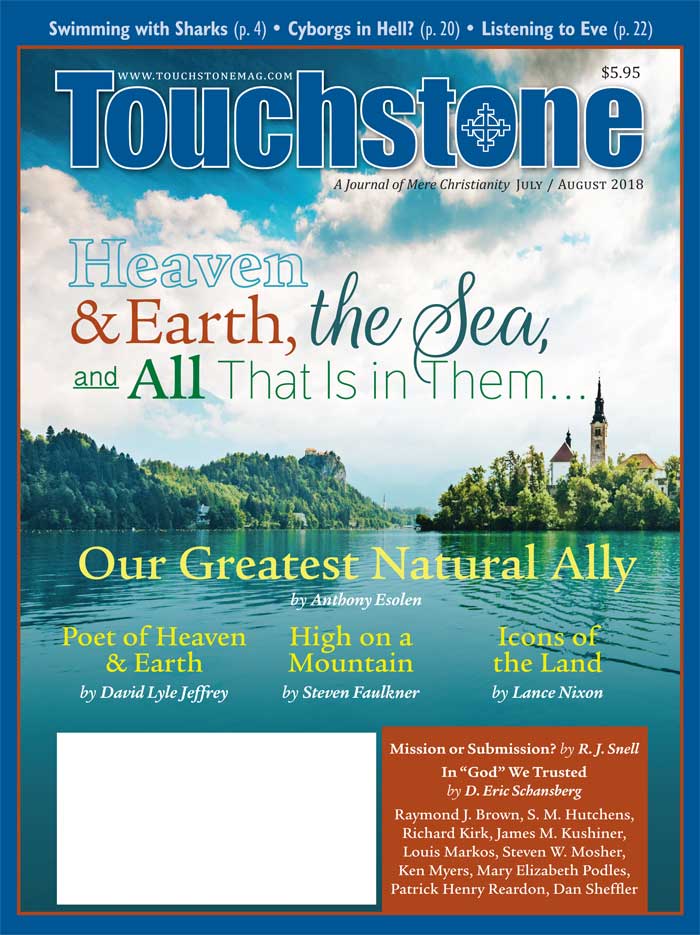
View
High on the Lolo
Steven Faulkner on God's Pictures of Life & Death & Eternity
I pitch my tent just off the Lolo Trail, a sand-and-gravel Forest Service road that rises and falls along high ridges of the Clearwater Mountains in eastern Idaho, a trail known to history as the route Lewis and Clark followed to cross the Rocky Mountains on their way to and from the Pacific Ocean in 1805 and 1806. It was also the route used in 1877 by members of the Nez Perce tribe—750 men, women, and children with their dogs and mules and 2,000 horses—as they fled their homeland, pursued by General O. O. Howard with his soldiers and his cannons.
I had hiked and mountain-biked this trail just three summers before with two of my sons. This time I am alone.
I gather firewood, break off twigs for kindling, and light a campfire. Tall spruce and pine trees stand behind me in the dusk, but to the southeast I count seven ridgelines, stepping down into the steep Lochsa River valley, then up to a distant horizon maybe 50 miles away, a thin line of rocky peaks that looks like the edge of a flint knife going red in the evening light. That ridgeline is the limit of the visible world. Evening shadows are rising slowly, slowly up the steep valleys as night descends.
I boil water, pour it into an aluminum package of freeze-dried beef stew, and begin to eat, watching as blue sky soaks into the layered mountain ridges, dyeing the entire landscape in shades of blue and charcoal as sky takes possession of earth. That impression increases as the sky deepens to black and the limits of sight give way to limitless space.
Far out in that dark infinity, stars appear.
"Look at the stars!" wrote the poet Gerard Manley Hopkins; "look, look up at the skies! / O look at all the fire-folk sitting in the air! / The bright boroughs, the circle-citadels there!"
They inhabit, as do we, that vast, endless vacuum.
Lifetimes in Miniature
It seems to me that we blind earthlings miss these obvious, daily reminders: God speaking in everyday parables to our illiterate souls. It's so obvious, so ordinary, that we miss just how extraordinary it is, ignore the fact that each day appears as a lifetime in miniature. Each morning we rise from darkness and walk and speak and cry and laugh and work our way round again to
darkness.
Far from the humdrum world of asphalt highways and concrete sidewalks where, to use Hopkins again, "all is seared with trade; bleared, smeared with toil; / And wears man's smudge and shares man's smell," the night skies give way to endless black punctuated by burning stars as "the last lights off the black West" go. Then again, as my campfire subsides into coals, for about the 2,490th night of my life, the patient God draws for his child pictures of life and death and eternity.
I crawl into my tent, slide into the sleeping bag, and, as one does every night, I yield to sleep. Soon enough, in spite of the hard sleeping pad, I lose consciousness and this solid earth evaporates. What more graphic image of death could we have? What more persistent reminder? Darkness comes and perception wanders away into the surreal.
Then morning reappears and earth and life return to us through no effort of our own. Because I'm sleeping at about 7,000 feet, the summer morning is cool, early sunlight slanting through the branches of the tall conifers onto my tent. I open my eyes and return to the land of the living as if awakened from a grave.
Perhaps this experience is more vivid on a high mountain ridge, yet every day of our lives we seem to die and rise again. Old paintings of saints and monks often include a memento mori, a skull to keep the image of approaching death nearby, to keep us cognizant that "all flesh is as grass," yet in our daily routines this memento of sleep is always at hand, as is the vibrant image of rebirth and resurrection. Hopkins again:
Oh, morning, at the brown brink eastward, springs—
Because the Holy Ghost over the bent
World broods with warm breast and with ah! bright wings.
We are offered new beginnings, a lifetime of successive resurrections. Each new day a novel chance arises to put away the shadows and stains of recent days and claim a fresh start.
Power Like the Dawn
How to claim it? Perhaps with words. Along these very ridges some miles from my camp there is a large pile of gathered rocks on a high, nearly treeless ridge that indicates an ancient place of prayer for the Nez Perce. Lewis and Clark's Nez Perce guides insisted on stopping there to smoke their pipes, which was a religious act, a form of prayer. Prayer seems a natural response on a high mountain, though Lewis and Clark themselves seemed little inclined to pray, stopping only at the insistence of their guides.
"Now," says essayist Annie Dillard, "we are no longer primitive; now the whole world seems not-holy. We have drained the light from the boughs of the sacred groves and snuffed it out in the high places." She says this is our own doing: "We live where we want to live." But perhaps we should be like the early Christians, and reclaim the high places, as they did the pagan temples, for Christ. Tear down the idols and erect shrines to the One God wherever we are, and there recite the songs of praise and kneel again before the Lord our Maker.
Words, perhaps combined with ritual acts like kneeling or lifting the hands, focus the mind and express the yearnings of our souls, calling out to that holy mystery that broods with warm breast over the bent world.
One middle-aged woman of my memory daily walked a city sidewalk up a high hill to the cathedral to celebrate morning Mass, returning home with cold, maybe arthritic fingers, counting the beads of a rosary. Monks chant the ancient psalms in choir. A man in his bedroom clicks on the bedside lamp and unfolds his Bible to read.
"A word has power," says N. Scott Momaday, "in and of itself. It comes from nothing into sound and meaning," like the dawn itself. God, says the Holy Scriptures, spoke ex nihilo the world and cosmos into meaningful being. So even the act of speaking is a picture of creation. By ritual and reenactment, we enter into words human and divine. Words that hold great power. If we attend to words, they attend us on our journeys, and we find ourselves within the divine story and the story rewriting our lives. Carrying right words, revelatory words, words enchanting and directional, we walk out of the infinite night onto the horizons of history.
God is not silent. Each night, each day, he hands us illustrated guidebooks.
Steven Faulkner teaches creative writing at Longwood University in southern Virginia. He is the author of Waterwalk: A Passage of Ghosts (2007) and Bitterroot: Echoes of Beauty and Loss (2016). Both books are memoirs of father-son journeys that followed the paths of missionary priests: Marquette (in Waterwalk) and De Smet (in Bitterroot).
A Journal of Mere Christianity—Delivered to Your Door
- Essays on theology, culture, and the Church
- Contributors from across the Christian traditions

Six print issues (one year) of Touchstone, plus full online access and PDF downloads for only $39.95.

Get a one-year full-access subscription to the Touchstone online archives for only $19.95.
bulk subscriptions
Order Touchstone subscriptions in bulk and save $10 per sub! Each subscription includes 6 issues of Touchstone plus full online access to touchstonemag.com—including archives, videos, and pdf downloads of recent issues for only $29.95 each! Great for churches or study groups.
Transactions will be processed on a secure server.
more on poetry from the online archives
37.5—Sept/Oct 2024
A Battle Plan for Peace While Growing Old by Anthony Esolen
more from the online archives
32.6—November/December 2019
The Year of Our Lord 1943: Christian Humanism in an Age of Crisis by Alan Jacobs by Jesse Russell
27.4—July/August 2014
The Bible, Sacred Theology & the Mind of Christ by Patrick Henry Reardon
27.3—May/June 2014
Religious Freedom & Why It Matters
Working in the Spirit of John Leland by Robert P. George
calling all readers
Please Donate
"There are magazines worth reading but few worth saving . . . Touchstone is just such a magazine."
—Alice von Hildebrand
"Here we do not concede one square millimeter of territory to falsehood, folly, contemporary sentimentality, or fashion. We speak the truth, and let God be our judge. . . . Touchstone is the one committedly Christian conservative journal."
—Anthony Esolen, Touchstone senior editor
