





Feature
A Melodious Life
How Polyphony & the Cantus Firmus Can Illuminate Integrity by Lauris C. Kaldjian
Over the course of my life, three areas of interest have occupied the largest portions of my study and practice: music, medicine, and ethics. As I entered upon each of these pursuits, I did not think about the transcendental properties of being they exemplify, but in retrospect I realize that, together, this trio of interests represents ways of pursuing the beautiful, the good, and the true. The theme of a conference at Notre Dame University ("You Are Beauty") encouraged me to reflect more deliberately on the interrelationships within this trio, and specifically on how beauty relates to truth and goodness in my own particular context. Regarding this context, let me note that I come to my topic not as a music theorist or historian, but as a physician and ethicist who began playing violin concertos by Bach many years before I started reading EKGs or books by Alasdair MacIntyre.
Music, especially sacred music, has been a steady consolation at times when the presence of suffering has brought dark clouds over the beautiful things of this world and I have struggled to make sense of the good and the true. Dietrich Bonhoeffer articulated this consolation in a letter (from prison) to his infant godson, saying that in the years to come music "will help to dissolve your perplexities and purify your character and sensibility, and in times of care and sorrow will keep a ground-bass of joy alive in you." For many of us, the consoling and clarifying power of musical beauty is broadly relevant to our lives, and it prompts me, as a medical ethicist, to consider how the beauty of music can illuminate one of the more perplexing problems in ethics: the problem of having to make a decision between two or more good options.
Tension in the Moral Life
Let me give a clinical example. Imagine a 75-year-old woman with end-stage leukemia. Although her disease is beyond human remedy, she continues to ask for blood and platelet transfusions so that she will not bleed to death. Her request pushes against her doctor's gentle but clear insistence that she is dying and transfusions will not change that fact. How should a doctor choose between the obligation of beneficence (the good of this woman's continued life, even if only for a few days) and the claims of justice or utility (the good for others who would receive greater benefit from these scarce resources)? How do we reconcile such contrasting and mutually exclusive goods? How do we prioritize one option over another, and thereby bring order to the moral field of possibilities?
These kinds of choices don't just involve patients, of course. They occur whenever we are forced to choose how to distribute our limited time, effort, and money between the interests of one person and those of another, or between one goal and another.
When faced squarely, the problem of deciding between competing goods may threaten our expectation of moral order and give the impression that the moral landscape in which we make choices is fragmented, not unified. This is the conclusion reached by the philosopher Thomas Nagel, who points out, in an essay titled "The Fragmentation of Value," that moral value is plural, but moral decisions are singular. He believes that moral plurality comprises six basic types of value (obligations, rights, utility, perfectionist ends, private commitments, and self-interest) that cannot be prioritized because each value is irreducibly distinct. As a result, there is an intrinsic tension in the moral life that defies resolution. (If we were to describe Nagel's position in musical terms, we might say these different moral values create a cacophony of competing melodies.)
The root of the problem, argues Nagel, is anthropological, because humans "can view the world from many perspectives . . . and each perspective presents a different set of claims." In the end, he deals with the problem of competing moral values by dismissing it, claiming that it's a mistake to look for "a single general theory of how to decide the right thing to do" for the same reason that it's a mistake to look for "a single theory of how to decide what to believe" (italics mine). But for those of us who believe such metaphysical explorations are not mistaken, the problem of tension in the moral life stokes our desire for a deep practical wisdom that gives our moral choices a certain order, coherence, harmony, and, especially, integrity.
Cosmic Order in Music
Integrity is a concept that carries important meaning in both ethics and aesthetics, so it is particularly helpful to keep it in mind when discussing how musical beauty can illuminate morality. Integrity is a component of traditional definitions of beauty, along with proportion, consonance of parts, resplendence, and the experience of pleasure. In musical beauty, integrity involves an ordered relatedness of notes and parts that creates coherence, coordination, movement, and balance; these ordered relationships between sounds of different pitch, pattern, volume, and duration give music its phenomenal ability to combine a multiplicity of contrasting sounds into a meaningful and often complex whole.
In his book Resounding Truth, the theologian-musician Jeremy Begbie describes how order and integrity explain not only the fascinating workings of music, but also a tradition of thinking about music that sees in it a reflection of the order of creation. This tradition was formed by a Christian-Greek synthesis that ran from Pythagoras and Plato through Augustine and Boethius into the medieval period. It maintained that musical sound and order, especially harmony, give expression to a universal, God-given cosmic order because music is part of that order.
With the coming of the Renaissance, however, this cosmological perspective gave way to an anthropological one, such that music was no longer justified on cosmic terms, but rather on the basis of human needs and aspirations. Of course, there are plenty of us alive today who still delight in the Christian-Greek tradition, being firmly persuaded that because we live in a world "vibrant with its own God-given integrities," as Begbie puts it, our making and hearing of music is "grounded in divinely bestowed matrices of order."
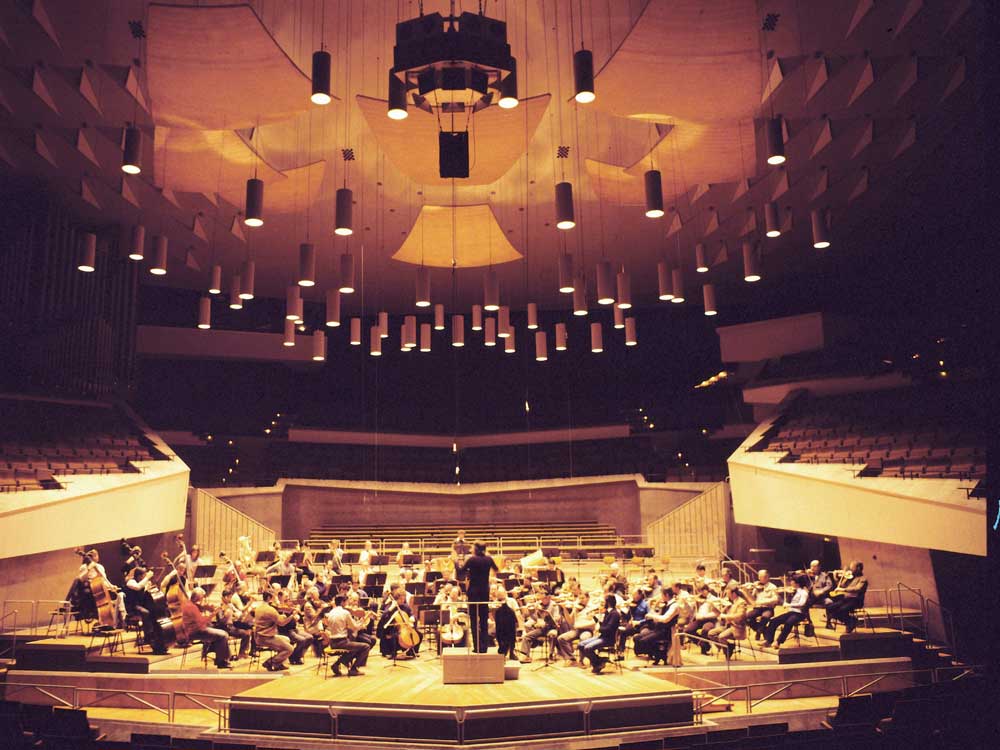
Two ways in which order constitutes beauty in music are harmony and polyphony. Harmony is the beauty we perceive when two or more notes sound at the same time, creating a combined effect that is agreeable, restful, and smooth, an effect we call consonance. In contrast to harmony, polyphony is the beauty we perceive when two or more melodies sound at the same time, creating a combined effect that increases complexity and meaning without compromising unity.
In the hands of a master, even starkly contrasting themes can be woven together into a larger polyphonic whole that reconciles their differences. One of the quintessential means of accomplishing this reconciliation is through use of the cantus firmus, a term that means "firm chant" or "fixed song." The cantus firmus serves as the melodic anchor of a polyphonic work. (When it was introduced in the twelfth century, the melody of the cantus firmus would have been supplied by the plainsong of a Gregorian chant.)
The Cantus Firmus in Bach
For one example of the use of the cantus firmus, we can look at the eighteenth century's preeminent master of polyphony, Johann Sebastian Bach, and his Cantata 137, Lobe den Herren, den mächtigen König der Ehren. The words of this cantata comprise the five verses of a German hymn by Joachim Neander (1680) that is known by many in the English hymn-singing world (along with its associated anonymous melody) as "Praise to the Lord, the Almighty, the King of Creation." (An excellent recording of the entire cantata by Ton Koopman and the Amsterdam Baroque Orchestra and Choir can be found on YouTube, and a translation of the text can be found on the website of Emmanuel Music [emmanuelmusic.org]).
This cantata has five movements, all of which are inspired by the melody traditionally used for Neander's hymn. In the first, second, and fourth movements, this melody serves as the cantus firmus for the polyphony.
The first movement, employing all the voices and instruments, allows us to hear how joyfully Bach can unleash the polyphonic potential of music; it at times sounds so busy that it would strike the ear as hectic were it not for the integrity that makes it beautiful. As the movement unfolds, we hear the instruments first, followed by a staggered entry (fugue) of voices, starting with the altos, then the tenors, and then the basses, before the sopranos enter with the cantus firmus. It is as if the instruments and voices are all racing to see who can praise God first!
By contrast, in the second movement, the alto sings a verse of the hymn as the cantus firmus, while a violin countermelody interweaves it. In the fourth movement, the tenor sings yet another verse of the hymn, but to a completely different melody, leaving the cantus firmus to the trumpet. A curious aspect of this movement is that the tenor aria is in a minor key, while the cantus firmus is in a major key, demonstrating the remarkable power of polyphony to reconcile extreme differences, even dissonances.
In the fifth and final movement, which is a chorale, the melody is proclaimed with full force by the whole choir and orchestra, using the words of the last verse of Neander's hymn.
In this and countless other examples of Bach's brilliant ability to weave multiple voices into an integrated whole, we see how difference need not be competitive with unity, but can actually be intrinsic to it; and we also see how the ordering power of beauty is capable of transforming even dissonance by integrating it into a larger, consonant whole (as Begbie observes in his essay, "Created Beauty: the Witness of J. S. Bach").
The relationship between difference and unity is of central theological importance as well. In his book Resounding Truth (2007), Begbie draws upon the thought of David Bentley Hart to suggest that we can hear diversity as part of unity because there is a logic at the heart of the cosmos itself that reflects a Trinitarian reality of difference between the Father, the Son, and the Holy Spirit that revolves around the dynamic of love.
The Organizing Priority of Divine Love
Now, to draw the parallel between polyphony in music and integrity in ethics, let me return to the problem of the plurality of moral values, and to Nagel's suggestion that there is no hope for reintegration of the fragmented moral landscape. Here I draw from Oliver O'Donovan's book Self, World, and Time (2013), where he argues that it was the Enlightenment that brought about the problem that Nagel describes as moral fragmentation but that O'Donovan calls the "collapse of the moral field." This collapse resulted, says O'Donovan, when "the structure of creation with its variety, order, and reflection of the Creator's glory no longer served to shape love and action." Instead, the will of the individual "became the exclusive giver of practical meaning."
This collapse came about because modernity abandoned something the Christian tradition had supplied: the organizing priority of the concept of love. St. Augustine articulated this prioritization as the rightly ordered love (ordo amoris) that provides the architecture of the virtuous life. O'Donovan notes how the love of God and neighbor offered an integrative hermeneutic (contra Nagel) through which the whole moral field could be ordered, with better goods distinguished from lesser ones, making possible "an ordered and consistent morality by banishing the specter of irreconcilable claims."
In the Christian tradition of ordered loves, we see that when the love of God forms the foundation of morality, the ethical life has integrity because it has a cantus firmus—a moral melody that inspires, anchors, prioritizes, and unifies our choices within an integrated whole. Such integrity, when it is grounded in the love of God, embodies what the Psalmist describes as an undivided heart (Ps. 86:11). Dietrich Bonhoeffer called it "the polyphony of life" and emphasized how our flourishing depends on a cantus firmus that only God can provide. In one of his letters from prison to his dear friend Eberhard Bethge (May 20, 1944), Bonhoeffer wrote:
God wants us to love him eternally with our whole hearts—not in such a way as to injure or weaken our earthly love, but to provide a kind of cantus firmus to which the other melodies of life provide the counterpoint. . . . I wanted to tell you to have a good, clear cantus firmus; that is the only way to a full and perfect sound, when the counterpoint has a firm support and can't come adrift or get out of tune, while remaining a distinct whole in its own right. Only a polyphony of this kind can give life a wholeness and at the same time assure us that nothing calamitous can happen as long as the cantus firmus is kept going."
Exactly how God integrates the melodies of our moral lives, and how these melodies harmonize with the wider polyphony around us, is not always apparent. The orchestration of God's good will is often inscrutable. But it is enough for us to play our parts as faithfully as we can, keeping pace with the cantus firmus and trusting in the mercy of Christ's reconciling love (Col. 1:15–20). As that harmonizing power pervades our lives, God tunes our hearts to the tones of his love so that, by grace, we might bear the image of his beauty as we are led and empowered by the Holy Spirit to make good, if difficult, decisions from among the choices that appear before us. These decisions will arise out of reasoning that is founded on faith, formed through prayer, and fixed on the hope that is set before us.
Restoring the Moral Landscape
Let me return to the hypothetical 75-year-old woman with end-stage leukemia, and let us suppose she is open to Christian pastoral care and counsel. What might we learn as we listen, inquire, and encourage? That the final stage of her illness has come upon her suddenly and found her unable to face the reality that she is dying? That an overwhelming fear of death has provoked a desperate effort to cling to life? That her physicians have heretofore failed to be frank with her about her poor prognosis for fear that candor would destroy hope? That discussions with health professionals have been so focused on interventions to cure disease and prolong survival that they have left her with the illusion that death can be forestalled indefinitely? That the treatment of her body has not been accompanied by the care of her soul?
In our culture, shared decision-making in healthcare between patients and clinicians may be guided so firmly by notions of patient autonomy that a person like our 75-year-old might be making decisions in a landscape barren of meaning except for the monotone prerogatives of her own will. Good pastoral care and counsel would seek to restore order, purpose, and harmony to this landscape by reminding her of the cantus firmus which only God can provide and which, when we resonate with it, allows us to flourish by loving God and neighbor and to have peace when we are near death.
When we love God above all else and recognize that our lives are not our own (Rom. 14:7–8), we are enabled to see that the goodness of continued earthly life is superseded in circumstances like hers by the goodness of God's will to use death (our conquered enemy) to call us home. And when we are enabled to love our neighbor, our interest in attempting to sustain our lives when our mortal flesh is quickly failing will yield to a desire to show love to others by forgoing treatments that are out of step with the reality of our terminal condition and that would better serve others. In such ways, the double love command brings order to the moral field of possibilities and guides decision-making.
Even so, there may be lingering questions and unsettling doubts at times when complete clarity is lacking but decisions are still necessary, such as in time-sensitive medical situations. These are some of the burdens of moral responsibility, and they remind us of our need to walk humbly with God. Every reminder of our weakness will prompt us to pray that our love for God will lead us to grow in knowledge and insight so that, when the moment of decision arrives, we may indeed be able to discern what is best (Phil. 1:9–10).
A Journal of Mere Christianity—Delivered to Your Door
- Essays on theology, culture, and the Church
- Contributors from across the Christian traditions

Six print issues (one year) of Touchstone, plus full online access and PDF downloads for only $39.95.

Get a one-year full-access subscription to the Touchstone online archives for only $19.95.
bulk subscriptions
Order Touchstone subscriptions in bulk and save $10 per sub! Each subscription includes 6 issues of Touchstone plus full online access to touchstonemag.com—including archives, videos, and pdf downloads of recent issues for only $29.95 each! Great for churches or study groups.
Transactions will be processed on a secure server.
more on music from the online archives
33.3—May/June 2020
Bach's Cantata BWV 106, Gottes Zeit ist die allerbesteZeit (God's time is the very best time) by Ken Myers
more from the online archives

32.4—July/August 2019
Today's Culture Wars Are Both Ancient & Modern by Allan C. Carlson

18.4—May 2005
The Idylls, Idols & Devils That Corrupt the Moral Imagination by Vigen Guroian

calling all readers
Please Donate
"There are magazines worth reading but few worth saving . . . Touchstone is just such a magazine."
—Alice von Hildebrand
"Here we do not concede one square millimeter of territory to falsehood, folly, contemporary sentimentality, or fashion. We speak the truth, and let God be our judge. . . . Touchstone is the one committedly Christian conservative journal."
—Anthony Esolen, Touchstone senior editor
