





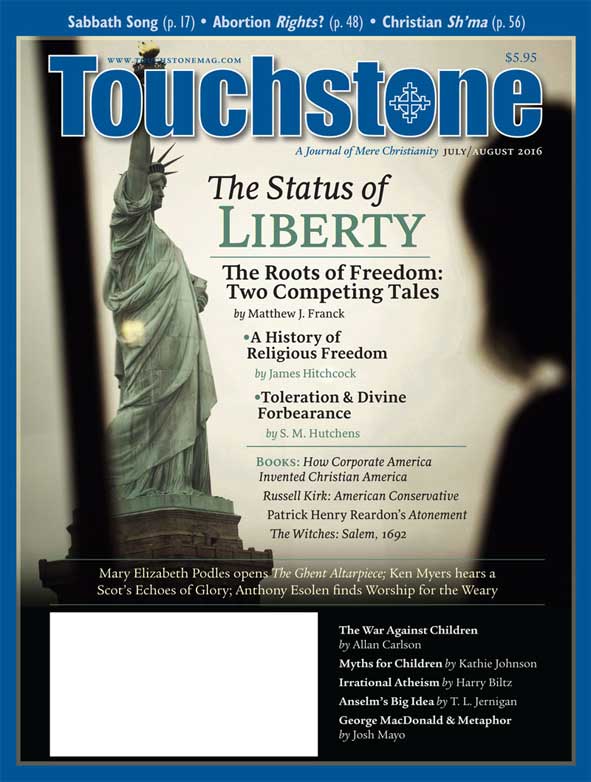
Column: Illuminations
Worship for the Weary
by Anthony Esolen
For now coming on fifty years, we long-suffering members of the Roman Catholic Church have had to bear the devotion of our brothers and sisters and its expression in song. It is like being held captive every Sunday to a recital: "You play the violin? My Ashley plays the violin, too! Ashley, go get your violin and play that Mahler piece you've started on." Or: "You teach poetry? My Madison writes poetry, too! Maddy, go get that poem you wrote for Earth Day. You see," says the star-dazzled mother, "the school has an Earth Day celebration, and they awarded first prize for the poem that best expresses our concern for the Earth and our need to Think Globally. Oh, here it is!" And the daughter, rolling her eyes but actually eager to comply, puts five pages of artistic effluvia before your eyes.We Catholics have been subjected to a kind of liberal-political-theological-anthropological-tragical-comical doggerel; Evangelicals, I've been told, have been subjected to emotive refrains repeated over and over, like the endless running-on of a rock and roll song stretched out over five minutes while the congregation wave their arms and smoke joints and throw Frisbees.
Yes, I know, it's not that bad. But I don't know why we should settle for paint-by-the-numbers pictures of Jesus at the Social Security Administration or Jesus with the Kindergarten Kids when we could have Fra Angelico or Albrecht Dürer; so also I don't know why we should settle for office memoranda and hypnopaedic mantras when we could have Bach or Vaughan Williams or the Wesleys.
THIS ARTICLE ONLY AVAILABLE TO SUBSCRIBERS.
FOR QUICK ACCESS:
Anthony Esolen is Distinguished Professor of Humanities at Thales College and the author of over 30 books, including Real Music: A Guide to the Timeless Hymns of the Church (Tan, with a CD), Out of the Ashes: Rebuilding American Culture (Regnery), and The Hundredfold: Songs for the Lord (Ignatius). He has also translated Dante’s Divine Comedy (Random House) and, with his wife Debra, publishes the web magazine Word and Song (anthonyesolen.substack.com). He is a senior editor of Touchstone.
A Journal of Mere Christianity—Delivered to Your Door
- Essays on theology, culture, and the Church
- Contributors from across the Christian traditions

Six print issues (one year) of Touchstone, plus full online access and PDF downloads for only $39.95.

Get a one-year full-access subscription to the Touchstone online archives for only $19.95.
bulk subscriptions
Order Touchstone subscriptions in bulk and save $10 per sub! Each subscription includes 6 issues of Touchstone plus full online access to touchstonemag.com—including archives, videos, and pdf downloads of recent issues for only $29.95 each! Great for churches or study groups.
Transactions will be processed on a secure server.
more from the online archives

29.4—July/August 2016
on Noticing That Modern Science Has Rendered Atheism Irrational by Harry Biltz

14.6—July/August 2001
Three Bad Ideas for Women & What to Do About Them by Frederica Mathewes-Green
calling all readers
Please Donate
"There are magazines worth reading but few worth saving . . . Touchstone is just such a magazine."
—Alice von Hildebrand
"Here we do not concede one square millimeter of territory to falsehood, folly, contemporary sentimentality, or fashion. We speak the truth, and let God be our judge. . . . Touchstone is the one committedly Christian conservative journal."
—Anthony Esolen, Touchstone senior editor
