Hubert and Jan van Eyck's The Ghent Altarpiece by Mary Elizabeth Podles

Column

A Thousand Words

Hubert & Jan van Eyck's The Ghent Altarpiece

The Ghent Altarpiece has been called the most coveted work in all Western art; since its dedication on May 6, 1432, one scholar has tallied thirteen crimes against it, including seven thefts. Early on, the altarpiece escaped the Protestant iconoclasm of the Reformation when it was hidden first in an attic and then in the town hall. During the Napoleonic Wars, it was plundered by the French. It was returned after the Battle of Waterloo, only to have its wings (minus two panels) pawned by the diocese and never redeemed. The wings were subsequently sold to an English collector and then to the King of Prussia. The remainder was damaged by fire in 1822, and a row of panels was lost. What was left was plundered by the Germans during World War I.

The altarpiece was returned in 1920 to Ghent as war reparations. There it remained until 1934, when two panels were stolen. One was returned as a goodwill gesture by the thief; the other is still missing. Theft on a grander scale occurred in 1940. The altarpiece was en route to the Vatican for safekeeping but was impounded by the Vichy French, and subsequently removed to Germany in 1942. There, to its detriment, it was stored in a salt mine. It was discovered and liberated by Allied forces, as detailed (more or less accurately) in the movie Monuments Men.

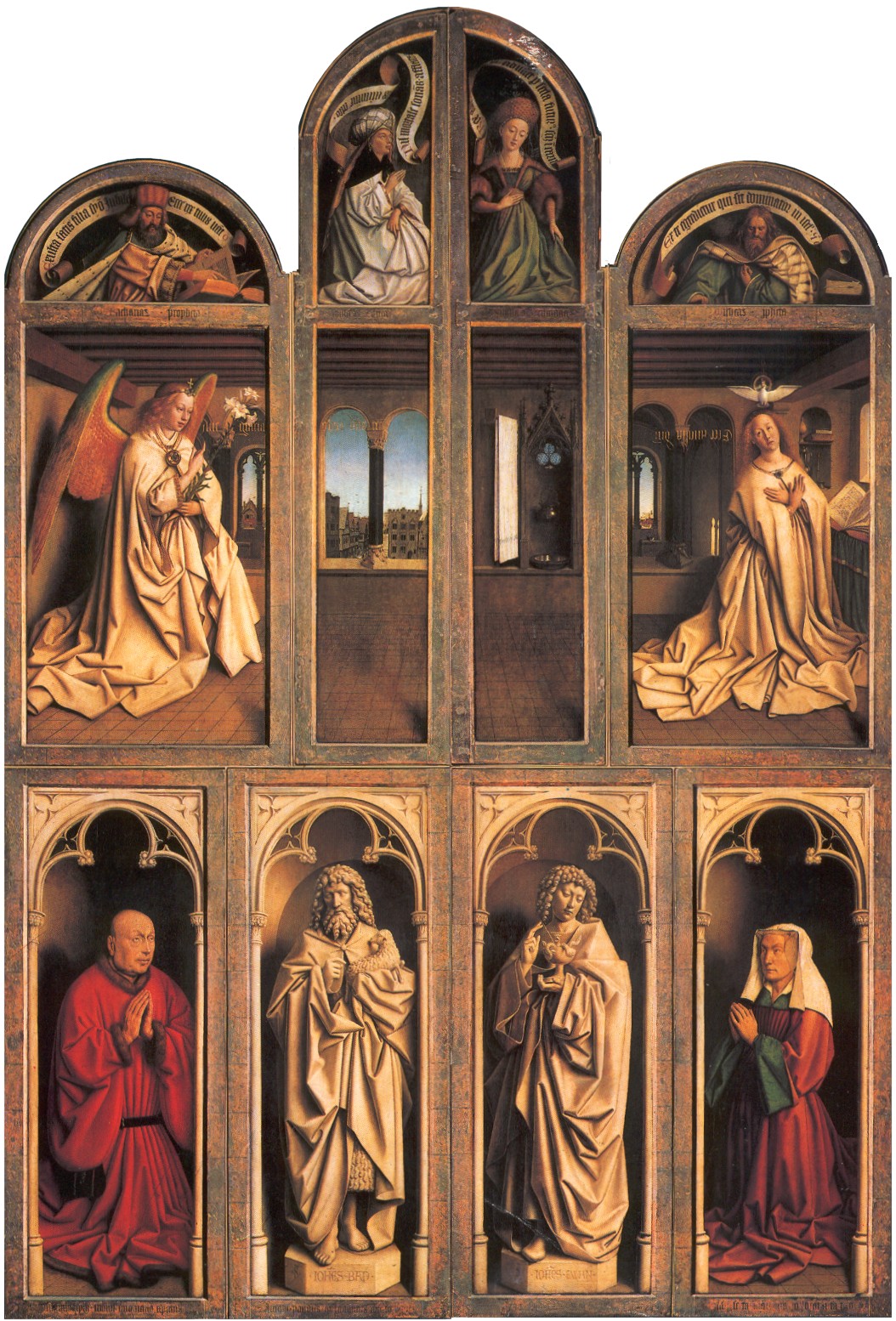
What is it that has made this altarpiece so desirable? Most days of the year, the altarpiece was folded shut and presented the view shown here. While it is masterly in execution, it is very restrained and shows an apparently conventional array of patrons, patron saints, prophets, sibyls, and an Annunciation. Only on Sundays and special feast days would it be opened.

Patrons & Saints

Closer examination suggests that perhaps the outside is not so conventional after all. We know from inscriptions and documents that the donors were Jodocus Vijd and his wife Isabel Borluut, a financially, socially, and politically prominent couple. He was verger of the chapel of St. John the Evangelist in the parish church of St. John the Baptist, which is now the Cathedral of St. Bavo, and he commissioned this painting to hang in that chapel.

As was customary, he had the painter include portraits of himself and his wife, kneeling in prayer beside statues of the two St. Johns. The portraits are almost painfully realistic and include wrinkles, warts, arthritic knuckles and all, yet they are not unflattering: the artist has given them expressions of solemn high seriousness and prayerfulness. Their red clothing is the brightest spot in the otherwise restrained color scheme, and they are lit by a warm light that falls from the right, as if from the actual window in the chapel. They are firmly fixed in the real world, kneeling, a little cramped, in the niches that flank the two saints.

The saints, too, are of this world. They are painted in grisaille, that is, monochrome, to imitate the stone statues that might decorate such a chapel; it was a point of pride for painters that they could successfully mime in two dimensions what a sculptor could only do in three. They are slightly out of scale, smaller, and standing on small platforms so that their heads are on a level with the patrons'. They, too, are lit by the real window. Clearly they are meant to be read as part of the real chapel's furniture. Yet they cast a very lively glance at each of their patrons, as if in the sculpture the saints were really present.

Vision of the Incarnation

Something a little more complex is going on in the middle register above them, in the Annunciation. The four panels of the middle register depict a single room, a mix of old-fashioned Romanesque architecture and up-to-date Gothic decoration. Gabriel kneels at the left, and Mary at the right. Between them an open window looks out onto a fifteenth-century Flemish town.

Beside it, and behind Mary, are ordinary household objects: a basin and laver, a lamp, a book. They are painted with meticulous realism, but they also carry a freight of hidden symbolic meaning. The basin and pitcher in the niche are a kind of domesticated sealed fountain, a symbol of Mary's purity; the lamp and the book suggest the light of the Scriptures. The fictive room is lit as if by the real window, and the frame casts shadows across the floor. However, sunlight bursts in through Mary's window, too. The real window is on the north wall of the chapel, which, considering Ghent's latitude, would never admit direct sun: this is supernatural light flooding her being as she speaks the words, "Behold the handmaid of the Lord" (written upside down, presumably for the convenience of the descending dove of the Holy Spirit).


Mary Elizabeth Podles is the retired curator of Renaissance and Baroque art at the Walters Art Museum in Baltimore, Maryland. She is the author of A Thousand Words: Reflections on Art and Christianity (St. James Press, 2023). She and her husband Leon, a Touchstone senior editor, have six children and live in Baltimore, Maryland. She is a contributing editor for Touchstone.

A Journal of Mere Christianity—Delivered to Your Door

  • Essays on theology, culture, and the Church
  • Contributors from across the Christian traditions

Subscribe (Print + Online)

Six print issues (one year) of Touchstone, plus full online access and PDF downloads for only $39.95.

Subscribe (Online Only)

Get a one-year full-access subscription to the Touchstone online archives for only $19.95.


bulk subscriptions

Order Touchstone subscriptions in bulk and save $10 per sub! Each subscription includes 6 issues of Touchstone plus full online access to touchstonemag.com—including archives, videos, and pdf downloads of recent issues for only $29.95 each! Great for churches or study groups.

Transactions will be processed on a secure server.


more on art from the online archives
33.2—March/April 2020

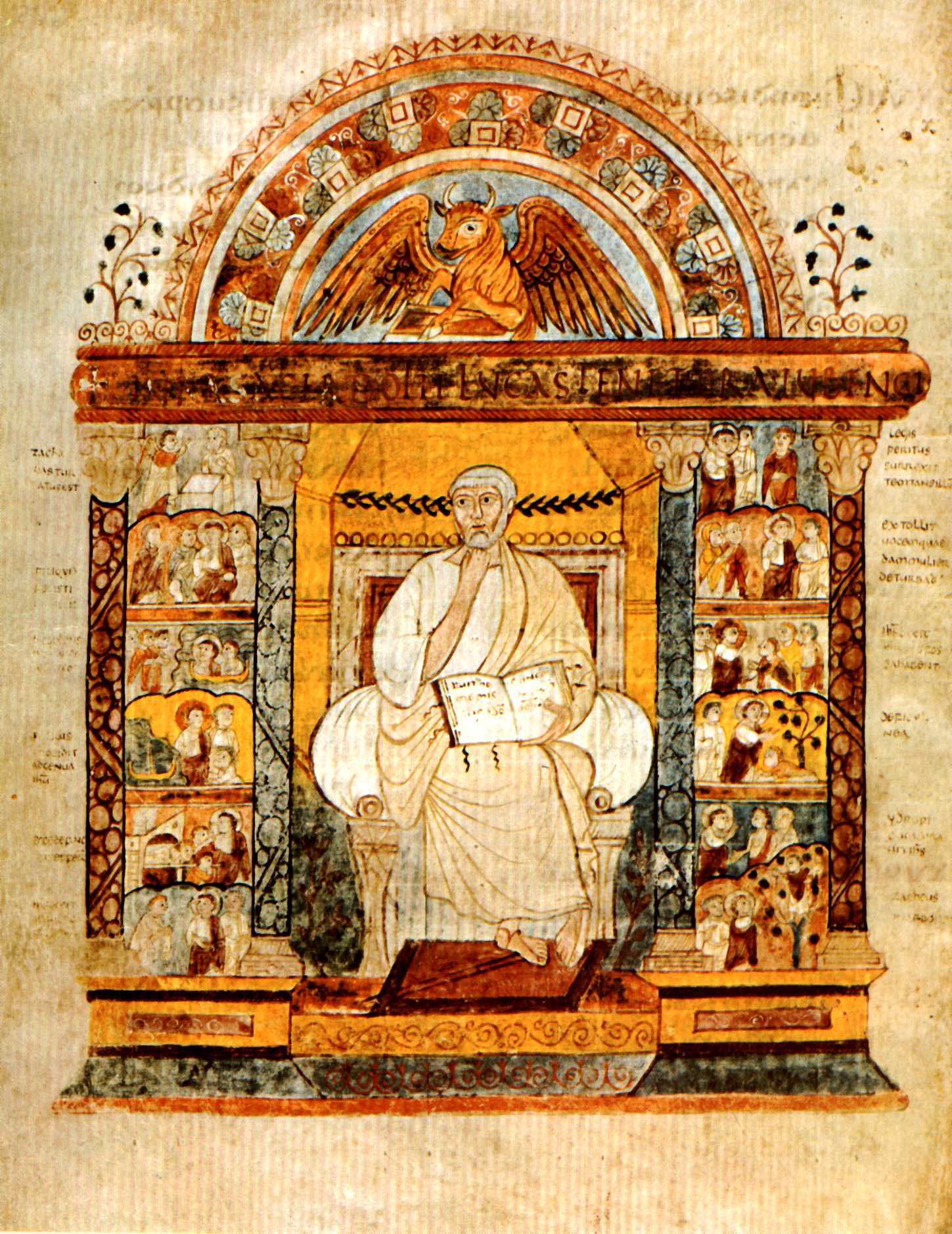
Christ Chapel at Hillsdale

An Architectural Sign of Mere Christianity by Michael Ward

32.4—July/August 2019

Sojourner Knight

on Single-Mindedness in Durer's Ritter, Tod, und Teufel by Anthony Costello
30.3—May/June 2017

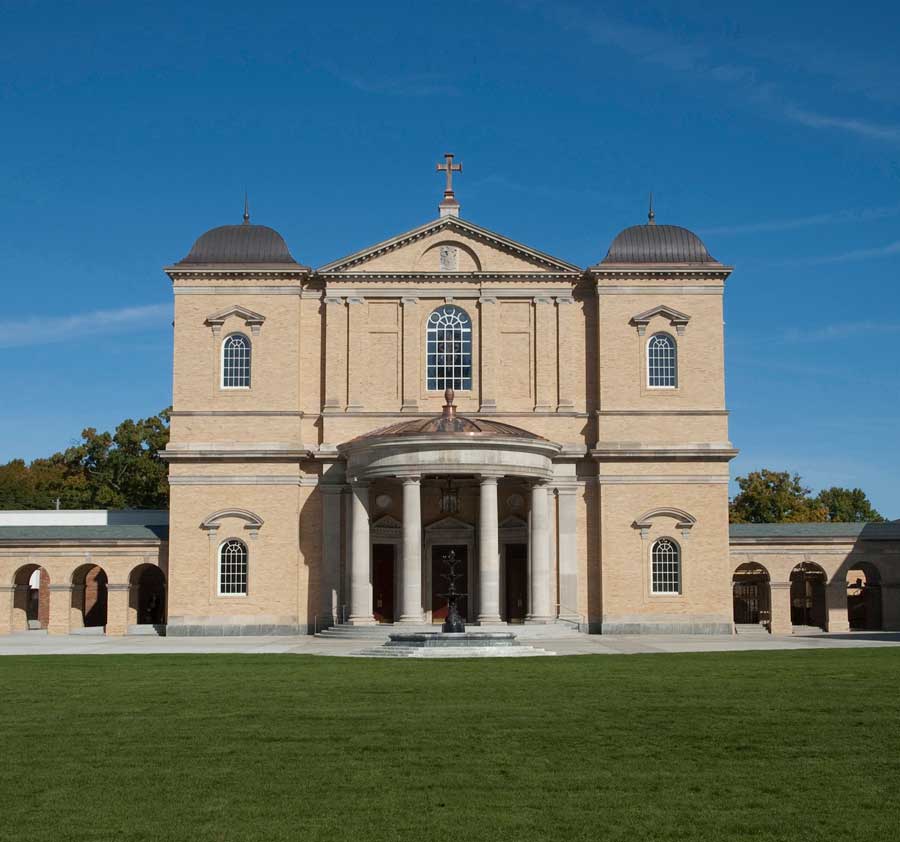
St. Luke the Evangelist

by Mary Elizabeth Podles


more from the online archives

33.1—January/February 2020

It's Personal

on the Consequences of One Birth Before Roe v. Wade by Craig Kellogg Galer

20.8—October 2007

Aliens in Zion

on Why I Can’t Be Just Another Earthman by Louis Markos

20.2—March 2007

Simply Lewis

Reflections on a Master Apologist After 60 Years by N. T. Wright

calling all readers

Please Donate

"There are magazines worth reading but few worth saving . . . Touchstone is just such a magazine."
—Alice von Hildebrand

"Here we do not concede one square millimeter of territory to falsehood, folly, contemporary sentimentality, or fashion. We speak the truth, and let God be our judge. . . . Touchstone is the one committedly Christian conservative journal."
—Anthony Esolen, Touchstone senior editor

Support Touchstone

00