




Column: A Thousand Words
Anastasis
Church of the Holy Redeemer in Chora
by Mary Elizabeth Podles
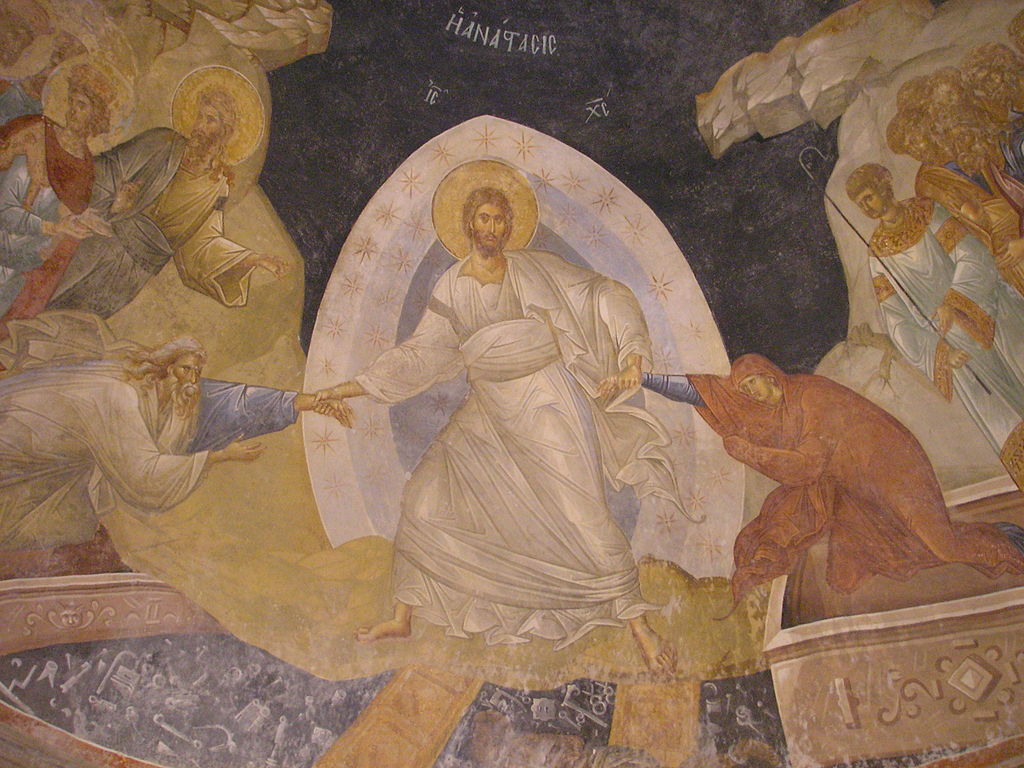
To the delight of the skeptics, the Resurrection, the event that validates Christ's salvific sacrifice, had no human onlookers. Scripture gives no eyewitness account. Artists wishing to depict the Resurrection must either refer to it allusively, by depicting the three Marys at the tomb or Mary Magdalene's encounter in the garden, or fall back on their own imaginations. In the West, artists concentrated on the risen Christ's very corporeality, giving him a physical and compelling presence. Eastern Christianity, perhaps in response to theological issues difficult to resolve by argument, developed the image that we see here.
In the East, artists depicted the Resurrection in terms of its effect, the salvation of mankind from sin and the opening of the gates of Heaven. This fresco, a late (1315–1321) example of the image developed over the centuries, demonstrates all of its possibilities. Central to the image is Christ himself, set off by a starry mandorla radiant against the darkness behind him. This almond-shaped mandorla also surrounds Christ in Byzantine icons of the Transfiguration and the Ascension, and represents the uncreated light of the divine as it breaks through into the natural world.
Christ is marked as divine, but is full of human energy. He takes an x-shaped, striding pose, braces his foot against the broken doors of Hell, grasps Adam and Eve by their wrists, and pulls them from their tombs in a single smooth and sinuous motion. In some versions of the Anastasis, the broken doors form a cross, symbol of the sacrifice by which Hell's gates were broken, but here, they fly outward, and with Adam and Eve's tombs make a fan of explosive energy along the rim of the half-dome.
For all its physical energy, though, the image still partakes of a cool Byzantine abstraction, a style deemed appropriate to the depiction of the spiritual realm. Christ floats in a timeless space, not a perspective construction based on observation of the physical world. Similarly, all the figures' volume is suggested by the serpentine lines of the drapery and the subtle nuance of color; they are weightless, and cast no shadows. Even the jagged rocks behind, the barren wilderness, rises up weightless into the dome.
Cast of Characters
As the image of the Anastasis evolved, an expanding cast of characters moved in. Adam and Eve were always central: the first created are the first raised by the new Adam. As early as the fourth century, an anonymous preacher had imagined the encounter:
He took him by the hand and raised him up, saying: "Awake, O sleeper, and rise from the dead, and Christ will give you light. . . . For your sake I, your God, became your son, I, the Lord, took the form of a slave; I, whose home is above the heavens, descended to the earth and beneath the earth. For your sake, for the sake of man, I became like a man without help, free among the dead. For the sake of you, who left a garden, I was betrayed to the Jews in a garden, and I was crucified in a garden. . . . Rise, let us leave this place."
Eve is included too: "See my hands, firmly nailed to a tree, for you who once wickedly stretched out your hand to a tree. I slept on the cross and a sword pierced my side for you who slept in Paradise and brought forth Eve from your side." Also springing up from Eve's tomb, with his shepherd's crook, is her son Abel, the first man to die at the hands of the unjust and the first prototype of Christ.
Behind Abel stands a crowd of witnesses, not strictly easy to identify by their given attributes. There was a certain leeway within the conventions of the icon, and an artist or patron could include saints or patriarchs with personal significance. Usually, the right side of the image included Moses and Elijah, symbolizing the fulfillment of the Law and the Prophets in Christ. Others might include Elisha, wearing the mantle of prophecy bestowed on him by Elijah, a youthful Judas Maccabeus, last martyr of the Old Testament, and sometimes saints, Evangelists, and martyrs of a later era, to signify the existence of the redemptive sacrifice outside of time and space.
The figures on the left are usually more easily identified. John the Baptist, the forerunner, stands closest to Christ and points the way toward him. Beside him, David and Solomon, the just kings, prefigure the majesty of Christ and remind us of his royal lineage. These three are always included; beyond them, others not (to my knowledge) clearly identified here could include Melchisedech, the kingly priest, and various apostles and martyrs of the patron's choice.
Mary Elizabeth Podles is the retired curator of Renaissance and Baroque art at the Walters Art Museum in Baltimore, Maryland. She is the author of A Thousand Words: Reflections on Art and Christianity (St. James Press, 2023). She and her husband Leon, a Touchstone senior editor, have six children and live in Baltimore, Maryland. She is a contributing editor for Touchstone.
A Journal of Mere Christianity—Delivered to Your Door
- Essays on theology, culture, and the Church
- Contributors from across the Christian traditions

Six print issues (one year) of Touchstone, plus full online access and PDF downloads for only $39.95.

Get a one-year full-access subscription to the Touchstone online archives for only $19.95.
bulk subscriptions
Order Touchstone subscriptions in bulk and save $10 per sub! Each subscription includes 6 issues of Touchstone plus full online access to touchstonemag.com—including archives, videos, and pdf downloads of recent issues for only $29.95 each! Great for churches or study groups.
Transactions will be processed on a secure server.
more on art from the online archives
33.2—March/April 2020
An Architectural Sign of Mere Christianity by Michael Ward
32.4—July/August 2019
on Single-Mindedness in Durer's Ritter, Tod, und Teufel by Anthony Costello
more from the online archives

31.4—July/August 2018
on the Brevity & Theology of Her Recorded Words by Judith Anderson

calling all readers
Please Donate
"There are magazines worth reading but few worth saving . . . Touchstone is just such a magazine."
—Alice von Hildebrand
"Here we do not concede one square millimeter of territory to falsehood, folly, contemporary sentimentality, or fashion. We speak the truth, and let God be our judge. . . . Touchstone is the one committedly Christian conservative journal."
—Anthony Esolen, Touchstone senior editor
