




Column: A Thousand Words
The Risen Christ by Michelangelo Buonarotti
by Mary Elizabeth Podles
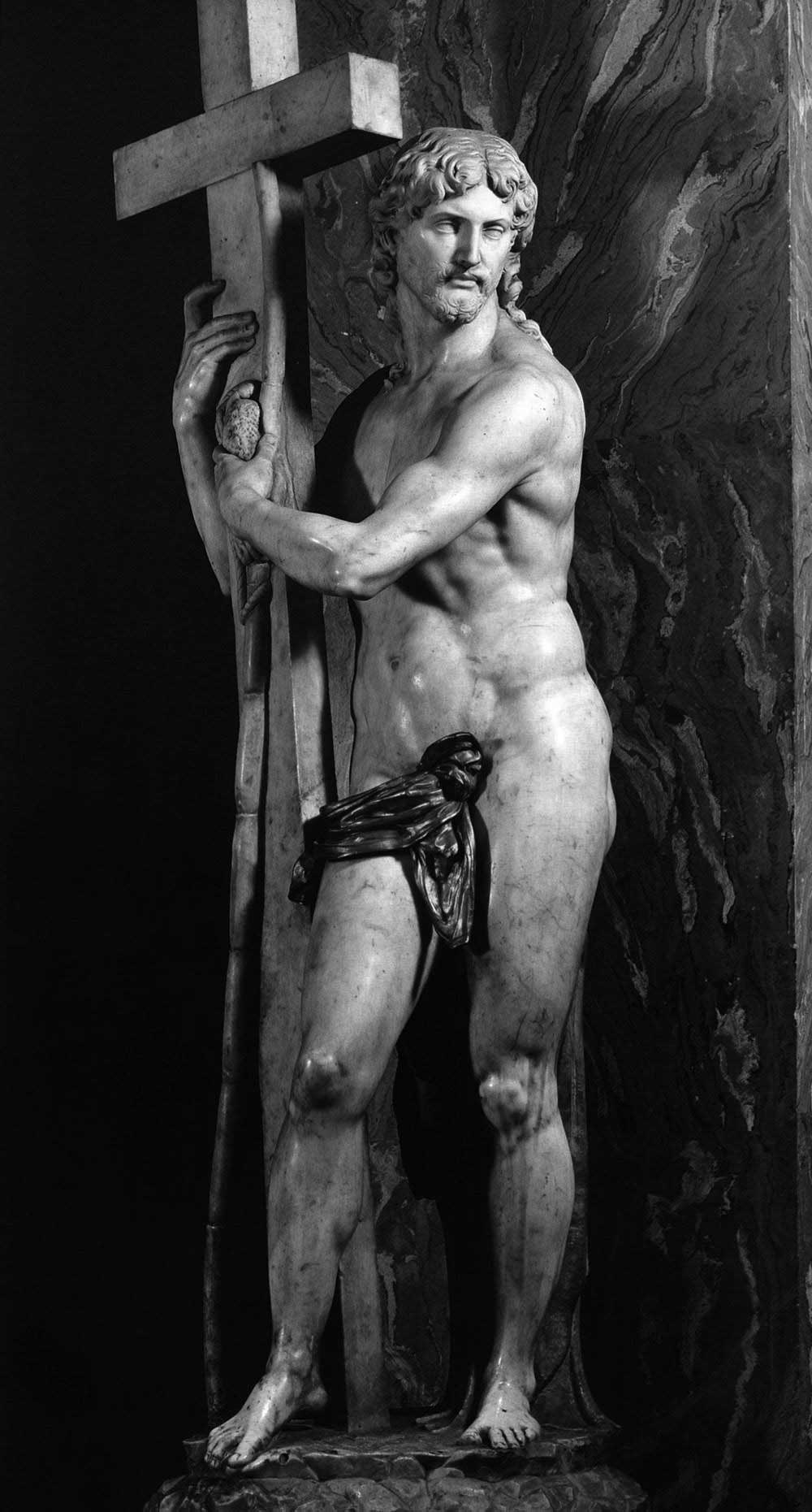
Perhaps the least known of Michelangelo's sculptures, the Risen Christ has had a checkered history. Metello Vari, a well-to-do Roman, in 1514 commissioned a nude standing Christ holding the cross (pretty daring for the Dominican home church at the time). Michelangelo started carving it in 1515 but discovered every sculptor's nightmare, a disfiguring flaw concealed within the block, a vein of black that would have run directly through Christ's face. The first version had to be abandoned, but a contract is a contract, and as time ran out, the final working was entrusted to an assistant so incompetent that he had to be removed and the finishing entrusted to still another. Finally completed in 1521, the sculpture is one to which the critics have not been entirely kind.
Classical Pose with Christian Resonance
There has been a certain amount of criticism of the figure itself, its proportions and stance. Christ stands in the Classical contrapposto, or counterpoised, position, with one leg bearing his weight and the other flexed, so that his body is both relaxed and yet has the potential for movement. The hip above the engaged leg is thrust upward, and the head and shoulders, to counterbalance it, are tipped and slightly twisted in the other direction, giving the body a graceful and sinuous curve.
The pose dates to Classical Antiquity and carries with it an implied psychological dimension. To the Greeks, the balance and harmony of the body thus posed conveyed the harmony and equilibrium of the ideal temperament it embodied. Body and mind are expressions of each other, and in Classical art, the body, especially the nude body, became the vehicle to convey the full range of human emotion and thought.
The Renaissance saw a rebirth of Classical learning and of this understanding of the body in art, but with the resonance of Christian theology added to it. The original patron specified a nude Christ: if the body is the perfect expression of the mind, is Christ's body not the perfect expression of the divine mind? Furthermore, as Leo Steinberg points out in The Sexuality of Christ in Renaissance Art and in Modern Oblivion, Christ is shown unclothed as is proper to his preternatural state of grace. His sexuality is subject to full rational control and uncorrupted by any lust. The risen Christ has conquered not only death but sin as well.
Steinberg misses, however, in his own modern oblivion, the connection between masculinity and sacrifice: Christ is not only nude, but masculine and nude, embracing the sacrificial cross of the hero's death to procure salvation for mankind.
Even so, Christ's nudity has proved too disturbing to later critics, and in the interest of propriety he has been given a bronze loincloth to cover the objectionable frontal exposure. A similar squeamishness led the pope to insist that Christ and the saints in the Sistine Last Judgment be made to wear clothing, too. The unfortunate artist given the job was ever after known derisively as the Pants-Maker.
Michelangelo's Envisioned Setting
Other critics have quibbled with Michelangelo's canon of proportions, arguing that, compared to the ideal, Christ's torso is too broad, his hips over-wide and his buttocks alarmingly large compared to the spindly legs, and more. But Michelangelo was always willing to tweak the canon to suit his expressive purposes (for instance, if the Madonna of the Pieta got to her feet, she would stand over seven feet tall).
Besides, the scholar William Wallace argues, the Risen Christ was not meant to be seen from every angle: Michelangelo adjusted the proportions to appear perfect from a single point of view, the one he had envisioned from the start. Modern photography, and the repositioning of the statue in the church of Santa Maria Sopra Minerva in Rome, where it resides, have made it visible from every conceivable direction, to its disservice. It was never meant to be examined in the round.
Contemporary illustrations suggest that in its original setting, the Risen Christ was set in front of a darkened niche, as if he were emerging from the tomb. The viewer would have encountered him as shown at right, with his head turned away and in filtered shadow. His cross and the instruments of the Passion thus confront us head-on, as Christ embraces them, points them out with both forefingers, and all but thrusts them in our direction. The light, falling from above at an angle, would have cast the shadow of his left arm directly across his genitalia, doubly emphasizing the nature of his sacrifice and the significance of his death.
He turns his head away from us in the traditional gesture of the Noli me tangere, in which Christ encounters Mary Magdalene and says to her, "Do not hold me, for I have not yet ascended to the Father." And the Ascension is implicit in Michelangelo's image, as well: his right leg is thrust forward as if he were already in motion. He presses his right foot hard into the ground as if preparing for the great leap heavenward, leaving his imprint on the earth behind him. The portal of death, then, the tomb he leaves behind him, is about to become the gate of heaven.
Critics notwithstanding, the power and physicality of Michelangelo's Risen Christ has not been lost on the faithful. Centuries of devout touches and kisses have worn away the tops of Christ's right toes, and for a time he wore a little bronze shoe to protect the marble. It has since been removed.
Recommended reading:
• Leo Steinberg, The Sexuality of Christ in Renaissance Art and in Modern Oblivion (Phaidon, 1983).
• William E. Wallace, "Michelangelo's Risen Christ," The Sixteenth-Century Journal, vol. 28, no. 4 (Winter 1997), 1251–1280.
• Leon J. Podles, The Church Impotent: The Feminization of Christianity (Spence, 1999).
Mary Elizabeth Podles is the retired curator of Renaissance and Baroque art at the Walters Art Museum in Baltimore, Maryland. She is the author of A Thousand Words: Reflections on Art and Christianity (St. James Press, 2023). She and her husband Leon, a Touchstone senior editor, have six children and live in Baltimore, Maryland. She is a contributing editor for Touchstone.
A Journal of Mere Christianity—Delivered to Your Door
- Essays on theology, culture, and the Church
- Contributors from across the Christian traditions

Six print issues (one year) of Touchstone, plus full online access and PDF downloads for only $39.95.

Get a one-year full-access subscription to the Touchstone online archives for only $19.95.
bulk subscriptions
Order Touchstone subscriptions in bulk and save $10 per sub! Each subscription includes 6 issues of Touchstone plus full online access to touchstonemag.com—including archives, videos, and pdf downloads of recent issues for only $29.95 each! Great for churches or study groups.
Transactions will be processed on a secure server.
more on art from the online archives
32.4—July/August 2019
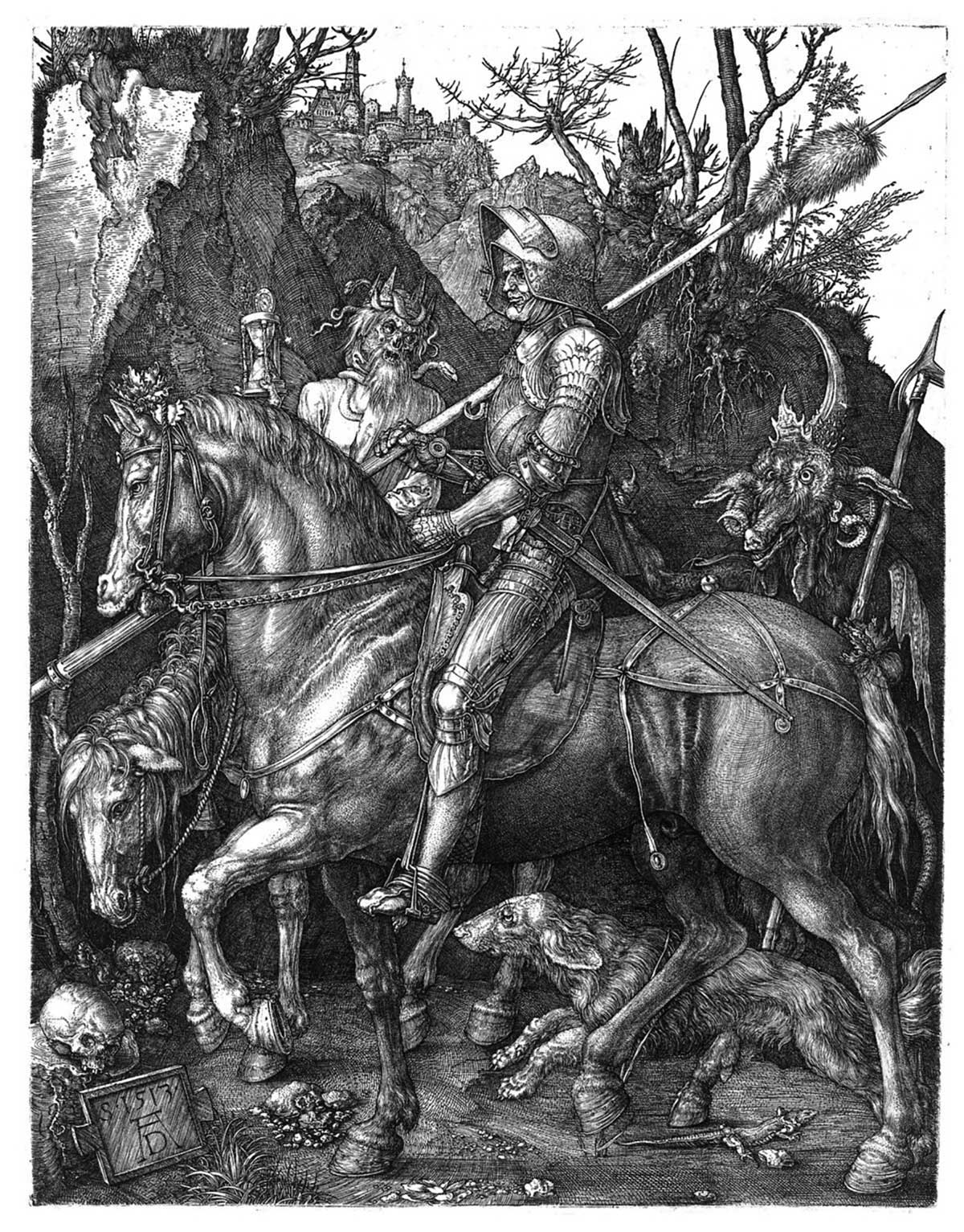
on Single-Mindedness in Durer's Ritter, Tod, und Teufel by Anthony Costello
33.2—March/April 2020
An Architectural Sign of Mere Christianity by Michael Ward
more from the online archives


31.1—January/February 2018
on Taking the Measure of the Deserving & the Undeserving Poor by Martin Bordelon
calling all readers
Please Donate
"There are magazines worth reading but few worth saving . . . Touchstone is just such a magazine."
—Alice von Hildebrand
"Here we do not concede one square millimeter of territory to falsehood, folly, contemporary sentimentality, or fashion. We speak the truth, and let God be our judge. . . . Touchstone is the one committedly Christian conservative journal."
—Anthony Esolen, Touchstone senior editor
