




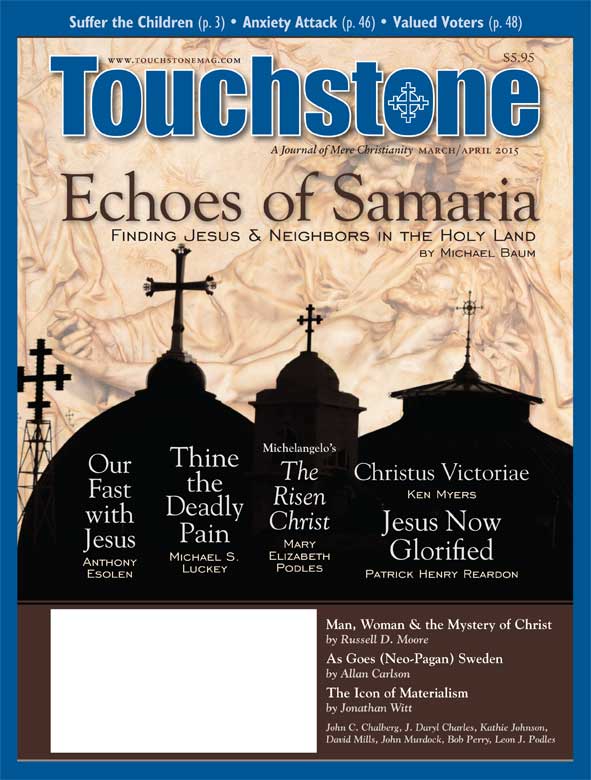
Feature
Echoes of Samaria
Finding Jesus & Neighbors in the Holy Land
by Michael Baum
As we finished the climb, Burqin spread out tranquilly below us: a place of profound poverty near the northern edge of what the world knows as the "West Bank" but Israel and the Bible know as "Samaria." Burqin houses perhaps 6,000 Muslims, with about twenty Christian families maintaining their ancient faith and tending their ancient church. Sasha, an American Orthodox expatriate who has lived in Jerusalem since about 2000 as a professional tour guide, tries to bring foreign pilgrims whenever he can. International visitors are a status symbol in a town that seldom gets outside attention of any kind. Visitors buy handmade olive-oil soap, which the church in turn buys from Muslim neighbors, helping nurture good relations.
It was May 2013, and this was our tour's first stop in Samaria. Burqin today is a "B area" under the Oslo Accords—administered by the Palestinian Authority but subject to Israeli security. On our arrival in Tel Aviv four days earlier, Sasha told us that current political conditions were favorable to visiting some parts of the region that are often off-limits. Ironically, only a year later, these same areas were to become scenes of lethal violence between Palestinian and Israeli forces during the 2014 Hamas-Israel hostilities in Gaza.
Though dedicated to St. George, the great soldier-saint whose name seems to appear on half the Orthodox churches in the Mideast, the Burqin church is better known, in ancient tradition, as the church of the Ten Lepers. (The name "Burqin" itself may derive from an old Arabic word for leper.) The church burrows into the hill: one interior wall is living limestone, and an archway in that wall leads into a tiny cave that now serves as a side chapel. Barely large enough for a narrow iconostasis (icon screen) and a few stacidia (high chairs with arm rests for brief respite from standing through long Orthodox services), the little cavern our group squeezed into that morning had, twenty centuries before, sheltered ten diseased fugitives until an itinerant rural rabbi came along and one leper cried out: "Jesus, Master,
have mercy on us!"
The serious-faced Arab Christian man who had unlocked the church for us stood by as we explored, took pictures, and venerated icons. Then he stepped forward and pulled down one of the lampadas (hanging oil lamps) on the iconostasis, dipping out some of the oil so one of our priests could anoint us for a blessing. Afterwards he escorted us to a low side building off the courtyard, where he and his wife served us sweetened coffee—the typical hospitality of the Mideast. For the first time he smiled, broadly. We stayed for a few minutes of fellowship, with Sasha translating, bought some of the Muslim-manufactured soap, and departed.
Face to Face with Scripture
That day at Burqin typified how our tour—the first time my wife and I had set foot in the Holy Land—brought us face to face with aspects of Scripture we had always known but never fully appreciated, or else knew in fragments but had never put together. Particularly: the Samaritans. "The Good Samaritan" apart, we had always known of Jesus' encounters with these estranged cousins of the Jews. But the full, cumulative significance only truly registered as we traveled the few square miles of Samaria and venerated the physical sites where these events took place. Contemplating the Samaritans shed light on the mystery of Jesus' coming, and provided new context for today.
The heart of ancient Samaria is about twenty miles from Burqin—a long day's walk. The modern-day town of Nablus, roughly biblical Shechem (possibly also Sychar), occupies the plain where Joshua first led the children of Israel across the Jordan and into the Promised Land (Josh. 8). Nablus nestles between two round-topped hills that rise so abruptly from the plain they're called "mountains." Mt. Gerizim and Mt. Ebal are also respectively named the "Mountain of Blessings" and "Mountain of Cursings" because that's where Joshua directed the heads of the twelve tribes of Israel to stand (six on each hill) and alternately declaim blessings on those who would obey God's commandments and curses on those who would not (Josh. 8:33). Mt. Gerizim gradually lost place as a site of worship to Jerusalem, especially after Solomon built the Temple, but the mount retained local veneration and is still regarded as a holy place by surviving Samaritans to this day.
After the glory days of David and Solomon, the children of Israel entered one of their periods of backsliding from God's commandments. The kingdom was divided, with the ten tribes in the north descending deeper into decadence until finally Assyria—the eighth-century b.c. regional superpower—invaded and sent the northern tribes into exile, never to be heard from again. Assyria also invaded Samaria and imported foreign populations, but Judea remained an independent Jewish state for about another 150 years. Then Assyria itself fell to Babylon, which invaded Judea and, in several successive forays, led them, too, into exile. Anyone shocked by the current chaos and bloodshed in the Mideast need only read through Jeremiah, 1 and 2 Kings, and Lamentations to see that it's always been like that and worse.
Competing Traditions
In less than fifty years, though, the chastened Jews experienced a reprieve at the hands of a rare enlightened despot of the ancient world, Cyrus of Persia. He conquered Babylon and set about repatriating many of the peoples the former empire had kidnapped. Seemingly wanting good relations with any god who would listen, he and his successors sent the Jews back to their homeland with instructions and support to rebuild the Temple so they could pray for him. Which apparently they did: Isaiah even calls Cyrus "messiah" (Isaiah 45:1), the only time in Scripture that term is applied to a non-Jew.
The returning exiles, however, met with a cool reception from the people they'd left behind. Those not deported by the Babylonians had soldiered on in the middle of the conquered kingdom, intermarried with local non-Jews, and tried to maintain their historic faith as best they could. To them, the destruction of the Temple may have seemed a sign that they had been right all along: worship to God should center on Mt. Gerizim. They continued to venerate the Torah, the only sacred scripture they'd had at the time of the Exile. Suddenly, the exiles returned, with plans and funding to build the Temple all over again—and insisting that a number of new religious books, written or collected during the Exile, had been added to the canon of Scripture. They didn't even commonly speak Hebrew anymore, but Aramaic, another Semitic language that had become the lingua franca of the Assyrian and Babylonian empires. And even their Hebrew was written with a new alphabet—an angular script associated with Aramaic—rather than the alphabet used in older Hebrew writings.
Both groups had reasons for regarding themselves as the true believers. The exiles had worked hard to preserve their customs and faith during their captivity (see Psalm 137/136: "How shall we sing the songs of Zion in a strange land?"). To the un-exiled, however, the returners had changed everything, while they who had stayed put were "Samerim" or "keepers of the law"—the Samaritan Hebrew etymology of "Samaritan," a reading supported by some of the early Christian fathers. Paradoxically, the very closeness of the two groups made their differences more divisive—much like the estrangement between Jews and Arabs today, or indeed between different groups of Christians.
The Samaritans felt threatened by the rebuilding of the Temple and the walls around Jerusalem. Later, as the region was invaded by a succession of foreign powers, Samaritans and Jews often took opposing sides, sometimes to the point of armed conflict. During the second century b.c., the Samaritans sided against the Maccabees in their war for independence from the Seleucids, and as a consequence the Samaritan temple on Mt. Gerizim was destroyed, along with Shechem (Nablus). By the time of the Gospels, although the pax Romana suppressed warfare, alienation between Jew and Samaritan was complete.
Jesus & the Samaritans
All this background, of which we'd been aware only dimly if at all before our tour, gave us new perspective as we visited the places Jesus walked 2,000 years ago. Samaria lies across all the direct routes between Galilee to the north and Judea to the south. In Jesus' time, Galilean Jews making the annual Passover pilgrimage to Jerusalem typically took a wide eastward detour around Samaria, crossing the Jordan twice in order to avoid contact with their ancestral rivals. Yet Jesus followed that traditional route only once that we know of—on his way to his final Passover to sacrifice his life for us on the Cross. Earlier in his earthly ministry, he seems to have been in and out of Samaria all the time, often with significant outcomes.
His encounter at Burqin was one of those significant moments. Jesus healed the lepers with a simple instruction to show themselves to a priest, following Mosaic Law, to confirm their restoration to health. Anyone who has read the Gospel account (Luke 17:11–19) knows what happened then. They all went away rejoicing, but one of the ten returned to thank Jesus. That one was a Samaritan. Knowing that the cave itself is in Samaria adds nuance to the story. For one thing, it further emphasizes how outcast the nine Jewish lepers were—they couldn't even suffer in a cave in their own country! No wonder then, when Jesus told them to show themselves to a priest, that they rushed off immediately. It was a good three-day walk to Jerusalem, and they were eager to escape this foreign exile and start on the road back to their own people and the heart of their own faith.
But the Samaritan turned back. Why? Well, for one thing, he couldn't follow his former fellow-sufferers, even had they been interested in still associating with him now that they were no longer unclean and banished. He couldn't show himself to a priest in the Temple in Jerusalem because Samaritans didn't believe it was the right place to worship, and he wouldn't have been let in anyway. But clearly more was happening here than just geography. The Samaritan apparently realized that his miraculous physical healing was less important than his relationship with Jesus. Healing, after all, is temporary. Everyone who recovers from illness, even miraculously, will sicken again someday, and someday die. Even those Jesus raised from the dead, like Lazarus, died again. But a relationship with the living God is eternal and leads to eternal life.
Jesus' response is instructive. First—apparently for the benefit of the listening disciples—he pointed out that the one ex-leper who made the correct response was not a Jew but a "foreigner." Next, he said to the Samaritan: "Your faith has made you whole." Actually, the Greek word the King James Version translates as "made you whole" is broader than physical healing; it refers to rescuing or keeping from destruction. It is more often translated elsewhere in the KJV as "save," and is related to the word for "savior." So the Samaritan, unlike his nine Jewish colleagues, recognized what was needful and received salvation into the bargain.
Learning What Matters
Jesus' other Samaritan encounters follow this pattern. He acknowledges the rift between Samaritans and Jews. Then he goes on to demonstrate, by word or deed or both, that this rift no longer matters. And in each case, he does something of significance that teaches us more about the kingdom of God. At a time when most Jews "had no dealings with Samaritans" (John 4:9), Jesus seems to go out of his way to say, "It's time for everyone to stop squabbling about unimportant things. The important thing is to follow me."
Even when one Samaritan village refused to give him lodging on his way to Jerusalem (Luke 9:51–56), he brushed off the slight and rebuked his disciples, who wanted to call down fire from heaven on the town (somewhat of an over-reaction, even by the standards of today's conflicts in the region). Jesus acknowledged (John 4:22) that "salvation is from the Jews," but it clearly is not only for the Jews.
The most famous Gospel reference to Samaritans, of course, is not an actual encounter but the parable that has become known as "The Good Samaritan." Publicly challenged by a Jewish legal expert to define the Torah principle summed up as "Love your neighbor" (Lev. 19:18), Jesus constructed a story contrasting loving behavior by one of those outcast Samaritans against callous behavior by a priest and a Levite, representatives of utmost Jewish respectability.
The story is parabolic, but Jesus took pains to make it realistic and timely, even as to its locale. He set the scene for the robbery and assault at a spot on the road from Jericho to Jerusalem—a well-traveled trade route, one familiar to his listeners, but also well-known as a road infested with robbers. It is as if someone today described a trip on a big-city thoroughfare that the listeners know runs through a dangerous part of town.
Today, the Jericho-Jerusalem road traverses one of the "C areas" under Oslo—its ultimate governance to be decided when (and if) Palestinians and Israel finally reach full territorial agreement. We visited an archeological site along this road that for many centuries has been known as the Inn of the Samaritan. This is, of course, not to say that the parable actually referred to this site, but much evidence shows the place to have been a travelers' way station far back into antiquity. It could plausibly have been the place in the minds of the Jewish audience the day Jesus deliberately used a Samaritan as an example of pious and God-fearing adherence to the Torah. It was a hard lesson for Jews to hear. When Jesus challenged his questioner to identify which person in the parable followed the commandment to love his neighbor, the lawyer choked out, "The . . . one who had mercy on him." The word "Samaritan" apparently stuck in his craw.
From Sinner to Saint
The longest Samaritan encounter recorded in the Gospels (John 4:1–42) took place in what is now Nablus, the town of around 130,000 mentioned earlier as the heart of Samaria. Our visit to the church of St. Photini, over Jacob's Well, seemed to telescope 3,500 years of history into the present moment—for good and ill.
Although not specifically mentioned in the Old Testament, Jacob's Well has been venerated by Jews, Christians, and Muslims for centuries. It presumably occupies the plot of ground Jacob purchased from a Canaanite for 100 pieces of silver (Gen. 33:19). Jesus stopped there on a hot day during one of his many trips through Samaria. While his disciples bought food in the town (evidently not finding reason on that occasion to want to call down fire from heaven on the inhabitants), he talked at length with a woman of dubious reputation who, in the Orthodox tradition, became known as Photini, one of the great saints and martyrs of the early Church, along with her sisters and her sons.
One must appreciate the importance of water in that arid part of the world to realize the full impact of the "living water" metaphor Jesus uttered to St. Photini that day. The inhabitants of the Holy Land, then and now, know thirst in a way that most Americans never will. Even an ordinary well or spring has enormous importance, and we visited many that were sites of significant or miraculous events and became places of veneration.
This well stands not only in Samaria, but also in the virtual shadow of Mt. Gerizim, where Jews had destroyed the Samaritan temple less than two centuries before. That fact lends special piquancy to the Samaritan woman's challenge concerning the proper locus of worship, as well as to Jesus' reply: "the hour is coming when neither on this mountain nor in Jerusalem will you worship the Father. . . . true worshipers will worship the Father in spirit and truth." Then Jesus went on to identify himself explicitly to her as the Messiah. As in the case of the Burqin leper, he takes the ancient dispute as an occasion to point out the significance of his own coming and to say, "Everyone leave aside these petty squabbles—the important thing is to know me."
Three Layers of History
We were greeted at the gate of the church and monastery compound by Fr. Ioustinos, who has led St. Photini as igumen (abbot) for decades. Fr. Ioustinos was cordial but a little shaken. That morning, a group of Palestinian youths had surrounded the compound and spent several minutes throwing rocks and chunks of concrete at and over the walls. The walls being solid masonry, about twenty feet high, and closed by a substantial iron gate, no real damage was done, and the Palestinian police had arrived promptly and chased the attackers away. (Nablus is an "A area" under Oslo—under full governance of the Palestinian Authority.) But it had clearly made a poor start to the day: the courtyard was still littered with debris when we entered. The incident appeared to represent no new burst of hostility toward Christians, but rather the youths' way of venting anger at the date. It was May 15, anniversary of the start of the 1948 war sparked by what many Palestinians call "The Catastrophe"—the founding of the state of Israel.
It was not the first time the church had been caught in crossfire. Years earlier, battles between Palestinians and Israel resulted in artillery fire that blasted a still-visible hole in the church's bell tower. More recently, Fr. Ioustinos himself was mugged and the church collection stolen—though again the Palestinian authorities intervened swiftly, dealing severely with the perpetrators. Overall, Fr. Ioustinos told us, he is on excellent terms with the neighbors, and Christians and Muslims co-exist in peace. But as in Jesus' time, strained relations reflect ancient divisions, and sometimes something snaps.
The church itself is lovely—one of the most beautiful we saw, full of light. The building is relatively new—a twentieth-century reconstruction of an earlier Crusader church—and much of the interior décor has been handcrafted over the years by Fr. Ioustinos, an accomplished blacksmith, woodcarver, and who knows what else. At the front of the church, to the right of the iconostasis, a narrow and steep flight of stairs descends to what presumably was ground level in Jesus' time—and to a small, candle-lit grotto housing Jacob's Well.
Less elaborate than shown in most iconography, the wellhead is a massive but simple low stone structure with a hole in the middle, surmounted by a prosaic crank and bucket. Far down below, water splashes as the bucket is cranked up and emptied into a stone basin so pilgrims can ladle out and partake. The water is clear, cool, and refreshing, without a strong mineral taste. It is not consecrated holy water, but sipping it seems to connect the visitor with sacred events of long ago. It is not hard to imagine Jacob, Judah, or Joseph drinking here, or to envision an oft-married Samaritan woman trudging up with her jar, only to encounter a Jewish man seated on the lip of the well, asking her for a drink, but actually preparing to change her life.
After drinking and anointing ourselves with the water—and in some cases filling little bottles of it to take home—we climbed back up the steep stairs to encounter one last reminder that history never ends, especially in this part of the world where God invented history. Near the head of the stairs, off to one side at the front of the nave, sits a glass-fronted wooden structure we recognized as the tomb of a saint. Not an infrequent sight in Holy Land churches, such tombs usually contain a reliquary with the remains of the saint inside—except in those instances where the whole body has remained incorrupt. This tomb held a body in priest's vestments, hands concealed, face covered with an embroidered cloth.
It is, we learned, the tomb of St. Philoumenos—igumen at St. Photini's before Fr. Ioustinos. Philoumenos Hasapis was a Greek Cypriot hieromonk (monk who is also an ordained priest, like Fr. Ioustinos) sent to Nablus to serve the monastery in 1979. In November of that year, while he prepared to celebrate vespers, a group of men broke into the church and killed him with hatchets. They mutilated him in various ways, including cutting the sign of the cross into his face. The crime was blamed on radicals indignant at a Christian church standing atop this ancient sacred site.
The patriarch of Jerusalem canonized St. Philoumenos in 2009. His incorrupt body lies in the church where he gave his life—a testimony to faith and sacrifice, but also to the sad fact that the discord and violence that have wracked this region since the days of Jeremiah have not abated, but have just found new occasions for mayhem.
Who Is Our Neighbor?
In the disputes that wrack the Holy Land today, it is easy to fix blame but harder to find equitable solutions. As with the Jews and Samaritans 2,000 years ago, all parties have some right on their side. Palestinians foster violent insurgencies against Israelis, but they are displaced people squeezed into increasingly untenable geopolitical positions. Israel wields armed force and fortified barriers that inflict grievous hardship against Palestinians, but it is surrounded by enemies and fighting for survival.
Sasha commented once that Jewish history—the destruction of the Temple, the persecutions and pogroms, and finally the Nazi Holocaust—readily leads to an Israeli worldview that could be summed up: "They destroyed our holy places and everyone hates us." Perhaps, as a resident foreigner living with and respecting all the cultures that churn together in this tiny land, he finds it easier to recognize differences without judging. We admired his habitual way of speaking about Christians and non-Christians. He never refers to them in those terms. Instead, he always speaks of "our brothers according to the faith," and "our brothers according to the image of God."
After Jesus' death and resurrection, he placed Jews and Samaritans on equal footing in the Great Commission to "be witnesses unto me both in Jerusalem, and in all Judea and in Samaria, and unto the uttermost parts of the earth" (Acts 1:8). Indeed, Samaria experienced one of the first mass conversions to Christ (Acts 8:4–25). One wonders whether Jesus' divine foresight led him to choose the Jewish-Samaritan rift to illustrate his message of forgiveness, love, reconciliation, and salvation.
As it was 2,000 years ago, so it is today. "It is time for everyone to end this squabbling. The important thing is to know me."
"Which of these was this man's neighbor?"
"The one who showed mercy on him."
"Go thou and do likewise."
Michael Baum is a management consultant, former English teacher, and writer with degrees in English literature and education from Yale University and an MBA from Northwestern. He and his wife live near Madison, Wisconsin, where they attend St. Ignatius Antiochian Orthodox Church. Their three adult children and five grandchildren attend Orthodox churches in Illinois, Wisconsin, and Indiana.
A Journal of Mere Christianity—Delivered to Your Door
- Essays on theology, culture, and the Church
- Contributors from across the Christian traditions

Six print issues (one year) of Touchstone, plus full online access and PDF downloads for only $39.95.

Get a one-year full-access subscription to the Touchstone online archives for only $19.95.
bulk subscriptions
Order Touchstone subscriptions in bulk and save $10 per sub! Each subscription includes 6 issues of Touchstone plus full online access to touchstonemag.com—including archives, videos, and pdf downloads of recent issues for only $29.95 each! Great for churches or study groups.
Transactions will be processed on a secure server.
more from the online archives

33.1—January/February 2020
Speaking Truth About the Sexes Is Not Optional by Anthony Esolen
33.2—March/April 2020
on How Bodily Resurrection Informs Social Justice by W. Ross Blackburn

33.3—May/June 2020
Bach's Cantata BWV 106, Gottes Zeit ist die allerbesteZeit (God's time is the very best time) by Ken Myers
calling all readers
Please Donate
"There are magazines worth reading but few worth saving . . . Touchstone is just such a magazine."
—Alice von Hildebrand
"Here we do not concede one square millimeter of territory to falsehood, folly, contemporary sentimentality, or fashion. We speak the truth, and let God be our judge. . . . Touchstone is the one committedly Christian conservative journal."
—Anthony Esolen, Touchstone senior editor
