




Bread & Ruminations
Bede the Venerable, telling the story of Caedmon, the illiterate cowherd who became by divine agency the first man to compose Christian poetry in the form of the ancient Germanic heroic verse, says that the monks would read to him stories from sacred Scripture, and then the man would do something with them. He would, says Bede, like the clean cattle of the old Law, chew the cud. He would ruminate upon them.That did not mean that he would test them against his own thoughts and feelings. Cows in the field, chewing the cud, do not ask themselves what they feel about clover and hay. There's something much quieter, almost unconscious, about rumination. It's almost as if the transformation works backwards upon the one who ruminates. The cud makes the cow: Caedmon could turn stories into poetry, because the stories were turning Caedmon into a poet.
This rumination, I think, is what sets the true Christian hymnodist apart from the pretender. Again, I do not mean that the hymnodist must think long and hard about Scripture, come to some conclusions, and then set them a-jigging to verse, burdening his brethren with his brilliance. That was not how Caedmon worked, or rather, how Scripture worked upon Caedmon. I mean instead that the hymnodist must allow the whole of Scripture to enter him, to possess him. He must breathe in it. It is not the object of his thought, but rather its very manner and form.
The Bread of Heaven
Only such possession can explain how men and women of fine but by no means extraordinary linguistic talents can compose verses that, in simple words and few, rival for breadth and subtlety and depth of human feeling anything that Frost or Dickinson ever wrote. Let's take for example the well-known hymn "Shepherd of Souls," its first three stanzas composed by that prolific fellow, Anonymous, and its final two by the estimable James Montgomery (1771–1854):
Shepherd of souls, refresh and bless
Thy chosen pilgrim flock,
With manna in the wilderness,
With water from the rock.
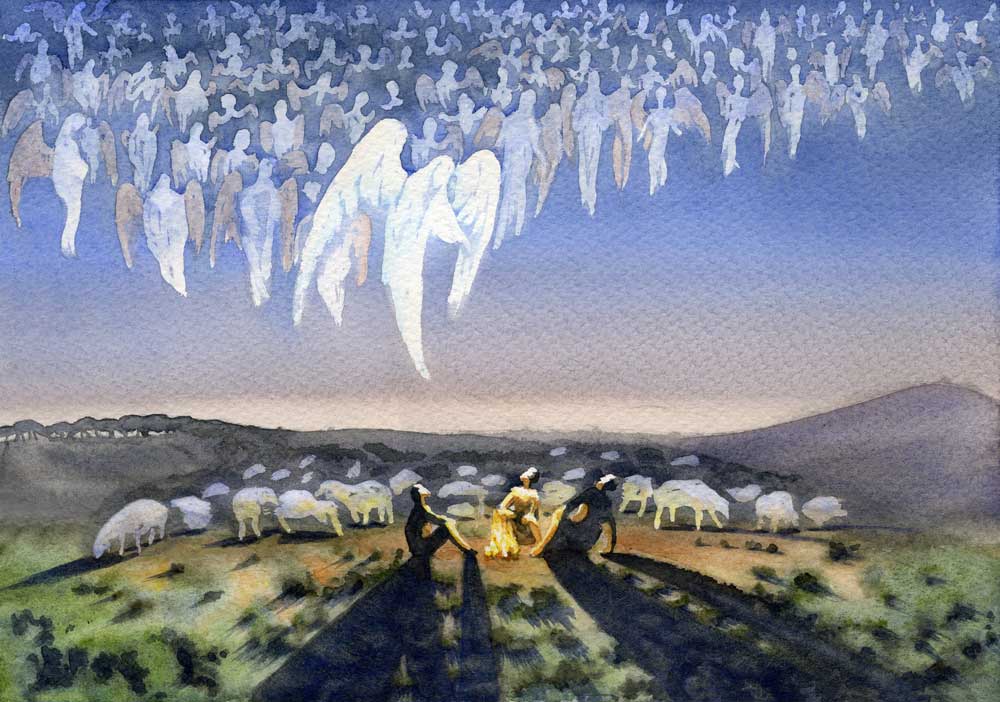
The author calls to mind, of course, those well-known incidents in the wilderness of Sinai, when God came to the aid of his grumbling people. They were hungry and wanted to return to Egypt, but God fed them with manna from heaven. They were thirsty and wanted to return to Egypt, but when Moses struck the rock with his staff, God caused water to flow forth.
The author is not just giving us a replay of those moments. He is praying for that manna and that water right now, because God never ceases to give us those blessings. That is because God is the shepherd and we are the sheep. We have not chosen him, but he has chosen us. And he feeds not only our bodies but our souls as well. He refreshes our souls, as the psalmist says. We are a pilgrim people, strangers in this strange land, moving on toward our true home, which is the kingdom of heaven.
The author did not say, "I shall write a stanza that brings together verses from Genesis, Exodus, Numbers, Psalms, Ezekiel, John, and 1 Peter." The cow does not draw up a plan for the cud. The cow doesn't need to; nor does the ruminating hymnodist. Consider the third verse, printed in most hymnals as the second:
We would not live by bread alone,
But by Thy word of grace,
In strength of which we travel on
To our abiding place.
"Man does not live by bread alone," says Jesus to the tempter, "but by every word that comes from the mouth of God." Jesus fasted in the wilderness. We are traveling through a wilderness. Jesus was hungry, and so are we. We do not wish to be like those children of Israel who thought of their bellies first. We want more than bread from heaven. We want the bread of heaven, here identified as God's word of grace, which gives us the strength to keep going, until we reach the place where we will abide forever.
Both Way & Destination
Anthony Esolen is Distinguished Professor of Humanities at Thales College and the author of over 30 books, including Real Music: A Guide to the Timeless Hymns of the Church (Tan, with a CD), Out of the Ashes: Rebuilding American Culture (Regnery), and The Hundredfold: Songs for the Lord (Ignatius). He has also translated Dante’s Divine Comedy (Random House) and, with his wife Debra, publishes the web magazine Word and Song (anthonyesolen.substack.com). He is a senior editor of Touchstone.
A Journal of Mere Christianity—Delivered to Your Door
- Essays on theology, culture, and the Church
- Contributors from across the Christian traditions

Six print issues (one year) of Touchstone, plus full online access and PDF downloads for only $39.95.

Get a one-year full-access subscription to the Touchstone online archives for only $19.95.
bulk subscriptions
Order Touchstone subscriptions in bulk and save $10 per sub! Each subscription includes 6 issues of Touchstone plus full online access to touchstonemag.com—including archives, videos, and pdf downloads of recent issues for only $29.95 each! Great for churches or study groups.
Transactions will be processed on a secure server.
more from the online archives
31.5—September/October 2018
Errands into the Moral Wilderness
Forms of Christian Family Witness & Renewal by Allan C. Carlson
calling all readers
Please Donate
"There are magazines worth reading but few worth saving . . . Touchstone is just such a magazine."
—Alice von Hildebrand
"Here we do not concede one square millimeter of territory to falsehood, folly, contemporary sentimentality, or fashion. We speak the truth, and let God be our judge. . . . Touchstone is the one committedly Christian conservative journal."
—Anthony Esolen, Touchstone senior editor
