




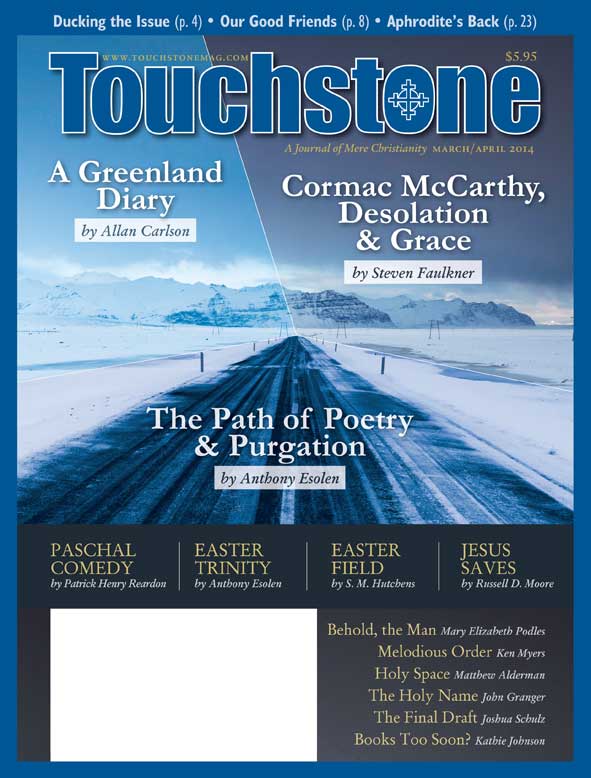
Holy Space
The Church Building as a Sacred Place: Beauty, Transcendence, and the Eternal
by Duncan G. Stroik
Hillenbrand Books, LTP, 2012
(192 pages, $75.00, hardcover)
reviewed by Matthew G. Alderman
Do we need another book on church architecture? The last decade has seen a wealth of new works on the subject, such as Denis McNamara's Catholic Church Architecture and the Spirit of the Liturgy, How to Read Churches, and Heavenly City, Ethan Anthony's The Architecture of Ralph Adams Cram and His Office, and the Jesuit Anthony Symondson's Sir Ninian Comper. Even the older standards in the field, such as Steven Schloeder's Architecture in Communion, are less than twenty years old. But all bring something unique to the table.
Master church-builder Duncan Stroik's The Church Building as a Sacred Place renders a significant new contribution to this banquet by offering an extensive theological rationale for a return to beauty. The author also draws on his experience as the head of a prominent architectural practice and as a professor at the University of Notre Dame School of Architecture to present specific design solutions to various questions.
Stroik's Vision
The book comprises a series of essays, a number of which have previously appeared in such publications as Lay Witness, Sacred Architecture, and Catholic Dossier. Some of these, such as "Ten Myths of Contemporary Sacred Architecture," from 1998, represent Stroik's early efforts in the field. But this volume is not merely a compilation of older material. Brought together with several new chapters, as well as more than 170 splendid color illustrations (including Stroik's signature water-colors), the older essays become part of a greater intellectual whole—a vision of sacred space as sacramental. As Stroik says in his Introduction,
Just as a sacrament is a visible expression of invisible reality, so does sacramental architecture portray through bricks, mortar, and iconography the mystery of salvation. Even the exterior of the church should remind us of Holy Communion, of Baptism, of Marriage. But how?
The book gives us a thorough answer, and one that does not privilege any single definition of the church building to the exclusion of all its other animating aspects and purposes. It thus gives us a powerful answer to the often maddeningly circular debate as to whether sacred art and devotional spaces somehow distract from active participation in the liturgy. How could they? The church is not only a place where the sacraments and liturgical rites are celebrated; it is also a place for public prayer, a place for conveying iconography and symbols, and, most importantly, a sacred place in itself.
Stroik shows how these meanings are elegantly yet concretely translated into bricks and mortar through chapters that explore the altar, the vocabulary of classical architecture, and other elements of the church building. Each architectural component is deftly examined and related carefully to the architectural macrocosm it inhabits. The chapter on the altar, for instance, explains its links to the tabernacle, then relates both to the chancel in which they stand, and in turn relates the chancel to the nave and the whole of the church.
One chapter even expands this small-to-big approach by examining the place of the church in the civic environment, contrasting the "New Urbanist" design movement with the "megachurch" style, which Stroik sees as symptomatic of Christianity's withdrawal from the American public square. While the book is written from a Catholic perspective, this last aside shows that questions about the role of culture in church building and design, and of the Church in the cultural environment transcend denominational
lines.
Protestant readers in particular may find much for contemplation in Chapter 12, "The Show Must Go On," a critical analysis of the "auditorium" church. Stroik's historical analysis shows that this style is not only an alien intrusion into Catholic liturgy but also a relative novelty within Protestant architecture. Indeed, it appeared to be on the way out a century ago:
Congregationalist writer John Scotford criticized the location of the choir in the theater church, and said that the minister appeared as a presiding officer or a king on his throne rather than a leader of worship.
The emphasis of the new churches of the twentieth century was to be on worship. Those who embraced this correct Gothic Revivalism [believed] that traditional styles and liturgical worship could actually foster Christian unity.
The structure of the book allows for digressions like these, which serve to illuminate the principal theme from unusual angles. Thus Stroik examines the roles of Popes John Paul II and Benedict XVI in the renewal of sacred architecture, reflects on the vocation of the architect, gives practical advice to pastors planning to build, and enjoyably eviscerates Richard Meier's glacial Jubilee Church in Rome.
A Happy Tension
Of particular interest is the chapter "The Classical Moment," which makes a coherent argument for the use of tradition and precedent in architecture, a practice that Stroik sees as analogous to religious discipleship rather than an act of mere imitation. His definition of classicism is broad enough to include the Romanesque and Gothic styles, which are organic descendants of the baptized classicism of the early Church.
The question of "imitation" in religious architecture is examined in "Renaissance or Revival?", where Stroik posits that historically inspired traditional work is not merely an act of "copying," for a true copy in architecture is a rara avis indeed. Rather, he argues, it is only within the embrace of tradition that innovation can really regain its frisson, which he calls a "happy tension." Tradition's guidelines are not limits, but invitations to ponder: "The temptation to find formulas that guarantee success is age-old, but creating architecture is a much more complex and difficult task."
So, do we need yet another book on church architecture? If the author is Duncan Stroik, the answer is a resounding yes.
Matthew G. Alderman is a freelance writer, liturgical artist, and contributor to several blogs, including www.thenewliturgicalmovement.blogspot.com and www.holywhapping.blogspot.com. He was recently named an assistant editor for Dappled Things, an online literary magazine for young Catholic writers. A graduate of the University of Notre Dame, he lives in Manhattan, where he works in the field of architecture and attends the Catholic Church of Our Saviour.
A Journal of Mere Christianity—Delivered to Your Door
- Essays on theology, culture, and the Church
- Contributors from across the Christian traditions

Six print issues (one year) of Touchstone, plus full online access and PDF downloads for only $39.95.

Get a one-year full-access subscription to the Touchstone online archives for only $19.95.
bulk subscriptions
Order Touchstone subscriptions in bulk and save $10 per sub! Each subscription includes 6 issues of Touchstone plus full online access to touchstonemag.com—including archives, videos, and pdf downloads of recent issues for only $29.95 each! Great for churches or study groups.
Transactions will be processed on a secure server.
more from the online archives

26.1—Jan/Feb 2013
The Alternate & Alternative Worlds of H. P. Lovecraft & C. S. Lewis by C. R. Wiley
32.1—January/February 2019
The Diabolical Failure of Leaders in the Present Crises by James M. Kushiner

17.6—July/August 2004
Old Science Confronts a Formidable Challenge in the Scientific ID Movement by Jay W. Richards
calling all readers
Please Donate
"There are magazines worth reading but few worth saving . . . Touchstone is just such a magazine."
—Alice von Hildebrand
"Here we do not concede one square millimeter of territory to falsehood, folly, contemporary sentimentality, or fashion. We speak the truth, and let God be our judge. . . . Touchstone is the one committedly Christian conservative journal."
—Anthony Esolen, Touchstone senior editor
