




Feature
Euripides' Beatific Vision
An Ancient Greek Drama Awakened a Powerful New Longing in Its Audiences
by James Ware
In the early spring of 438 b.c., a large crowd gathered at Athens in an open-air theater on the southern slope of the acropolis to view a series of twelve dramatic performances staged in conjunction with the yearly festival of Dionysus. Exhibited before the very image of the god, which had been transported in sacred procession from the adjacent temple, the twelve plays included four each by the famed tragic poets Sophocles and Euripides. The playwrights vied with each other, and Sophocles, we know, won the coveted first prize that year. But the only drama from the festival to survive is the last of Euripides' four plays—the Alcestis.
The Alcestis was thereafter widely performed in antiquity, and it remains to this day much studied—and controversial. For it involves a series of mysteries. The plot conforms to no genre that would have been familiar to Euripides' audience. Its core celebrates a virtue that was central neither in the philosophy of the playwright's own time nor in philosophy as it would develop after Plato. And the climactic scene depicts an event that, to the best of our knowledge, both Euripides and his audience believed to be impossible and contrary to the divine order. Compounding the riddle, each of these features of the play offers a striking parallel to the story of Jesus told in the Gospels. What are we to make of such things?
The Backstory
Let us begin with the story. The Alcestis recounts one of the ancient Greek tales about gods and men that would have been familiar to Euripides' audience. In the backstory of the myth, Apollo, the god of healing, through union with a mortal woman has a semi-divine son, Asclepius, who brings his own healing arts to such a pitch of perfection that he even raises many slain heroes back to life. In retribution for this violation of the prerogatives of Hades, the god of the nether world, Zeus, the most powerful of the gods, kills Asclepius with a thunderbolt. Apollo in turn slays the Cyclopes, the creatures who manufacture Zeus' lightning bolts.
Banished from Olympus by Zeus for this crime, and sentenced to be a slave for nine years in the house of a mortal man, Apollo serves as a shepherd in the palace of Alcestis' husband Admetus, the youthful king of Thessaly. Admetus, alas, is fated to die young, but Apollo, out of love for his noble host, tricks the Fates into allowing the king to escape an untimely death, provided he can find someone who is willing to die in his place.
But no one can be found. Even Admetus' aged father and mother are unwilling to make the sacrifice. Then Alcestis, out of love for her husband, freely offers—much to Admetus' dismay—to die so that he may live.
It is at this point in the story that the play begins, with black-robed Death at the doors of the palace, Admetus sorrowing over his wife's impending fate, and Alcestis, struck with illness, breathing her last.
Apollo's Limited Friendship
The plot of the Alcestis moves on the fulcrum of Apollo's friendship toward Admetus and his household. Such affectionate friendship, or philia, of the gods for those on whom their favor rests is a staple theme of Greek mythology. Within the anthropomorphic conception of the popular religion, the gods were considered subject to the full range of human passions and emotions: they were capable of love, pity, kindness, and mercy—but also of lust, hatred, malice, envy, jealousy, rivalry, covetousness, and deceit.
Beginning already in Euripides' time, the constant tendency of Greek philosophical thought was to combat this anthropomorphic understanding and to promote a purer, higher conception of the divine untouched by frail passion. But this more remote conception of the divine, while abolishing the gods' lusts and misdeeds, also abolished the prospect of their love and friendship. As Aristotle put it, there can be no friendship (philia) between gods and men.
Most scholars believe that Euripides shared these philosophical views of the divine. After all, he was associated with philosophical circles in fifth-century Athens, is said by ancient authors to have been a student of the pre-Socratic philosopher Anaxagoras, and, according to Diogenes Laertius, he personally gave a copy of Heraclitus' book On Nature to Socrates.
But whatever the playwright's own views may have been, the drama of the Alcestis hinges upon the traditional mythical conception of the gods. The unpredictable, quixotic, and thus menacing character of the divine realm forms the backstory of the play—the cosmic struggle between Zeus and Apollo, the decision of the goddesses known as the Moirai (or Fates) that Admetus must die young, and the presence of the daimon Death to claim Alcestis.
But the main plot of the play itself celebrates the beneficent friendship (philia) of Apollo. Out of love for Admetus and his household, Apollo first bends the rules and deceives the Fates, allowing a substitute for Admetus. Then, when Alcestis has become the substitute, he presses implacable Death to forego his claims on her—although to no avail. The love of Apollo for the royal couple, like the love of Athena for Odysseus and Penelope in the Odyssey, lends an aura of divine graciousness to the
entire tale.
The friendship of the gods, however, only goes so far. Within Greek mythology, the very nature of divinity precludes self-sacrifice. So while Apollo can deceive the Fates into accepting a willing substitute for Admetus, he does not, indeed cannot, offer to be that substitute himself. For the gods can have nothing to do with suffering or death.
"Such is the fate the gods have spun for wretched mortals," says Achilles to Priam in the closing scene of the Iliad, "that we should live in sorrows, but they themselves are without cares." So, too, in the opening lines of the Alcestis, Apollo's efforts to save Admetus' wife having proven fruitless, the god announces that he must reluctantly forsake the house of his friends: "But I leave the most beloved shelter of this palace, lest the pollution of death come upon me in the home."
Alcestis' Self-Sacrificing Love
It is Alcestis, then, who offers to be the substitute. Her philia (the Greek term is broader than our word "friendship," embracing all relationships involving mutual love and affection) is not only kindly, but self-sacrificial. In recent decades, critics have often sought to "deconstruct" Alcestis' heroic act, questioning her motives or the wisdom of her decision to die for her husband. Ironically, such views share striking affinities with the mindset of Admetus' father Pheres, the anti-hero of the play, who denigrates Alcestis' sacrifice.
In contrast with the misgivings of many moderns, the ancient poet celebrates Alcestis' deed as the highest act of human love. Regarding human philia there was a significant convergence in antiquity between philosophical and popular views. The popular sentiment is illustrated by an anecdote of Cicero's concerning Pacuvius' play the Dulorestes. In the drama, King Thoas interrogates two captives, Orestes and Pylades, wishing to discover which one is Orestes, so that he may put him to death. Seeking to save his friend, Pylades claims to be Orestes. Cicero tells us that whenever this scene was enacted, at Pylades' words, "I am Orestes!" the audience would leap to their feet with cries of emotion. Similarly, all the philosophers (except for the Epicureans) were agreed that friends were to be loved for their own sake, and that the good person, if necessary, would die on behalf of his friends.
But in the Alcestis we also see an important difference from the philosophical understanding. In the systems of the philosophers, philia was only one component of the virtuous life—not peripheral, to be sure, but not central either. But in the play's meditation, through choral ode and song, on Alcestis' deed, the other-regarding virtue of love becomes paramount. Alcestis is "by far, by far the noblest of all," sings the chorus, and then gives the reason: "for you alone, O dearest of women, undertook to exchange your life for the life of your spouse, delivering him from death." In the world of the Alcestis, the highest virtue is philia, and its crowning expression is self-sacrifice.
Sacrifice, but No Salvation
And yet, this noblest of deeds does not achieve the end that Alcestis envisioned. In a tragic and ironic reversal, her sacrificial death, which was meant for the salvation of Admetus, results instead in his destruction. For without Alcestis, he, too, perishes. Not literally, for he remains alive, but his life is no longer livable. The tragedy of death, for which there can be no consolation, receives powerful expression in the scene of Admetus' homecoming from Alcestis' burial. The chorus (made up of the royal couple's loyal friends) seeks to comfort him, but in vain:
Chorus: Misfortune, misfortune hard to wrestle with has come.
Admetus: Oh! Oh!
Chorus: And you see no limit to your griefs.
Admetus: (Moaning)
Chorus: These things are grievous to bear, but nonetheless . . .
Admetus: No! No!
Chorus: Endure. You are not the first to lose . . .
Admetus: (Weeping)
Chorus: A wife.
"Go in, go in, go inside the house," the chorus urges Admetus. But he cannot. Without Alcestis, the once joyous home has become a black and hateful place:
Once, with torches of Pelion and wedding songs I was entering in, holding the hand of my dear wife, amid the joyous shouts of the wedding party, calling us happy, both I and she who is now gone, because the two of us, of noble birth and each from the most virtuous of families, were now joined in wedlock. But now, laments instead of wedding songs, and black robes instead of wedding garments, escort me inside, to an empty marriage bed.
Euripides' treatment of Alcestis' death highlights another significant difference between the popular and philosophical views in antiquity. Within the philosophical movements, however otherwise varied, and in the "consolation literature" that they produced, the death of the body was uniformly viewed as a part of the nature of things, not an evil, and therefore neither to be feared nor lamented. Euripides' teacher Anaxagoras, when told of the death of his sons, is reported to have
said, "I knew that my children were mortal."
But in the Alcestis, reflecting the common sentiment in antiquity, Euripides envisions a very different reality. Death is not a rational part of the cosmic order, but the ultimate horror. If the consolation literature portrays death as natural, the Alcestis portrays death as an unnatural, monstrous intruder. When Admetus stands outside the palace, unable to enter, a tragic reversal has taken place. Alcestis' sacrifice of love, because it ends in death, ends in tragedy.
A Unique Reversal
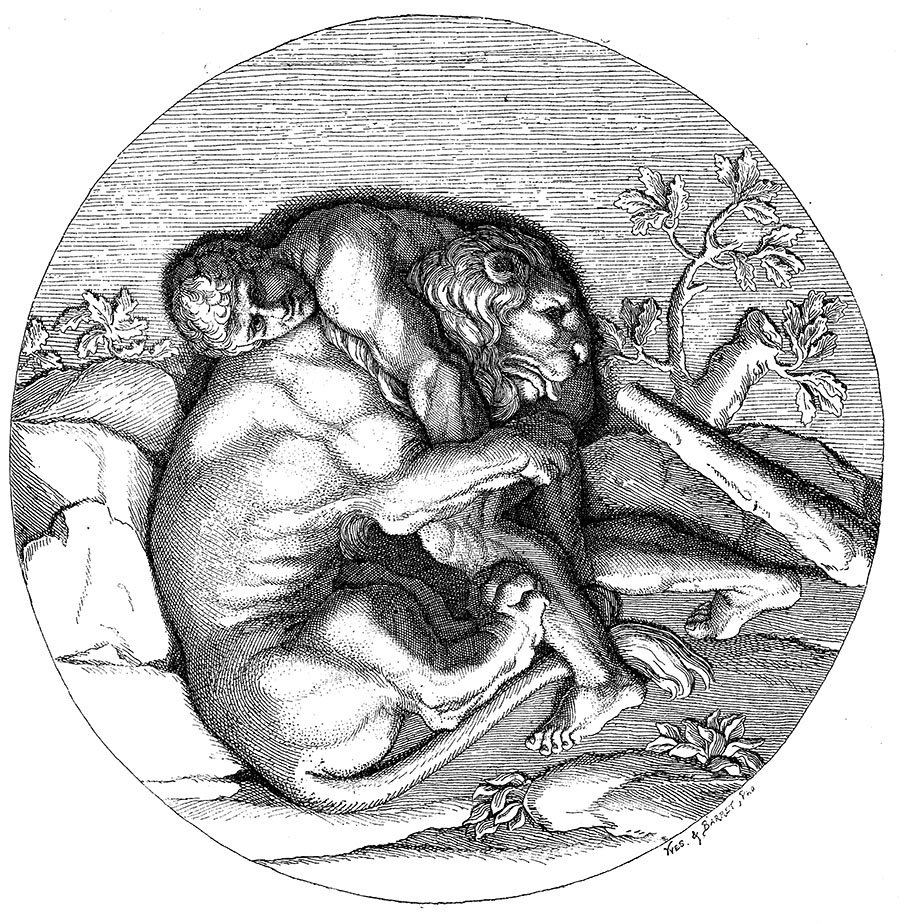
But yet another reversal is to follow, and it is the nature of this second reversal that makes the Alcestis unique in all of classical literature. The reversal begins in the scene just prior to Admetus' homecoming from the entombment. In transit to the eighth of his famed twelve labors, the semi-divine hero Heracles, the son of Zeus and the mortal woman Alkmene, arrives unexpectedly at Admetus' doorstep as Admetus is preparing Alcestis' body for burial. In an act of love paralleling Alcestis' own, Admetus receives Heracles into the palace, concealing the reason for his sorrow from his friend. When Heracles nevertheless learns of the tragedy from a servant, he resolves upon the feat of feats: he will go to Alcestis' tomb, engage in combat with Death himself, bring Alcestis back to life, and restore her to his noble host.
In the climactic final scene, Admetus, after his homecoming, remains outside the house, unable to enter, when Heracles returns from successful combat at the tomb (about which Admetus knows nothing), accompanied by a young woman, her face concealed by a hood or veil. The hero requests that Admetus take the woman, whom he claims to have won in an athletic contest, into his home. His deception allows Alcestis herself to witness Admetus' devotion as it is put to the test one last time.
The king begs that he not be asked to bring the young woman into the palace. She would only be a painful reminder of his loss, particularly as she bears a striking likeness to Alcestis. Admetus breaks down in sorrow for his lost wife.
But Heracles persists in his request, and in an effort to console Admetus suggests that the future will bring an end to mourning and eventual remarriage for the king. Indignantly rejecting the suggestion as a betrayal of his dead wife, Admetus declares his undying devotion to Alcestis, his one true love. At last, however, out of love for his friend, and on the understanding that he will have nothing to do with the woman, he relents, commanding the servants to take her inside.
But Heracles insists that Admetus himself lead her in, clasping her right hand (the hand clasped within the ancient marriage ceremony). In this scene of exquisite joy, the audience waits with anticipation for the moment when Heracles will remove the hood, revealing to Admetus his beloved wife, restored to life:
Admetus: I would not touch the woman; but she herself may enter.
Heracles: To your right hand alone will I entrust her.
Admetus: Sir, you force me to do this against my will.
Heracles: Dare to stretch forth your hand and touch the stranger.
Admetus: (Looking away) Yes, I will stretch forth my hand—but like one cutting off the head of the Gorgon!
Heracles: Are you holding her hand?
Admetus: Yes, I am holding her hand.
Heracles: Keep her now, and someday you will say that the son of Zeus is a noble guest. (Removing the hood) Look at her, if in any way she seems to resemble your wife. And in your happiness let grief now depart!
Admetus: Oh, gods! What can I say? This is a miracle beyond hope! Do I truly look upon this my wife, or is some god deluding me with a false joy?
Heracles: No, this woman you see is your wife.
Admetus: Beware that this is not some ghost from the dead!
Heracles: (Smiling) You don't think I'm a necromancer, do you?
Admetus: But do I look upon my wife, whom I just now placed in the tomb?
Heracles: Be assured you do; but I am not amazed that you cannot believe your good fortune.
Admetus: May I touch her, speak to her, as my living wife?
Heracles: Speak to her; for you have everything you have desired.
Admetus: (Caressing her face) O face and cheeks of my most beloved wife! Beyond all hope I have you, never imagining I would see you again!
Heracles: You have her; and may none of the gods be jealous!
Admetus: O noble child of greatest Zeus! May it be well with you, and may your father who begot you preserve you! For surely you alone have restored for me all things.
A True but Temporary Resurrection
Euripides' portrayal of Alcestis' salvation from death and reunion with Admetus is unique in ancient Greek and Roman literature. To be sure, ancient dramatic, literary, and philosophical texts consider a great variety of possibilities regarding life after death, ranging from the denial of any post-mortem survival to firm belief in the immortality of the soul. What is not envisioned elsewhere, however, is the possibility of death's reversal through the resurrection of the physical body.
In ancient thought, whether popular or philosophical, physical resurrection from the dead was considered impossible, and a violation of the cosmic order. The one exception to the rule is the Apollo mythic cycle, of which the story of Alcestis forms the climax. Alcestis' rescue from death, like the beneficiaries of Asclepius' healing art in the myth's backstory, is entirely different from other visions of life after death in Greco-Roman literature. Her death is not the end, but neither is it merely followed by some form of afterlife. Rather, Alcestis' death is reversed through her restoration to full bodily life. Alcestis is raised from the dead.
To be sure, even the resurrection of Alcestis is no true exception to the iron finality of death in ancient Greek thought. For her resurrection is not a permanent reversal of death, but only its postponement. Alcestis is temporarily rescued from death, but she is not freed from its law. She will die again. The inescapable decree of death for all mortals remains firmly in place.
In the Alcestis this fact receives dramatic expression by an otherwise puzzling feature of the play: the antagonist overcome by Heracles is not Hades, the powerful god of the dead, whose claim on every human life not even Zeus can forestall, but Death (Thanatos), a lesser deity or daimon in the service of Hades. For Euripides and his audience, Alcestis' temporary salvation from death did not therefore constitute any ultimate disruption of a cosmic order in which death had the last word.
A Longing Awakened
And yet. In the climactic scene of the Alcestis we see something more at work, through the power of the playwright's dramatic art. Although it is assumed, Euripides' drama does not narrate or allude to the later death of Alcestis. Rather, the play closes with a vivid celebration of life, restored in its fullness. The audience that beheld Alcestis' death now beholds its reversal and her restoration to a life now richer and fuller than she had previously known. Through the friendship of Apollo and Heracles, the noble couple "have entered upon a better life than before." In the final scene, unequaled for the intensity of its joy in all of Greek literature, the audience glimpses, if only momentarily, an order of things in which death does not have the last word; in which the friendship of the gods is stronger than death; in which death is not merely postponed, but abolished altogether.
That Euripides' drama did awaken some such hopes in ancient audiences and readers is attested by a striking fact: the appearance in ensuing centuries of images of the reunion of Alcestis and Admetus on ancient tombs, sarcophagi, and funerary monuments. The ultimate source of these portrayals is Euripides' play, for in almost all cases Alcestis appears hooded or veiled, a feature of the joyous "recognition scene" found first in Euripides' dramatization of the myth.
Clearly, the portrayal of this scene on the tomb of a loved one expresses an acute longing for the reversal of death. We seem to encounter here a genuine paradox: in a world in which it was axiomatic that death was the immovable law of the cosmic order that even the gods were powerless to alter, Euripides' drama aroused the hope of resurrection.
The Heart of Divine Reality
But before seeking an answer to this paradox, we must address another fascinating feature of the play. Contemporary readers are often struck by the parallels between Euripides' dramatization of the Alcestis myth and the story of Jesus in the Gospels. One obvious observation is that the concept of divine friendship, which suffuses the Alcestis, also pervades the Gospels. But that concept is also radically transformed. Ancient philosophy's insistence, in critique of the myths, upon the moral purity of the divine is affirmed and heightened in the biblical conception of the absolute goodness and holiness of God: "God is light, and in him there is no darkness at all" (1 John 1:5). In place of the friendship of unpredictable and quixotic deities is the love of a
holy God.
Another key difference is that, in the mythic world of the Alcestis, the affectionate friendship or philia of the gods is preferential, bestowed upon a few noble favorites such as Admetus and Alcestis. In the Gospels, the love of God extends to all humanity. The entire Gospel narrative pivots on the fulcrum of the Incarnation—God becoming man in the person of Jesus of Nazareth. And the motivation for the Incarnation is the all-embracing love of God: "God so loved the world, that he gave his only Son" (John 3:16).
But there is a difference between the friendship of the gods in the Alcestis and the love of God in the Gospels that is more crucial still. Euripides' drama celebrates the self-sacrificing love of Alcestis—she lays down her life so that Admetus may live. But the playwright doesn't dare to envision that such love might be at the heart of divine reality. In both ancient myth and ancient philosophy, the nature of divinity precludes self-sacrifice. In striking contrast, the story of the Gospels is a narrative not only of God become man, but of God become man for the purpose of suffering, crucifixion, and death.
It is at the very heart of the Christian story that, in the crucifixion of Jesus, God has revealed himself as a God of self-giving, sacrificial love. "God shows his love for us, in that while we were still sinners, Christ died for us" (Rom. 5:8). "In this is love, not that we have loved God, but that he himself loved us, and sent his Son as a sacrifice for our sins" (1 John 4:10). If in the Alcestis the friendship of the gods only goes so far, in the Gospels the love of God extends to the point of death, even death on a cross. The contrast is powerfully expressed in Edward Shillito's poem "Jesus of the Scars":
The other gods were strong, but Thou wast weak;
They rode, but Thou didst stumble to a throne;
But to our wounds only God's wounds can speak,
And not a god has wounds, but Thou alone.
A Greater Love, a Fuller Triumph
In the Bible, this divine love becomes in turn the pattern or model for human love. As a result, the other-regarding, self-sacrificial virtue of love assumes within Christian ethics a central place, which the virtue of philia never had in Greek philosophy: "By this we have come to know love, that he laid down his life for us; and we ought to lay down our lives for the brethren" (1 John 3:16).
So different is the conception that, to express it, the New Testament authors generally eschew the time-honored word philia as inadequate. Instead, they adopt a previously little-used word, agape, making it central to their proclamation and investing it with new significance: an unconditional, sacrificial love that comes from God, was revealed in Christ, and is henceforth to be the way of life for all Christians.
This brings us to the most obvious and arresting parallel between Euripides' drama and the Gospels. Unique among classical texts in antiquity, the Alcestis concludes with a resurrection. Each of the four Gospels concludes with Jesus' resurrection from the dead. The parallel is real, for in each case the climax of the story does not involve the mere entrance into some sort of afterlife, but the physical resurrection of the dead body from the tomb. The tomb is empty. Death is overcome, defeated, reversed.
But the contrasts are also striking. Euripides' play claims to be no more than a dramatic retelling of a story from the mythic past; the claim of the Gospels is that the resurrection of Jesus was an actual event within the space-time universe, verified by eyewitness testimony. This claim has no ancient (or modern) equivalent. Further, Jesus' resurrection in the Gospels is not a mere resuscitation, as in the Alcestis, but a permanent reversal of death and the overthrow of its power: "Christ having been raised from the dead can never die again; death no longer has mastery over him" (Rom. 6:9).
Most crucially, the story of Easter in the Gospels is the story of the defeat of death for all humanity. "Because I live, you shall live also" (John 14:19). The resurrection of Jesus, God made man, has abolished death, bringing the hope of future bodily resurrection for all: "But now Christ is risen from the dead, the first fruits of those who sleep. . . . But each in his own order; Christ the first fruits, then those who belong to Christ at his coming" (1 Cor. 15:20,23).
Good News That Resonates
The parallels between the Alcestis and the Gospels reveal a fascinating pattern. The Alcestis portrays a friendship of the gods toward Admetus and Alcestis; the Gospels proclaim a love of God for all humanity. The playwright celebrates self-sacrificial love as the noblest of virtues; the Gospels proclaim the revelation of God's love in Christ crucified, and a new ethic of love patterned after the cross of Christ. Euripides' drama portrays the restoration of Alcestis to full bodily life, in a scene that stirred ancient audiences to an acute yearning for the defeat of death; the Gospels proclaim that in Jesus' resurrection death has been defeated. In each case, the Alcestis awakens a longing that the Gospels claim to fulfill.
The Gospels and Euripides' play are each narratives of human restoration in which, through the power of self-sacrificial love, humanity's great enemy, death, is abolished. But in Euripides' drama, this restoration belongs to the inaccessible world of myth. In the Gospels, this restoration is an event in the real world, revealing self-giving, sacrificial love to be at the heart of all reality, and freely offering the gift of life and resurrection to all who will receive it.
The yearning for resurrection in the Alcestis is answered by the unique claim of Easter. Judging from the Alcestis alone, the remarkable fact that the first Christians would call their message to the pagan world "gospel" or "good news"—and expect this to resonate with their hearers—becomes lucidly comprehensible. The Alcestis excites a hope; the Gospels announce the fulfillment of that hope.
Two Explanations
Which brings us to the question with which we began. What are we to make of such things? How are we to explain the longing for divine love and resurrection expressed in the Alcestis?
One answer is that the yearning leads nowhere. On this view, such hopes belong to a mythic view of reality disproven or superseded by modern knowledge. The ancients in whom the Alcestis stirred up a longing for the defeat of death were, to that extent, deceived. Such hopes are unfulfillable—and therefore inexplicable.
Another solution is cogently expressed by Benedict XVI: "The Word-made-man did not simply enter a world that knew nothing whatsoever about him. He sent his radiance ahead of himself into the world and thus awakened the yearning of humanity." Benedict's words reflect the concept, which has always had an important place in Christian theology, that pagan religion, thought, philosophy, and art were neither complete in themselves, nor simply one unrelieved mass of errors, but rather a preparation for the gospel.
This concept is classically expressed in the book of Acts' account of the speech of the Apostle Paul before Stoic and Epicurean philosophers on Mars' Hill, a center of philosophic discussion located just northwest of the theatre of Dionysus, where, centuries earlier, the Alcestis had first been staged. Discovering among the sacred precincts' objects of worship an altar to an "unknown god," the apostle proclaimed to the Athenians, "What, therefore, you worship but do not know, this I announce to you" (Acts 17:23)—whereupon Paul proceeded to announce the good news of Jesus and his resurrection, and to call his hearers to salvation through faith in the gospel (Acts 17:24–34).
From this perspective, the yearning for divine love and resurrection in the Alcestis is entirely explicable, for it is a yearning given by God and fulfilled in the gospel of Christ. And on this explanation, it is this yearning for resurrection—the real defeat of death—that underlies not only the Alcestis but also the varied lesser visions of life after death in antiquity, from reincarnation to the immortality of the soul.
Unlocking the Mystery
Does the longing for resurrection expressed in the Alcestis point nowhere, or does it point to Easter? Is the yearning for resurrection a delusion, a form of human wish-fulfillment, or is it a preparation for the Christian gospel?
Many would be inclined, no doubt, to regard the first explanation as the "scientific" view, and the second as a perspective of "faith." But if by a perspective of "faith" we mean conclusions dependent upon prior beliefs or commitments which cannot themselves be proved, this is also true of the first explanation—indeed, of any explanation about anything. And if by "science" we mean inference to the best explanation, one might argue that the second solution is far more compelling.
The claim that the resurrection hope in the Alcestis is a preparation for the gospel explains both the Alcestis and the Gospels. The key fits a lock. The claim that this hope is a dead end does not seem to explain either.
From a scientific perspective, the Christian theological claim possesses great explanatory power. From an existential perspective, a great chasm clearly divides the two solutions to the mystery of Euripides' vision. According to one solution, the Alcestis is a ray of false light within an ultimately dark and tragic universe, awakening a hope incapable of fulfillment. According to the other solution, Euripides' play is a true but partial light, pointing beyond itself to a glorious fulfillment which the poet could not have known—but which he could, and did, envision. •
James Ware is Professor of Religion at the University of Evansville in Evansville, Indiana. His newest book is a guide to Paul's letters for clergy, students, and laypeople, Paul's Theology in Context: Creation, Incarnation, Covenant, and Kingdom (Eerdmans, 2019). He and his wife Jan attend Holy Spirit Catholic Church in Evansville, Indiana.
A Journal of Mere Christianity—Delivered to Your Door
- Essays on theology, culture, and the Church
- Contributors from across the Christian traditions

Six print issues (one year) of Touchstone, plus full online access and PDF downloads for only $39.95.

Get a one-year full-access subscription to the Touchstone online archives for only $19.95.
bulk subscriptions
Order Touchstone subscriptions in bulk and save $10 per sub! Each subscription includes 6 issues of Touchstone plus full online access to touchstonemag.com—including archives, videos, and pdf downloads of recent issues for only $29.95 each! Great for churches or study groups.
Transactions will be processed on a secure server.
more on Imagination from the online archives

18.4—May 2005
The Idylls, Idols & Devils That Corrupt the Moral Imagination by Vigen Guroian


19.10—December 2006
Training Up a Child Requires a Well-Formed Imagination by David Mills
more from the online archives


33.3—May/June 2020
on the Wisdom of the Good Doctor Edmund Pellegrino by Allen H. Roberts II
calling all readers
Please Donate
"There are magazines worth reading but few worth saving . . . Touchstone is just such a magazine."
—Alice von Hildebrand
"Here we do not concede one square millimeter of territory to falsehood, folly, contemporary sentimentality, or fashion. We speak the truth, and let God be our judge. . . . Touchstone is the one committedly Christian conservative journal."
—Anthony Esolen, Touchstone senior editor
