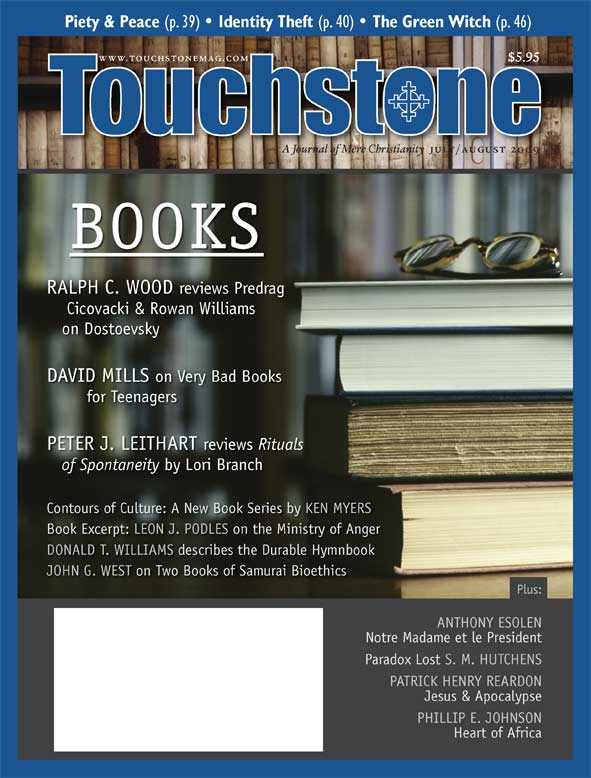
Freedom & Propriety
Rituals of Spontaneity: Sentiment & Secularism from Free Prayer to Wordsworth by Lori Branch
reviewed by Peter J. Leithart
We have Erasmus to thank not only for the word “ceremony” but also for the derogatory connotations attached to it. His Latin neologism, ceremonialae, has been translated as “trivial little ritual nonsenses.” Early English occurrences of “ceremony” follow the Erasmian usage. Gentility, one sixteenth-century critic wrote, is no more than a “meer flash, a ceremony, a toy, a thing of nought.”
Medieval Christians would have found these sentiments bewildering. Rituals were not toys but powerful tools that performed a kind of magic. So powerful was the ritual of the Mass that everything connected with it—the altar cloth, the chalice, the table—glowed with the radiance that, in historian Eamon Duffy’s term, “leaked” out of the consecrated host and wine.
The Reformation was about many things. But historian Edward Muir hit upon a central point of conflict when he characterized it as “a revolution in ritual theory.” Luther assaulted the magical Mass as vigorously as he attacked the works-righteousness he discerned in the medieval doctrine of salvation, and the Reformation itself fractured along sacramental fault lines, as Luther and Zwingli parted ways on Eucharistic theology.
The Ideology of Spontaneity
For a variety of reasons, historians have not followed the story of ritual, sacrament, and ceremony beyond the Reformation. This is unfortunate, because no attitude is so characteristic of the modern Western mind as its indifference, or even hostility, to ritual. In the sixteenth century, Europeans fought wars over the meaning of Hoc in the Eucharistic formula “Hoc est corpus meum” (“This is my body”). Today, differences of that sort are greeted with a quizzical yawn.
In her dense and sophisticated work, Rituals of Spontaneity: Sentiment and Secularism from Free Prayer to Wordsworth (Baylor University Press, 2006), Lori Branch has filled in a considerable part of the history between religious war and irreligious yawns. Focusing on English literary culture and religion, Branch examines the formation of an “ideology of spontaneity” from the Reformation attacks on ritual through Puritan defenses of free prayer to the Romantic poetry of William Wordsworth. She demonstrates that the anti-ritual attitude is a central theme in the formation of modern views of religion, subjectivity, morality, and literature.
The “ideology of spontaneity” is more explicitly expressed in the early part of this history. English Protestants attacked the ceremonies of the Catholic Church and the remnants of ceremony in Prayer Book liturgies, not only because they thought these ceremonies lacked biblical support but also because they believed that set liturgical forms were, in themselves, inimical to religious sincerity. This had the effect of detaching believers from communal actions. Medieval Christians were participants in rituals; after the Reformation, Christians began to see themselves as detached individual selves, desperately ginning up religious passion.
For many Protestants, sacramental rites could not accurately represent or effectively communicate the grace of God. Faced with this “crisis of representation,” Christians looked inward to find a place of communion with God. Not just any inward experience would do, however. Sincere religious expression had to be the product of the Spirit working on the human soul. Genuine prayer arose from agony, pressed, in Bunyan’s phrasing, from the solitary soul as “blood is forced out of flesh.”
Peter J. Leithart is an ordained minister in the Presbyterian Church in America and the president of Trinity House Institute for Biblical, Liturgical & Cultural Studies in Birmingham, Alabama. His many books include Defending Constantine (InterVarsity), Between Babel and Beast (Cascade), and, most recently, Gratitude: An Intellectual History (Baylor University Press). His weblog can be found at www.leithart.com. He is a contributing editor of Touchstone.
A Journal of Mere Christianity—Delivered to Your Door
- Essays on theology, culture, and the Church
- Contributors from across the Christian traditions
Six print issues (one year) of Touchstone, plus full online access and PDF downloads for only $39.95.
Get a one-year full-access subscription to the Touchstone online archives for only $19.95.
bulk subscriptions
Order Touchstone subscriptions in bulk and save $10 per sub! Each subscription includes 6 issues of Touchstone plus full online access to touchstonemag.com—including archives, videos, and pdf downloads of recent issues for only $29.95 each! Great for churches or study groups.
Transactions will be processed on a secure server.
more from the online archives
calling all readers
Please Donate
"There are magazines worth reading but few worth saving . . . Touchstone is just such a magazine."
—Alice von Hildebrand
"Here we do not concede one square millimeter of territory to falsehood, folly, contemporary sentimentality, or fashion. We speak the truth, and let God be our judge. . . . Touchstone is the one committedly Christian conservative journal."
—Anthony Esolen, Touchstone senior editor