




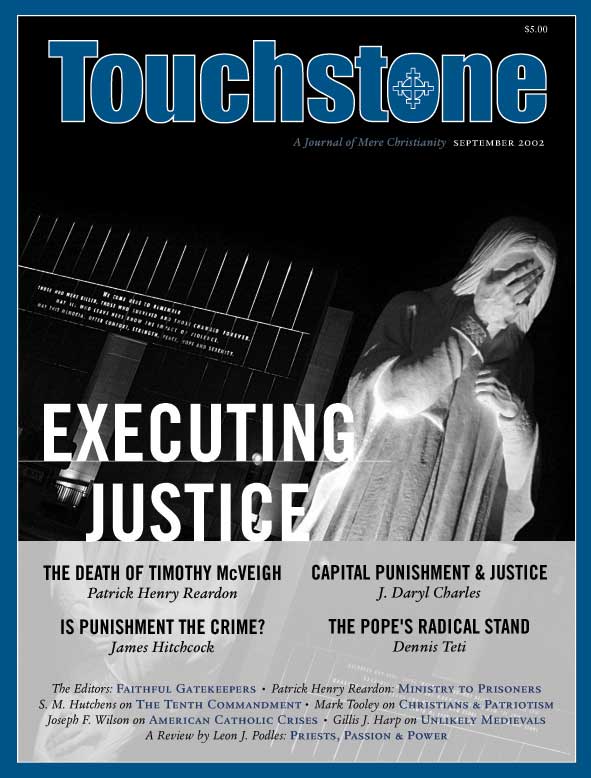
The Crime of Punishment
Capital Punishment & Cultural Change in American Life
by James Hitchcock
The campaign against capital punishment in the United States is ostensibly inspired by a heightened respect for human life, a growing realization that the taking of life by the state is itself an injustice. It is, however, at best problematic to claim that Americans, especially the liberal middle class, are more sensitive to human life than they were forty years ago. The phenomena of abortion, euthanasia, assisted suicide, cloning, even selective infanticide, obviously belie this and require that an explanation be sought elsewhere.
To some extent the campaign against the death penalty follows a trajectory familiar in American reformist movements since the early twentieth century—the public identification of a “problem,” intense discussion in the media to “inform” the public, the marshalling of forces to correct the abuse. While many such issues—the place of women in society, the conservation of the environment, sexual behavior—may have seemed unproblematic to most people only a short time before, once “discovered,” they quickly generate new orthodoxies, with “enlightened” opinion thereafter measuring itself on the basis of how quickly and completely it absorbs the new viewpoint.
One leading Catholic opponent of the death penalty, Antoinette Bosco, carries moral authority in that her own son and daughter-in-law were brutally and gratuitously murdered, and Mrs. Bosco suffered great anguish searching for a way of coping with that catastrophe. But her ultimate response to the murders seems also to have been dictated by an outlook on life already fully formed—she was an anti-war activist, a feminist, an environmentalist, a liberal journalist, a critic of capitalism—positions that could scarcely sustain a “hard” attitude towards crime. (Her murdered son was also a liberal activist, who among other things campaigned for election to a school board by advocating permissive child-rearing.)1
The liberal approach to crime was an outgrowth of the general reformist impulse of the earlier twentieth century, an impulse that often denigrated the ability of ordinary citizens to make competent judgments about public issues and that proportionately exalted the wisdom of trained experts whose theories were thought to be appropriate for shaping public policy. It was a view of reality badly tarnished by the failed “war on poverty” of the 1960s, but it still persists. Essential to such a view is the assumption that only certified experts see reality in all its complexity, perhaps most keenly when their opinions seem to go contrary to common sense. Thus, the noted psychiatrist Karl Menninger, although his views about crime were expressed quite emotionally, insisted that he was merely being “scientific,” something which, he asserted, ordinary people would have difficulty understanding.
Evolving Standards
Some European countries abolished capital punishment in the nineteenth century, as did some of the United States, but the major campaign began only around 1960. Thus, for some American abolitionists the chief argument against capital punishment is simply that the practice places the United States “behind” other countries and is a source of international embarrassment. The late Chief Justice Earl Warren once argued against the death penalty merely on the grounds that it violated “evolving standards,”2 while another critic of the practice faults it simply for not being “modern.”3 But for many traditionalists, modernity itself is suspect, as are the impulses that they see driving the campaign against capital punishment.
The harbinger of the modern American campaign was perhaps the Leopold-Loeb murder case in Chicago in 1924, when the famous criminal lawyer Clarence Darrow for the first time put psychologists on the stand, not to argue that his clients were insane but that they should be spared the electric chair because of certain vaguely defined psychological deficiencies (“diminished responsibility”). It was a difficult argument to make, given that both murderers were highly intelligent and had been raised in luxury, but Darrow succeeded in reducing even the judge to tears of sympathy for the “misunderstood” defendants.4 For perhaps the first time in a major American criminal case, there was a deliberate “transvaluation of values,” in which the criminals were successfully presented as victims, at least to the extent of persuading the judge that they did not deserve the death penalty for a premeditated, cold-blooded murder.
The vogue of sympathy for violent criminals then periodically revived, as in the Caryl Chessman case of the 1950s, when liberal opinion strenuously lobbied against the execution of a serial rapist and murderer, partly on the grounds that Chessman possessed literary ability. More recently the novelist Norman Mailer championed the cause of Jack Henry Abbott, a murderer whom Mailer thought showed talent as a writer and who, soon after his release from prison, committed another murder.5 Mailer had a similar attitude towards Gary Gilmore, a murderer executed in Utah in 1979.6
In the 1988 presidential campaign a convicted criminal named Willie Horton became a symbol for both Republicans and Democrats, the former pointing out that he had committed a brutal crime while on furlough from prison in an experimental program, the latter portraying him as a scapegoat for white racist politicians. The Horton case followed the familiar pattern wherein liberals find mitigation in the poverty and discrimination of the criminal’s personal history. But, as in the Leopold-Loeb and Chessman cases, some criminals are granted extenuation even if they cannot plausibly be presented as victims of deprivation.
James Hitchcock is Professor emeritus of History at St. Louis University in St. Louis. He and his late wife Helen have four daughters. His most recent book is the two-volume work, The Supreme Court and Religion in American Life (Princeton University Press, 2004). He is a senior editor of Touchstone.
A Journal of Mere Christianity—Delivered to Your Door
- Essays on theology, culture, and the Church
- Contributors from across the Christian traditions

Six print issues (one year) of Touchstone, plus full online access and PDF downloads for only $39.95.

Get a one-year full-access subscription to the Touchstone online archives for only $19.95.
bulk subscriptions
Order Touchstone subscriptions in bulk and save $10 per sub! Each subscription includes 6 issues of Touchstone plus full online access to touchstonemag.com—including archives, videos, and pdf downloads of recent issues for only $29.95 each! Great for churches or study groups.
Transactions will be processed on a secure server.
more on america from the online archives
29.4—July/August 2016
Russell Kirk: American Conservative by Bradley J. Birzer by Hunter Baker
29.2—March/April 2016
The History of Family Strength in America May Reveal Good News by Allan C. Carlson

30.5—Sept/Oct 2017
The Christian Cure for What Ails Modern Politics by David Bradshaw
more from the online archives

23.5—September/October 2010
The Loss of a Christian Understanding of Virginity Is Pure Tragedy by Eleanor Bourg Donlon

31.6—November/December 2018
Victimhood Culture Scapegoats Its Very Source by Michael P. Foley
calling all readers
Please Donate
"There are magazines worth reading but few worth saving . . . Touchstone is just such a magazine."
—Alice von Hildebrand
"Here we do not concede one square millimeter of territory to falsehood, folly, contemporary sentimentality, or fashion. We speak the truth, and let God be our judge. . . . Touchstone is the one committedly Christian conservative journal."
—Anthony Esolen, Touchstone senior editor
