




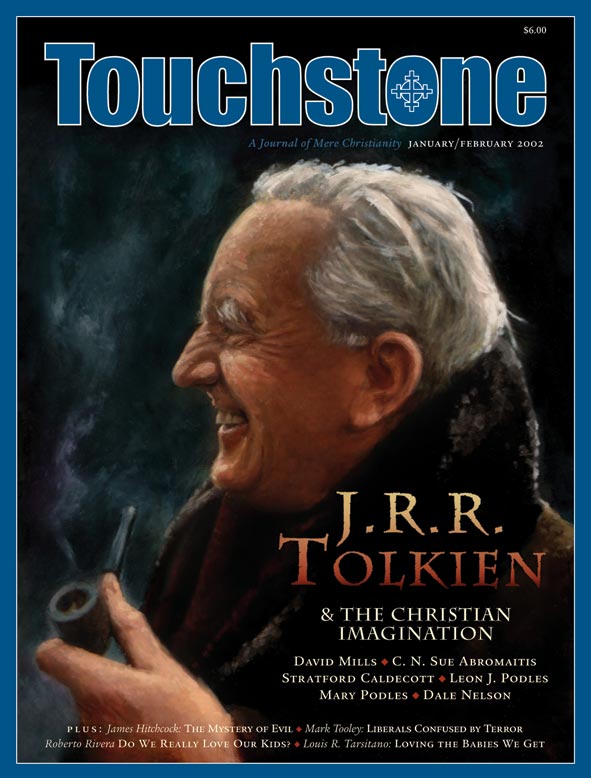
The Heroes of Middle-Earth
J. R. R. Tolkien & the Marks of Christian Heroism
by Leon J. Podles
J. R. R. Tolkien’s hold on the imagination has been surpassed by few writers in the twentieth century. His books have sold tens of millions of copies, and the website for The Lord of the Rings has had 30 million hits per month (at one point it was getting one million hits per hour). British readers have voted The Lord of the Rings as the best book of the twentieth century and, according to members of the Folio Society, the best English book ever.
I discovered Tolkien when I was sixteen. I was also discovering Chestertonian Catholicism, the nineteenth-century artist, designer, and writer William Morris, and Icelandic sagas (which Morris translated), and I found in Tolkien a kindred soul. But Tolkien’s enormous popularity is based upon an appeal to concerns broader than mine at that age: concerns about what it is to be a man and hero, about what love is between mortal creatures, about the meaning of life lived under the shadow of inevitable death.
Tolkien probes these concerns because his own life, like the twentieth century itself, was lived under the shadow of war and mass death. He knows that salvation comes by grace alone, through a heroism very much like that of Christ.
Tolkien’s imagination is both Christian and masculine. The heroic manhood that he portrays in The Lord of the Rings shares key aspects with Christ’s heroic mission: bravery, pity, mercy, love, self-sacrifice, and suffering. All of these can be found in Tolkien’s heroic tale, The Lord of the Rings, and are key to understanding both its broad appeal and its richness as a work of the Christian imagination.
Heroic Manhood
The Lord of the Rings is in the tradition of heroic fantasies like The Odyssey. Every boy’s life is a quest to become a man. Boys are raised on stories of boys who leave home, face challenges and danger and death, and return transformed into men. The boy must distance himself from the person to whom he is closest and whom he loves most—his mother—because she cannot provide him the model of what he is supposed to become.
He must leave the world of childhood, in which he is cared for and protected, so that he can enter the adult male world, in which he learns to care for and protect others. The quest theme is universal because all cultures tell their boys stories about the quest to become a man. The hero, the one who has achieved this quest and become a man, is the central literary figure of each culture. Even though most of the males Tolkien writes about are Hobbits, they have the same problems of growing up that human males have.
Tolkien achieved manhood during the Great War. He lost close friends to death. He saw the reality of battle and the special horror of industrialized mass death, which poisoned the earth and left tens of thousands of bodies rotting on the battlefield.
His intellectual interests were the masculine Anglo-Saxon and Icelandic literatures. The style of these literatures is laconic, and their subject matter is battle and struggle in the face of inevitable death.
Leon J. Podles holds a Ph.D. in English from the University of Virginia, has worked as a teacher and a federal investigator, and is president of the Crossland Foundation. He is the author of The Church Impotent (Spence), Sacrilege (Crossland Press), and Losing the Good Portion: Why Men Are Alienated from Christianity (St. Augustine Press). Dr. Podles and his wife have six children and live in Baltimore, Maryland. He is a senior editor of Touchstone.
A Journal of Mere Christianity—Delivered to Your Door
- Essays on theology, culture, and the Church
- Contributors from across the Christian traditions

Six print issues (one year) of Touchstone, plus full online access and PDF downloads for only $39.95.

Get a one-year full-access subscription to the Touchstone online archives for only $19.95.
bulk subscriptions
Order Touchstone subscriptions in bulk and save $10 per sub! Each subscription includes 6 issues of Touchstone plus full online access to touchstonemag.com—including archives, videos, and pdf downloads of recent issues for only $29.95 each! Great for churches or study groups.
Transactions will be processed on a secure server.
more on J. R. R. Tolkien from the online archives
more from the online archives
27.6—Nov/Dec 2014
Tales of Forbidden Stereotypes
Real-Life Men & Women & the Tragic Loss of Human Comedy by Anthony Esolen

32.2—March/April 2019
Flight from the Absolute: Cynical Observations on the Postmodern West, Volume II by Paul Gosselin by Louis Markos
33.3—May/June 2020
Bach's Cantata BWV 106, Gottes Zeit ist die allerbesteZeit (God's time is the very best time) by Ken Myers
calling all readers
Please Donate
"There are magazines worth reading but few worth saving . . . Touchstone is just such a magazine."
—Alice von Hildebrand
"Here we do not concede one square millimeter of territory to falsehood, folly, contemporary sentimentality, or fashion. We speak the truth, and let God be our judge. . . . Touchstone is the one committedly Christian conservative journal."
—Anthony Esolen, Touchstone senior editor
