




A Long Resistance in the Same Direction
The Quiet Revolution in the Presbyterian Church (USA)
by Parker T. Williamson
A seismic shift is shaking the Presbyterian Church (USA). Riding into office on the premise that Scripture’s God had died, those who have been in control of this denomination’s infrastructure since the early 1960s now find that it is their authority that struggles for survival. Having hemorrhaged more than one million members since 1965 and having been drained of more than $60 million from the denominational treasury, managers have little to show for their attempts to replace theology with sociology. Faced with the fact that their programs are being rejected and that clinging to post-modern mantras is no longer deemed credible, vintage sixties liberals are losing their grip on the Presbyterian Church (USA).
Cultural Christianity
Believing that the church’s mission was politics, denominational leaders in the 1960s hopped from one social movement to another in a frenzy to be on the cutting edge. They declared with Carl Sagan that the universe is “all there is,” concurred with the World Council of Churches that “the world sets the church’s agenda,” and labeled cultural trends “prophetic” for the life and ministry of the church that they superintended.
It was this move to speak, not for the transcendent God but for a sensate culture, that enticed Presbyterian leaders into their preoccupation with sex. What they chose to showcase was not a sexual expression that honors the creator God—engendering life, love and communion—but one titillated by human narcissism and self-gratification. Sexual politics became the centerpiece of the Presbyterian agenda, and after a brief flirtation with feminism, the focus turned androgynous. Homosexual rights became the cause célèbre.
Changing the Rules
To get where they wanted to go, denominational leaders in the mid 1960s first set out to undercut the source of Presbyterian authority. They approved a document, “The Confession of 1967,” that effectively removed Scripture as the foundation of Presbyterian faith and life. “The words of Scripture,” declared the new confession, “are the words of men.” That was the declaration that removed theos from logos, and shifted all things spiritual into categories of feeling rather than fact.
Now all affirmations could be called perspectives and the circle of acceptability was positioned for infinite expansion. After all, how can one reject another person’s feeling? If he or she experiences a feeling, then it is—due solely to the fact that the feeling exists—true. Thus in short order, the Presbyterian Church encompassed a pantheon of ideologies expressed as modes of affection, which were shielded from judgment on grounds that sentiment cannot be judged. The Reformed tradition’s dictum, “Reformed and always reforming under the word of God,” was truncated to “Reformed and always reforming,” which was taken to mean that bizarre is better. Integrity, being true to one’s own feelings, became the new moral benchmark.
Sexual Politics
No longer encumbered by Scripture, Presbyterian leaders could now maintain that making the church relevant to contemporary issues was their chief concern, and they appointed committees whose passion was to discover and follow “what God is doing in the world,” a euphemism for pursuing cultural conformity. In the mid 1970s a task force was named to consider the church’s attitude toward homosexuality. Given the group’s composition, its conclusion—that same-sex behavior is an acceptable option for ordained Presbyterians—was predictable.
A Journal of Mere Christianity—Delivered to Your Door
- Essays on theology, culture, and the Church
- Contributors from across the Christian traditions

Six print issues (one year) of Touchstone, plus full online access and PDF downloads for only $39.95.

Get a one-year full-access subscription to the Touchstone online archives for only $19.95.
bulk subscriptions
Order Touchstone subscriptions in bulk and save $10 per sub! Each subscription includes 6 issues of Touchstone plus full online access to touchstonemag.com—including archives, videos, and pdf downloads of recent issues for only $29.95 each! Great for churches or study groups.
Transactions will be processed on a secure server.
more from the online archives
20.7—September 2007
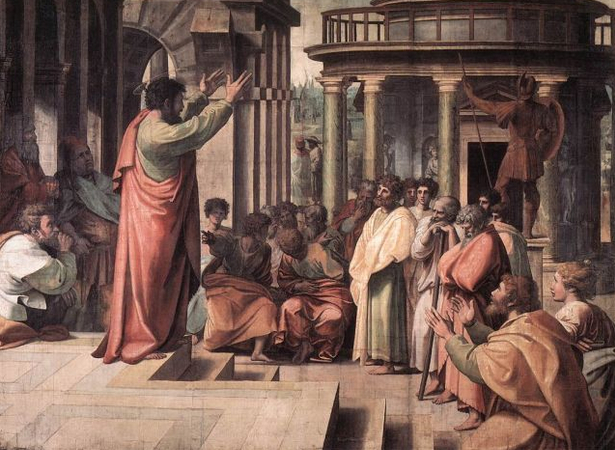
Paul Didn’t Build Bridges to Popular Culture by Russell D. Moore

33.3—May/June 2020
On Flight & Fight in the Present Tribulation by Douglas Farrow
calling all readers
Please Donate
"There are magazines worth reading but few worth saving . . . Touchstone is just such a magazine."
—Alice von Hildebrand
"Here we do not concede one square millimeter of territory to falsehood, folly, contemporary sentimentality, or fashion. We speak the truth, and let God be our judge. . . . Touchstone is the one committedly Christian conservative journal."
—Anthony Esolen, Touchstone senior editor
