Column: A Thousand Words
Portico de la Gloria by Master Mateo
by Mary Elizabeth Podles
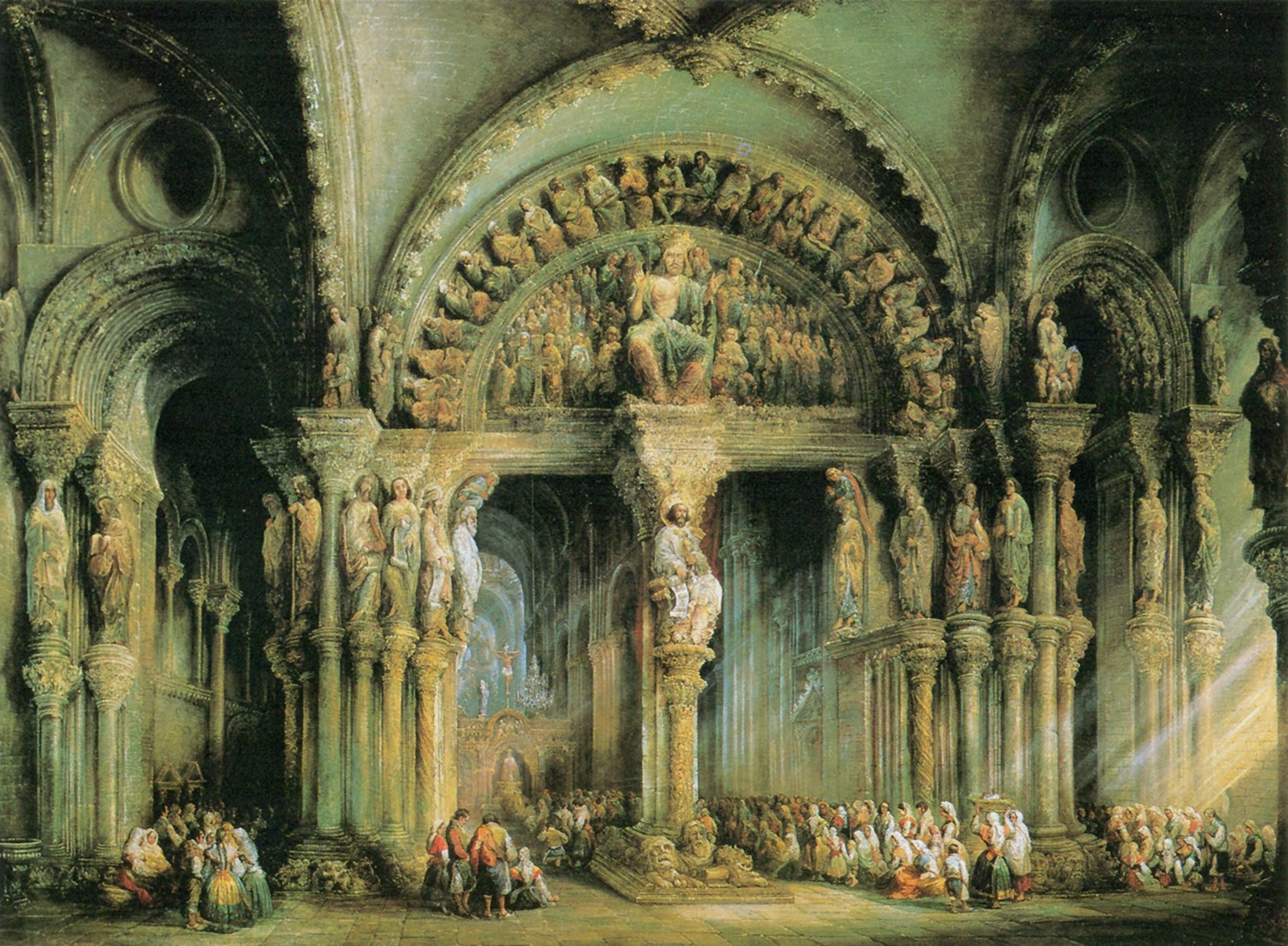
The Portico de la Gloria was originally the main entrance to the Cathedral of Santiago de Compostela (Figure 1), the end point of one of Christendom's principal pilgrimage routes. In the Middle Ages, wealthy European pilgrims traveled to the Holy Land to walk in the footsteps of Jesus; the comfortably well-off crossed the Alps to St. Peter's in Rome; and the rest of Europe went on foot to visit the remains of St. James at Compostela.
The portico itself (Figure 2) is enclosed in a porch-like narthex, and has three entrances opening onto the central nave and the two flanking aisles. Above the left-hand door are carvings depicting the Last Judgment; on the right are saints and Old Testament figures; and in the center sits Christ in Majesty surrounded by the instruments of the Passion, the Evangelists, and the souls of the blessed. Above and around him sit the twenty-four Elders of the Apocalypse, and at his feet,
St. James.
The Medieval Church Portal
Such an arrangement is a departure from the kind of portal that travelers had already met along the pilgrimage route. The more usual program, as at Conques Abbey (Figure 3), would have featured a central Last Judgment, complete with graphic renderings of the final reward of souls. Death was a present reality in an uncertain world: high infant mortality, disease, and the prevalence of violence contributed to a life expectancy of thirty to thirty-five years. Life was doubly precarious when traveling on foot far from home, and a reminder of the last things would have been timely and pertinent.
In addition, the function of the church portal in medieval life added a further symbolic resonance to the theme of judgment. Church doors were viewed metaphorically from a biblical perspective, taking on the Old Testament role of the city gates, and the image of Christ as the door ("Whoever enters through me shall be saved"). Physically, the church door thus became the actual place of judgment. Ecclesiastical trials were convened at the church portal, and it gradually became the seat of secular justice as well. Over time, the church door became the place to swear oaths, seek asylum, sign contracts, marry, make trade agreements, and store the standard weights and measures for the marketplace spread at its feet. Often the bases of the doorjambs were decorated with lions, a reference to the throne of Solomon, and documents were marked as having been signed "inter duos leones," between two lions.
By contrast, the portal at Santiago specifically does not focus on the Last Judgment, and from the start was intentionally different. The contract with Master Mateo was drawn up in 1168 and specified that the king would pay him an annuity (and a handsome one) for life, from which he was to defray the cost of the foundations and architecture of the narthex and doors and the design and manufacture of the sculpture. The project took over forty years, but was completed in time for the cathedral's dedication in 1211. Master Mateo left his effigy as a signature on the inside of the door, kneeling in perpetual prayer with his face to the high altar.
Mateo's Departure from the Norm
Again, Master Mateo's design was a self-conscious departure from the norm. For starts, the portico is not in the open air, a place of judicial activity and public commerce, but enclosed in a roofed space that offered arriving pilgrims relief from the everlasting rains of Galicia. One entered the church and only then encountered the portal. The Last Judgment was still present, but shifted from the center to the left-hand or sinister portal, and was put on the voussoirs or arch surrounds rather than on the semicircular tympanum above the door. Similarly, on the right hand door, the focus is on the voussoir figures, this time mainly Old Testament saints who, having played out their roles in salvation history, now await its consummation.
The tympanum of the central door is thus the focus of all eyes (Figure 4). There, a benign Christ sits in majesty. Angels hold up the arma Christi, the marks of the Passion, and at Christ's feet is a capital depicting his temptations in the wilderness. Christ has overcome both sin and death. Around him stand the Evangelists, who have spread the good news of salvation to the ends of the earth. (Compostela and its satellite Finisterra stand almost at the westernmost point of continental Europe.) Behind the Evangelists stand forty of the souls of the blessed awaiting entrance into Heaven, the number forty in the Bible signifying a time of testing or trial, which they have successfully
completed.
Supporting the tympanum is St. James welcoming the incoming pilgrims (Figure 5). He is seated, not standing, like a familiar friend and genial host, wearing a jeweled crown and traces of his original brightly colored paint. The column on which he sits is the Tree of Jesse, depicting the ancestry of -Jesus, fitting for St. James, the kinsman of Jesus. At the foot of the column is a bearded figure, plausibly Noah, from whom the whole human race sprang up after its cleansing in the flood. Like the pilgrim, Noah experienced purification through a kind of baptism and rebirth. Also, the story of Noah is a signal of the mercy of God, consonant with the welcoming -figures of Jesus and St. James.
Mary Elizabeth Podles is the retired curator of Renaissance and Baroque art at the Walters Art Museum in Baltimore, Maryland. She is the author of A Thousand Words: Reflections on Art and Christianity (St. James Press, 2023). She and her husband Leon, a Touchstone senior editor, have six children and live in Baltimore, Maryland. She is a contributing editor for Touchstone.
A Journal of Mere Christianity—Delivered to Your Door
- Essays on theology, culture, and the Church
- Contributors from across the Christian traditions
Six print issues (one year) of Touchstone, plus full online access and PDF downloads for only $39.95.
Get a one-year full-access subscription to the Touchstone online archives for only $19.95.
bulk subscriptions
Order Touchstone subscriptions in bulk and save $10 per sub! Each subscription includes 6 issues of Touchstone plus full online access to touchstonemag.com—including archives, videos, and pdf downloads of recent issues for only $29.95 each! Great for churches or study groups.
Transactions will be processed on a secure server.
more on art from the online archives
more from the online archives
calling all readers
Please Donate
"There are magazines worth reading but few worth saving . . . Touchstone is just such a magazine."
—Alice von Hildebrand
"Here we do not concede one square millimeter of territory to falsehood, folly, contemporary sentimentality, or fashion. We speak the truth, and let God be our judge. . . . Touchstone is the one committedly Christian conservative journal."
—Anthony Esolen, Touchstone senior editor