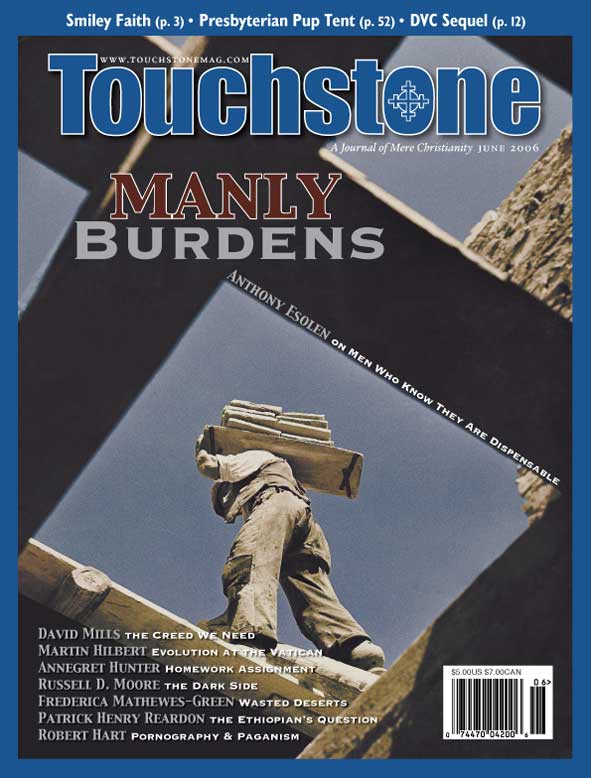
Over Our Dead Bodies by Anthony Esolen
Over Our Dead Bodies
Men Who Are Willing to Lay Down Their Lives Are Truly Indispensable
by Anthony Esolen
When the old slate quarries of the Pennsylvania town ceased operation, the
land was sold to an enterprising fellow who leveled the heaps of refuse and
cleared dozens of acres for junking cars. That man’s a millionaire now,
and does necessary work, but he has not been able to alter the quarries entirely.
On his property remain three holes, each of them well over an acre in breadth
and from a hundred to two hundred feet deep, now shining as lakes of cold clear
water. They are banked by screes of jagged slate that will cut a bare foot
as quickly as shards of glass, as I have found by experience. But sometimes
it is not a bank, either, but a veritable wall cut vertically in the rock,
with the clean corrugations of the quarrying saws still visible.
Wrested Slate
Water was an important part of the slater’s day. You had to recirculate
water as coolant in the works of diamond-grit saws, lest in a few moments the
heat generated by the friction of blade-rock against quarry-rock fuse the machine’s innards. The -quarry’s own gut
had to be pumped continually, lest the breached water table fill the cavity.
And human bellies, too, have their needs. A workman might sweat fifteen pounds
of water on a day of normal heat. They replenished it, usually in a form to
stir up conviviality or fighting or both; and those, too, are not the least
of the calls of the man’s life.
For all that it had to be wrested from the mountains by daring and force,
the slate was put to delicate use: blackboards for schools, tables for elegant
dining rooms (and for smoky billiard halls), and shingles for anyone who could
afford better
than wooden shakes and tarpaper. To my eye, there is no finer roofing than
slate, sometimes glossy black but oftener a sheeny silvery-gray with irregular
washes of light iridescence.
The shingles are cut square, oblong, or scalloped, to cover the gables and
turrets of Victorian houses. And when the sun breaks out upon a slate roof
after a storm, the tiles glisten like jewel-work. Delicately beautiful are
they, yet stalwart and stubborn. Some slate slabs an inch thick can support
the weight of two men; and slate shingles can last over a century without crumbling
or falling.
That town was literally sawn out of the hills by sturdy Welshmen. Now its
Welsh character and its sturdiness are hardly memories. What else, when “safety” is
extolled as the summum bonum, and when we are all encouraged to look
upon the globe as our dreary universal suburb, rather than see in our own small
town a peculiar and precious glint of the universe? Welsh boys no longer pick
fights with Italian boys from the Catholic town above. Do not attribute to
forbearance what may more plausibly be attributed to apathy or despair. They
don’t fight, because there is nothing to fight for.
We Must Not Fall
Yet maybe a vein of the old virtus remains beneath, sustaining
the flitting life above it, but unseen and unknown. For when the junkman bought
that land, the town required him to render it “safe” by putting
a chain-link fence and barbed wire around the most spectacular of the lakes.
We must not fall for or into anything: That is the first rule of the nannied
life. But the local boys have dutifully trodden the fence down in several places,
and wise policemen have looked the other way.
If you walk up there, then, and trespass over the straggling barbed wire
(as I have), you will be struck by a sudden vista of astonishing beauty. On
two sides you will have to scramble over jumbled slabs of slate, from a few
pounds to many tons, steeply concluding in a lake as broad as a park. Its sides
facing you will be banked by walls, etched and grooved by man’s tools,
tufted with grass and birch at the top and in odd dirt-catching crevices, rising
to a height of 115 feet above the water.
But the trespassers are boys, so naturally there’s more. I don’t
mean smashed-glass evidence of parties or other debaucheries, though that is
there. Initials, names, some insults, dates, and other feints at immortality
are painted on that wall, at all heights. The only way any kid could do it
is by hitching himself to a rope, secured by his buddies at the top. Some insults
it takes a team to deliver.
Nor is it a small matter to fall into the water from such a height. Fall
with a leg cocked and it may snap like a matchstick. Fall aslant and you may
break your back or your neck and drown before anybody can get to you—even
if there were an easy shore for you to be conveyed to, as there is not.
One young man told me that jumping off the cliff was the most dangerous thing
he had ever done. He wore sneakers, he said, to give his feet weight and help
him point the toes downwards. It didn’t help: the force of the air lifted
them against his strength, and when he hit the water his legs felt as if they
had been jammed upwards, like a cartoon character’s, into his trunk.
He leapt twice, though.
So down you go to paint your initials, to boast about your football team,
to decry the perversion of a particular enemy, or to display perduring affection
for a girl whose name you will have forgotten long before your hair is gray.
But you see to it that the cliff remembers. And there on that same wall, twenty
feet from the top, some patriotic lad has painted, in block letters eight feet
high, with stars and stripes in red, white and blue, the words UNITED WE STAND.
Manhood’s Risk
In this place, risk and manhood are to be glimpsed in an instant, with beauty
and folly, and pride and love, hard to extricate the one from the other. It
is a strange and bold witness of life. Like life, it is heartily unsafe. It
brings no therapy, no anodyne; it is not the dose of nepenthe that Helen of
Troy, the essential matriarch, slips her semivirile husband; it is not the
lotus; it is not what we whimsically call Higher Education.
Men cut the rock, and the rock cuts back. We men who have neither been born
eunuchs nor made ourselves eunuchs for the kingdom of heaven, but who have
allowed others to make eunuchs of themselves and of us, all for a watercolor
impression of peace, a safe life of Monet purple, with even erotic love blurred
into the bland, as we pretend to courage while rutting in padded cells with
helmets and shin guards and other soft and slack prophylactics of the soul—we
nannied men could not have carved this place.
Yet a memory of what men could and did create lingers: United We Stand. Brave
fellow, he who painted that. Were I his father and had I learned of the stunt,
I would exercise my prerogative and administer to his backside another sort
of tattooing. But I would be proud, too.
A husband is the head of his wife, says Paul, “even as Christ loved
the church, and gave himself for it; that he might sanctify and cleanse it
with the washing of water by the word, that he might present it to himself
as a glorious church, not having spot, or wrinkle, or any such thing; but that
it should be holy and without blemish.” Ah, the hard sayings of Christ
and his apostles!
Individualists may balk at “Inasmuch as ye have done it unto the least
of these my brethren, ye have done it unto me,” and that says little
about Christ and a lot about the pinchedness of individualists. Capitalists
squirm when they hear that the rich young man “went away grieved: for
he had great possessions,” and that says little about Christ and a lot
about the dependencies of capitalists. Roman soldiers who converted to the
Way no doubt stuck hard at the injunction to love their enemies.
And we, what do we find difficult? Paul’s common sense about husbands
and wives.
Headship Absorbed
When people are in theological straits, they resort to the safety of arguing
that Jesus or Paul did not mean what the plain sense of the text suggests.
Thus, some absorb the husband’s headship into the humility, rather as
a paramecium is absorbed into an amoeba; so I have seen servile Christian men
tout their obedience to this verse because in “sacrifice,” in Christlike
sacrifice, they allow their wives to do whatever their wives please.
I have also seen the sense so transmuted that headship is reduced to a cipher,
since all the really important Christian work is in service. It is as if Paul
had said that the husband was to be the figurehead of the wife. Such exegetes
had better watch lest Christ become but the figurehead of their churches.
I think, rather, that cutting stone out of a mountain sheds better light
on Paul’s words: A stick of dynamite is worth a sheaf of exegetes. Properly
understood, there must be something dangerous and alive about the headship
of the husband. After all, headship was not safe for Christ, nor for his people—that
is to say, it was not comfortable, was not, is not, nor ever shall be what
the members of his body, the Church, would choose for themselves. To be a man
as Christ was is to embrace the danger, not in bravado but in deep humility.
For God has created us men to be the ones who do not give birth, and who
therefore are, as a brute biological fact, dispensable. Therein lies our glory
and the claim we justly make upon our wives. A man is indispensable, so to
speak, only insofar as he assumes the danger of leading in faith and love.
Such a man knows that the breath in his lungs is of no consequence. Lower the
rope, he calls to his comrades at the top of the cliff.
Women, as a brute biological fact, are indispensable. They bear children,
wherein their glory lies and also, if we may trust Paul’s mysterious
words, their salvation. In humility the woman is called to acknowledge that
indispensability and to bind herself to it, in physical or spiritual motherhood.
In humility the man is called to recognize that he matters as a man only if
he knows that he does not matter at all, and to allow himself to be severed,
if need be, from those he loves most.
True Soldiers
The humility of risk is perfected in Christ and is, even when marred or hidden
by the swagger, essential to natural manhood. The men of all really thriving
cultures know that their lives, if truly lived, are not their own. The samurai
was taught to relish each day as one won from death, an unexpected boon: For
the moment he swears allegiance to his lord, he must consider his life as already
forfeit. Thus, he can lay that life down at a nod, whenever the sacrifice should
be required.
Men who went down to the sea in ships, Viking marauders or Nantucket whalers,
knew well they might never return, yet they did go; and the man on the mizzen
in the midst of a storm knew that his life literally hung by a thread, and
that many of his fellows in just his situation never saw land again, but without
him and his obedience there could be no voyage beyond the calm of a bay. The
crewmen on the Titanic held it as their duty, once the iceberg’s devastation
had been reckoned, to assume that their lives were lost. Only so could they
tax their muscles and their broken hearts to the last stretched fiber, to save
as many other souls as they could, particularly women and children.
The lad who carried the flag in the old fields of war was unarmed and most
conspicuous, but most necessary for the rallying and ordering of his comrades.
He was indispensable in his choosing the honor of being the single man least
likely to survive the battle. The man first up the ladder to scale the walls
of a besieged city would likely also be the first man dead beneath; but if
he does not go, no one goes.
The Spartans at Thermopylae knew they could not hold that pass forever against
a Persian army many times their strength, but they held long enough for the
Athenians to prepare for the onslaught. And you hold a pass by understanding
that your life is not your life. You block the opening. The foe must break
through over your dead body.
A man need not bear a saber to be a true soldier. When Louis Pasteur was
searching for cures for infectious diseases, he had not our same luxury of
safety. He was a devout Catholic who attracted to himself young men of high
ideals and similar devotion. Those men knew that to be Pasteur’s assistant
meant constant exposure to, and experimentation with, disease. Theirs was less
a profession than a creed. They went forth in the wake of a plague in Egypt,
to seek knowledge and cure the sick.
One gentle young man, like the holy Damien of Molokai, contracted the disease
himself, and laid his body down in that alien land. The men embraced the risk.
They were dispensable; the cause was not.
Strange Humility
This strange humility of the dispensable man may look like glory, in part
because it really is glorious and is justly rewarded with glory.
When the Etruscan king Porsena had entrenched his soldiers around an uppity
village called Rome, a youth named Mucius sneaked out of the city and found
his way into the enemy camp unnoticed. There he saw an important-looking personage
surrounded by officers and giving orders. Drawing his dagger, Mucius rushed
the man and buried it in his stomach. But he was mistaken. It was Porsena’s
secretary he had slain. The soldiers seized him and dragged him before the
king, who sentenced him to be burnt to death.
“I came to kill you, and failed,” said the boy to Porsena. “You
may execute me for that. I will not weep at the honor of laying down my life
for my city. Do not rejoice,” he continued, thrusting his hand into the
flames nearby, “but see the determination of a Roman. For after me will
come another, and another, and another.” The hand burned, but -Mucius
did not flinch. So stunned was Porsena by the lad’s virtue—a manly nobility, his having made himself wholly dispensable
for his people—that he ordered the soldiers to set him free.
As for Mucius, his hand was useless from then on, so the good men of Rome
tagged him with an affectionately insulting and reverent nickname: Scaevola, “Lefty.” Mucius
bore it proudly as a new surname, and so it remained, commanding respect for
centuries to come.
And the humility of the dispensable man may look like folly—like boyish
high spirits, as a saner age than ours might say, or like immature and irresponsible
risk-taking, as our schoolmarmish age does say. But my heart is with the boys
and not the schoolmarm.
Gideon’s Men
As thick as grasshoppers were the Midianites when they beset the people of
Israel, burning their crops and driving them into the clefts of the mountains
to hide. But the Lord chose a youth, Gideon, to drive them out. Gideon seems
not to have been, at first, a particularly devout -follower of the Lord. He
was a young man of his day, one who combined a canny caution with utter temerity.
He puts God Almighty to the test, requiring of the Creator of the universe
empirical evidence by way of signs, and even making double sure by asking God
to switch those signs around.
Yet once the signs are given, we hear no more about Gideon’s caution.
For this is the same Gideon who would be arrested for vandalism, having gone
out with ten of his servants in the dead of night to pull down the altar of
Baal. That feat earned him a nickname, too. When the Midianites came to his
father Joash to accuse the boy, Joash cunningly said that they themselves were
blaspheming against Baal, tartly observing that if Baal were really a god,
then Baal could come down and plead Baal’s own case. So Gideon became
known, with the relish of derision, as Jerubbaal, or “Let Baal come down!”
Now how do you choose an army to defeat a people as swarming as the Midianites?
Simple. You recruit as few men as possible, and you employ no known tactics
of war. Trusting in the Lord is never “safe.” So the Lord himself
thins out Gideon’s army by removing from it all those who think to save
their skins. That cuts it by more than two-thirds, leaving Gideon with ten
thousand men.
Still too many for the Lord, who wishes to show Israel that the battle is
his, not man’s. So he devises a strange and amiable way to cut the army
to the bone. “Bring them down unto the water,” he says. “Everyone
that lappeth of the water with his tongue, as a dog lappeth, him shalt thou
set by himself; likewise everyone that boweth down upon his knees to drink.” Those
who lap like dogs are taken; everybody else is sent home. Gideon now has three
hundred men.
What are we to make of this? A convenient but otherwise meaningless device?
Not so. Note the care with which the many minister to themselves, and note
the doglike eagerness of the few. The true men, they who surely thought their
lives would soon be dust, are most like happy children, boyishly ready to fight,
never mind the delicacies. And when, that night, they sweep upon the Midianite
camp, each bearing a pitcher to smash and a trumpet to blow and a sword for
the enemies pitched into confusion, they rally by crying, “The sword
of the Lord, and of Gideon!”
Not their own names do they cry, but the names of their generals. They are
the dispensable three hundred, the remnant, the stump of an army; they are
the naked boy against an armored giant, a half-mad prophet against the cosmopolitan
Jezebel, an old stutterer against the emperor and god of Egypt, a babe in swaddling
clothes against all the powers of darkness.
A Man’s Answer
So the boy has his friends lower him down on a rope, and he paints United
We Stand on the wall of a quarry where it is illegal for him to be. Why? What
can come of it? He can be caught and arrested, earning a hefty fine for his
parents. He can—it does happen—fall, perhaps die. Not one terrorist
will set aside his enmity because of it. No hill will be taken, no city freed,
no countryman brought home alive. Yet he does it.
Set aside all questions about the justice of the war. You cannot be a man,
you cannot know about manhood, if you can find no answer to that question.
You do it because it ought to be done. You do it because you sense
that, in the present circumstances, you are not important. Indeed, you are
dispensable. The country is important. You do it (and you are probably proud
of it, and cannot resist showing it to some pretty young lady) because you
acknowledge order and hierarchy: something greater than yourself, to which
you pay honor. You kneel, and you hold your head high.
I need hardly say that if American boys are taught such lessons today, it
is by accident. A good coach or a policeman can teach them; but in general,
boys are taught two incompatible falsehoods. First, they and everyone else
are taught the narcissistic notion that the individual and those skittish electrochemical
blinks which he is pleased to call his “opinions” are all-important,
and that he ought to fight any attempt to enlist his obedience or to stir his
homage towards the truly excellent.
Second, he is taught that somehow his own longings and his masculine desire
to impose structure and order—hierarchical order—upon chaos are
inferior to the all-embracing tolerance of his sisters. To obey is to grovel,
unless it is a man obeying a woman. The boy is taught not that he is dispensable.
All brave and true men have agreed to become dispensable. He is taught that
he is unnecessary, and that is quite a different thing.
It is as if a helmeted and holstered policewoman were to ticket my quarry
painter, smiling benignly to herself and shaking her head at his immaturity,
agreeing to impose the indignity of a light reprimand and a course on safety.
Or it is as if Mary, plena superba after the descent of the Spirit
at Pentecost, were to assume headship of the Church, preaching the ever-safe
doctrines of man’s -inherent goodness and the equality of all religions,
advising her social workers to go forth unto the ends of the earth, even unto
Bangor, and be baptized by whatever name should be popular there on that day;
rendering unnecessary her own Son, the indispensable Savior himself, whose
life was to be dispensed for his enemies.
We do not need a savior, do not need the Man, and can smile at his fevered
idealism, his submission to, of all things, a Father in heaven. We grieve about
the Cross, but think that if Jesus had only learned of his own true importance,
he never would have tossed his life away. It is as if a Parks Commission were
to whitewash the graffiti of the Gospels.
Forgetting Men
Or, more outlandish still, it is as if men themselves were to forget their
manhood and were to coddle their flesh, prinking it and bedaubing it and festooning
it with trinkets, while cheering their daughters on in the games of war and
sending them off with tears to the real thing; as if these same half-men should
consign their boys to be raised by women, for women, and as women, depriving
them of healthy and culturally dynamic ways to satisfy their longing for danger,
their need to be needed, their chance to stand tall in obedience to duty.
It is as if they were to snatch the very Cross from the shoulders of those
young men still inclined to take it up. It is as if the hard edges of this
wondrous and dangerous world, hard as slate, real as the Welshmen who jammed
their pickaxes into it and sawed it and hauled it away, were to be softened
and rounded and padded.
United We Stand? A few of us anyway, my brave fellow. May the Lord soon reduce
us to three hundred.
Anthony Esolen is Professor of English at Providence College in Providence, Rhode Island. He has translated Tasso's Gerusalemme liberata (Johns Hopkins Press) and Dante's Divine Comedy (Random House). He is a senior editor of Touchstone. |