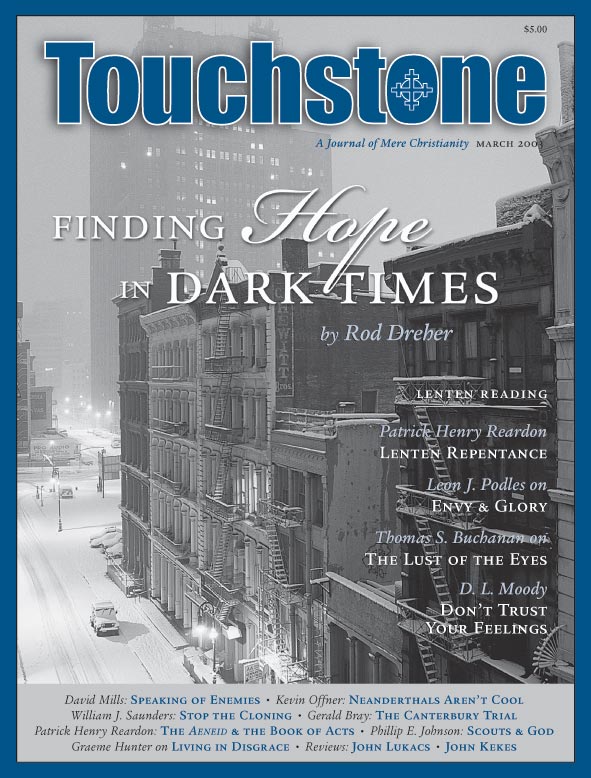
Neanderthals Aren’t Cool by Kevin Offner
Neanderthals Aren’t Cool
Kevin Offner on the “Gender Issue”
There’s no question about it: Today, if you hold to the traditional understanding
of men and women in the family and the church, you are “uncool.”
If you believe that God has assigned to men a unique calling to authoritative
leadership, where they alone are ordained in the church and they alone are to
be heads of their families, you will be seen as backward, fearful of change,
and a misogynist.
And (just between you and me) you probably hold the Neanderthal position you
do because you’re an insecure man who is frustrated over his loss of cultural
hegemony. Furthermore, either you aren’t married (it figures!) or your
wife (for surely you are male) is a shriveled doormat of a human being, who
has low self-esteem and wears heavy make-up to hide the welts where you have
beaten her.
The Uncool Christian
It really doesn’t matter to the cool people what kind of a traditionalist
you are. You might believe women bear the imago Dei and are deeply
loved by God, have been given spiritual gifts that they should be encouraged
to develop and use in their local churches, and are essential and valuable partners
in their families as wives and mothers. You might respect women, work in partnership
with women, and learn from women. But if you believe it is God’s (good
and gracious) will that men have been given certain unique positions of leadership
in church and family—even if you believe this leadership ought to be exercised
in a humble, servant-like fashion—the cool people will see you as anti-women.
It also doesn’t matter that your belief regarding the sexes has been
the normal position held by the majority of all people, everywhere, over all
of time, up until about A.D. 1960. For the current cultural propaganda brushes
aside all history before the rise of modern feminism as uniformly oppressive
to women. Ordered relationships between the sexes are to be outgrown just like
witchdoctors, horse-drawn carriages, and rotary telephones.
So what is an uncool Christian to do?
One wrong response is simply to lay low and never go public with your position
on this controversial topic. Just focus on your own private world and hope that
the differences in the public world will soon iron themselves out on their own.
Many conservative Christians today, especially men, under the guise of being
humble and “peacemakers,” are in reality cowards and people-pleasers.
Martin Luther said that the gospel is best heard at those places in the culture
where the battle rages hottest, and surely the sex and gender wars would qualify
here. We desperately need men and women today who won’t duck their responsibility
to bring truth front and center when arguing about how we should think about
being men and women in our ever-changing contemporary culture.
The second wrong response is to move into attack mode. It is foolishly thought
that the way to regain proper male leadership is by rejecting the challenges
outright and simply reasserting the traditional teaching (or your own version
of it). Just state the teaching, and assume that those who don’t agree
have nothing to say and cannot be changed. But belittling and accusing, rather
than listening and winsomely seeking to persuade, burns rather than builds bridges
between people.
Neither passivity nor attack will do. But I think there are at least four right
responses for those of us who hold the uncool position on male-female relations,
a position we are convinced is the orthodox one.
The Right Responses
First, we need to learn to be okay with not fitting in. Our concern for truth,
God’s glory, and, yes, our love for men and women, must be greater than
our desire to be liked and affirmed. We must ask God to make us courageous,
thick-skinned, and desirous of hearing his “Well done, my good and faithful
servant,” more than the applause of men. We need to grow up and learn
to live increasingly for an audience of One. Since when has fidelity to Christ
ever meant that a person would be liked and approved of by the majority?
Second, we must learn to empathize deeply from the heart with women who have
been in truly abusive churches and families. Of course, sometimes this “abuse”
is nothing more than living out the principle of a woman’s being under
a man’s authority, and for this we need feel no remorse. But in other
instances, the abuse is real: The wife whose attempts at submission were taken
advantage of by her husband with physical harm or intimidation; the single woman
who has let men pursue her, only to find herself treated like a piece of meat;
the godly older woman who faithfully attends church and humbly seeks to use
her gifts within that Christian community, only to be ignored or treated like
a child by male leaders who are young enough to be her children.
It is no secret that, over the 2,000-year history of the Church, men have sometimes
used their positions of authority in the church and the home to oppress those
under their care rather than to serve them. A high view of male leadership must
not turn a blind eye to the sins men have committed against women and must understand
that sometimes resistance to the traditional teaching comes from having suffered
under its corruption.
Oftentimes, men and women who reject the orthodox position on sexual order do
so not so much out of principle but simply because they have rarely seen male
leadership done well. As one feminist, to my surprise, told me over breakfast
recently, “If a man loved me the way Ephesians 5 describes Christ loving
the Church, I would submit to him in an instant!”
But to repent over past and present misuse of God-given authority is not the
same thing as eschewing that God-given authority altogether. The antidote to
bad male leadership is not no male leadership but good
male leadership. Have men in the past sometimes implemented God’s ordained
structures in their own self-interest and without regard for women? Then by
all means, let’s dedicate ourselves to doing it right—but let’s
not attempt to reinvent the whole structure from scratch in the meantime.
Have our younger male brethren sometimes acted like animals on a date? Then
let’s kick their behinds, offer strong corrective words of wisdom, and
encourage them to go to the phone, call Sally, and do it right the next time.
But we mustn’t let them think the lesson they are to learn is that male
initiative in dating, per se, is a bad thing.
We need to train our young men to become good leaders in the church and family,
and this will involve giving them some authority. But men must be given help
to see that true, godly authority is primarily about serving, not coercing.
Third, we need to know our Bibles. The novel biblical interpretations of the
egalitarians have been used so repeatedly and forcefully for forty years now
that we can easily assume they must therefore be correct. But we need to understand
how novel and eccentric they are. For example, only very recently has Genesis
1–3 been understood not to teach the headship of the husband before the
Fall (that is, as part of God’s created order); only very recently has
Ephesians 5:21 been understood to teach that all people are to be in “mutual
submission” to all other people; and only very recently has Galatians
3:28 been seen as the canon-within-the-canon of the Apostle Paul’s writings
on the places of men and women.
If the historic position on the sexes is in fact the correct one, we have nothing
to lose from researching the Scriptures more thoroughly. We must learn to respond
to bad exegesis, patiently and winsomely, with good exegesis, offering thoughtful
counter-interpretations of each of the biblical texts in question.
Two Bad Ideas
Fourth, we must understand that the challenge to the traditional understanding
of men and women in the Church grows from two strains in the modern American
worldview, and respond accordingly. (Many who embrace egalitarianism do so because,
having accepted certain philosophical assumptions, they can’t imagine
how the traditional perspective could possibly be good news for women.) The
contemporary American notion of freedom is wedded to two anti-biblical philosophical
presuppositions: individualism, which asserts that freedom and authority are
by nature incompatible; and nominalism, which asserts that to treat any individual
thing as part of a larger genus or nature inevitably detracts from its identity
and significance.
First, individualism: The radical, autonomous individualism that underlies almost
everything in our culture today insinuates that one is most free when he is
out from under any and all external authority. Whether that authority be the
State, the Church, the Bible, or even God himself, the very fact that it remains
in some sense external to the individual is seen as, by definition, restrictive.
If the human being is the measure of all things, then any formulation of right
outworking between the sexes that includes positions of authority will be suspect.
The very thought that a woman could be most free and flourishing, reaching her
greatest potential as God’s image-bearer and using her gifts to the utmost,
when she is under certain God-appointed male authorities, is counter-intuitive
to the modernist American mindset. If by very definition freedom means anti-authority,
why would anyone want to embrace ordered relations between the sexes?
And yet, as orthodox Christians we know something of the paradox of Christian
ethical teaching here. One is most free when he is in submission to
God, and one way we practically work out our submission to God in the real world
of physicality (for we are not gnostics) is by submitting to those people whom
he has placed in authority over us.
The second modern philosophical commitment that shapes our thinking is nominalism.
The nominalist worldview is so pervasive in America today, and so taken for
granted that, like the air we breathe, it has virtually become invisible to
our consciousness. This is the notion that individual, particular things are
the highest level of identity, and any collection of individuals into a subset
under a larger genus or nature inevitably takes away from the individual’s
identity and significance. To speak of human beings as a genus, having certain
needs or traits, having a common human “nature,” being different
as a group from animals, and so on, inevitably (so it is thought) denigrates
the individual. “Well, most people might be like that, but I,
you see, am different. I’m not like everyone else.”
When the notion that the particular is always more significant than the genus
becomes part of our worldview, to speak of “men” and “women”
as two distinct classes of human beings created by God, inevitably seems to
limit and oppress them. “Most men might be protective by nature, or called
to lead, but I am different. . . . Most women might
be drawn to marriage and motherhood by nature but not me. . . .
Don’t squeeze me into your male-ness or female-ness mold. In fact, I’d
feel more alive as a person if you didn’t think of me as either male or
female—just as the unique, particular ‘me’ that I am! Look
at me in my unique, particular giftedness, and not under the boring, uniform
category of ‘man’ or ‘woman’!”
Of course a sense of balance is needed here, for it is possible to overemphasize
genus to the detriment of the individual. Like so many things in life, the key
here is to stress “both/and” rather than “either/or.”
A female human being is a woman, not a man, but she is also the particular woman
“Susan Smith,” not generic “woman.”
If God has created two (not one or three) sexes for a reason, then we only
become fully human—fully fulfilled in our individual particularities—when
we seek to live out, rather than to oppose, the specific nature of our sex.
If God intends our humanity not to be diminished, but actually enhanced, by
creating any one of us male-and-not-female or female-and-not-male, it behooves
us to take great joy in living life consciously and intentionally as the man
or woman that we are.
How should we respond to those who, however unwittingly, have bought into one
or both of these errant philosophies? We must, I think, begin with the positive.
We must show that we sincerely and passionately agree with the importance of
affirming human freedom and the integrity of the individual. We, too, want men
and women to flourish and become all that God intends them to be.
But then we must go on to show that one’s personal freedom is actually
enhanced when one humbly submits to God-given human authorities and when one
submits to the limitations and idiosyncrasies of his or her own God-given sexual
nature. And we ought to show what happens when one lives out individualism and
nominalism, to show how the Christian ordering of the sexes offers true liberation
for the individual.
Ordered Equality
Though it is “uncool” to be a sexual traditionalist, I believe that
we should passionately promote the church’s historic, orthodox position
of “ordered equality” between the sexes in the church and the home,
not only because it is true but also because it is good. When men lead in their
churches and homes with a God-given authority that sacrificially serves those
placed under their care, and when women submit to this God-given authority with
joy and discernment, both men and women will flourish.
All of God’s rules were given for our good, and we are most free when
we are most obedient. God loves us, and he knew what he was doing when he created
us in his image as male and female. Ordered equality is good news for both men
and women. And therefore, it’s also pretty cool.
Kevin Offner is on the staff of InterVarsity Christian Fellowship. He has written for Re:Generation Quarterly, Critique, Student Leadership Journal, and First Things. He lives in Washington, D.C., with his wife Amy. They are members of the Presbyterian Church in America. He is a contributing editor for Touchstone. |