|
|
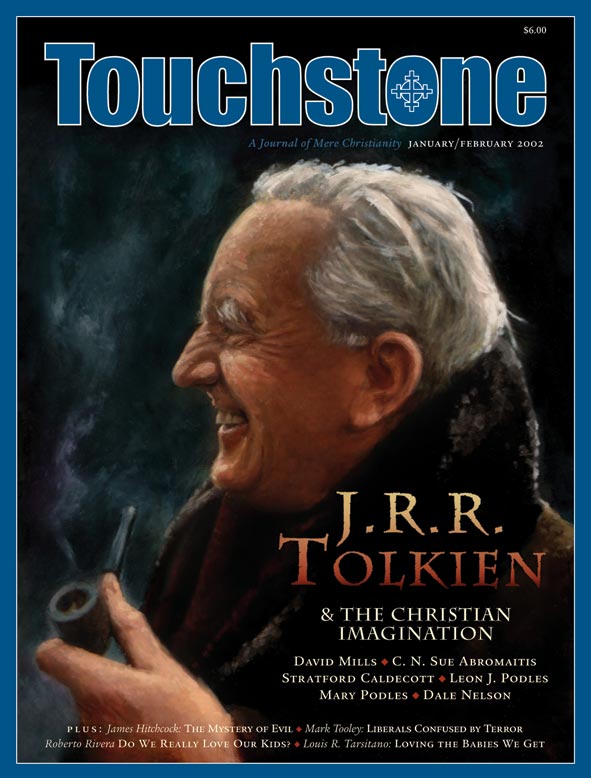
Touchstone: A Journal of Mere Christianity “The Distant Mirror of Middle-Earth” first appeared in the January/February 2002 issue of Touchstone. The Distant Mirror of Middle-EarthThe Sacramental Vision of J. R. R. Tolkien by C. N. Sue Abromaitis Most notable about J. R. R. Tolkien’s books is the imagination that created their world. Tolkien himself reflects upon the use of the creative imagination, believing that man, made in God’s image and likeness, shares in the work of God’s creation. At the same time Tolkien is quite aware of his being in a fallen world, one in which he is working against the zeitgeist. This spirit of the age permeates the artistic depiction of man as the inevitably alienated stranger. The presumption of the age is, in a certain sense, a mixture of two apparently opposed concepts of the real: materialism, reducing all of reality to that which is sense perceptible, and gnosticism, positing a spiritualistic reality available only to the illuminati. Both mainstream and avant-garde artists and critics adhere to a vision of the world that is materialistic and/or gnostic. Their work essentially denies meaning and harmony, assumes that nothing can be known with certitude, and apotheosizes the self-consciously absurd, nihilistic, hedonistic, anti-heroic, deterministic, and downright ugly. Ranged against this horror is the sacramental vision that imbues Tolkien’s work, sacramental because Tolkien still sees reflected in the fallen world and its creatures the manifestation of God’s love for man. He believes that all who will open themselves to the epiphanies that surround them can experience this goodness. Fairy Stories & Fantasy Tolkien’s literary theory and practice affirm the glorious reality of the world created by God and sees in the beauty of creation proof of the hallowed nature of man. But fallen man needs imagination to perceive this hallowed nature. Tolkien creates his literature to aid that perception. He admits that “one object” of his literary creation is
In one of Tolkien’s major theoretical works, the 1947 essay “On Fairy-stories,” he describes the four marks of the fairy story in which “unfamiliar embodiments” can help “bring home” such truth and good morals. The first mark is fantasy. He uses the word to mean “both the Sub-creative Art in itself and a quality of strangeness and wonder in the Expression, derived from the image.”2 “Fantasy is a natural human activity,” Tolkien concludes.
Even as Tolkien defends fantasy as a good thing, he does not ignore the evil uses to which it may be put or its ability to delude the writer or the reader. In another context he comments that
His fantasy is neither ill nor evil nor delusive because he sees his art as an expression of man’s sacramental nature. He is using his God-given faculties by imitating God in making. He asserts that this secondary creation is a good act “because we are made: and not only made, but made in the image and likeness of a Maker” (Tree 55). Thus, his aesthetic is informed with the universal moral law even as he praises the goodness of him who created nature. Recovery & Escape Similarly, in his explanation of recovery, the second mark of fairy stories, Tolkien’s belief in objective reality that means itself and at the same time is a sign of something else is apparent.
These same premises are apparent in his discussion of the third quality, escape. Tolkien defends it against the critics who disapprove of escape in literature by contending that he is speaking not of “the Flight of the Deserter” but of “the Escape of the Prisoner” (Tree 60). And the prison that he would have his readers escape is “the Robot Age, that combines elaboration and ingenuity of means with ugliness, and (often) with inferiority of result” (Tree 61). Tolkien comments that there is an attempt to escape from this ugly world in the stories of “Scientificition”; however, what these “prophets” create are worlds of “improved means to deteriorated ends” (Tree 64). Without an authentic teleology, theirs is an escape without a destination. Moreover, although modern man recognizes that “the ugliness of our works, and of their evil” is something to flee, this too often results in a serious misconception about beauty. We believe that evil and ugliness are “indissolubly allied. We find it difficult to conceive of evil and beauty together. The fear of the beautiful fay that ran through the elder ages almost eludes our grasp. Even more alarming: goodness is itself bereft of its proper beauty” (Tree 65). Tolkien points out that the healthy perception that beauty can lead man to hell has been lost in the modern world. The dreadful result of that loss is apparent in the deformed morality that pervades the modern age: If something seems beautiful and, therefore, arouses my desire, it must be good for me to have it. Joy & the Gospel Tolkien’s analysis of the meaning and nature of the particular aesthetic embodiment of imagination in the fairy story is informed by a consistent rejection of the vulgarity of solipsism and relativism. These reflexes cause modern man to reject his sacramental nature. This rejection, in turn, accounts for the barrenness and joylessness so evident in modern art. In contrast, as his discussion of the final mark of the fairy story makes clear, Tolkien emphasizes transcendent joy. He asserts that “the Consolation of the Happy Ending”—what he called eucatastrophe—“is the true form of fairy-tale, and its highest function” (Tree 68). He then explains:
This “sudden joyous ‘turn,’” he continues, “does not deny the existence of dyscatastrophe, of sorrow and failure: the possibility of these is necessary to the joy of deliverance.” Instead, “it denies (in the face of much evidence . . .) universal final defeat and in so far is evangelium, giving a fleeting glimpse of Joy, Joy beyond the walls of the world, poignant as grief.” In the Epilogue to the essay, Tolkien explicitly connects the Gospels with fairy stories. “The Gospels contain a fairy-story, or a story of a larger kind which embraces all the essence of fairy-stories,” he writes.
Just as Pope John Paul II’s encyclical Fides et Ratio4 insists that reason can only find its fulfillment in Revelation,5 so Tolkien insists that art can only find its fulfillment in Revelation: The gospel “is supreme; and it is true. Art has been verified” (Tree 72). Just as it is an inherent principle of creation that finite man use his reason, so also does man’s telling stories flow from the nature of creation:
Such enrichment of the primary world is a great achievement. In reading Tolkien’s works, particularly The Lord of the Rings, one senses that his artistry and faith have succeeded in kindling and rekindling, resulting in his writing a story that enriches primary creation. A Secondary Real World One of the ways in which Tolkien achieves this effoliation of reality is by situating the events of the book within a secondary world that is true to its mythic self even as it conforms in all important ways with the primary creation that provides the trilogy with its rock and stone, water and air, earth and tree, men and other reasoning beings. He begins the book with a prologue that explains the background for the story in The Red Book of Westmarch and, in so doing, adds to the consistency of the work by setting it within a history.6 Allusion to records and histories is not unique in this passage.7 His work is filled with poems that tell of events in a variety of pasts upon which characters reflect. In one of the most moving passages in the book, Frodo, the hero, and his loyal companion, Sam, are sitting exhausted, outside the tunnel through which they must travel to continue their journey to the Crack of Doom, the only place in which the Ring may be destroyed. Their conversation reveals just what a tale means to them. Frodo says that the place seems accursed, then adds, “But so our path is laid.” Sam agrees and says:
These comments occur, of course, in this imagined narrative; at the same time, they have significance that transcends the imagined world. These mythic characters are dealing with the most essential things that all men must confront: fate and free will, victory and defeat, virtue and vice. Moreover, their conversation reinforces a fundamental theme in Tolkien’s work: What is occurring is part of a story, and the story goes on after that part has ended. After the destruction of the Ring, as Frodo and Sam await what seems to be sure death, Sam speaks:
Borne out here is Tolkien’s conviction that “there is no true end to any fairy-tale” (Tree 68). The Real Hobbit The stories in these passages are presented as if they were history, a record of human action, important because the actions of rational beings made in the image and likeness of God have eternal significance. This same sense of the high dignity of the person is behind Tolkien’s careful attention to psychological verisimilitude. The devising of seeming truth is necessary because in a fantasy the writer must convince the reader that the secondary world with its characters is real. Tolkien adapts most of his characters from traditional lore, and he stays true to the mythic ethos that each has. Moreover, he creates his own mythic rational being: “In a hole in the ground there lived a hobbit. Not a nasty, dirty, wet hole, filled with the ends of worms and an oozy smell, nor yet a dry, bare, sandy hole with nothing in it to sit down on or to eat: it was a hobbit-hole, and that means comfort.”8 In this description of Bilbo’s home, Tolkien makes sure that the reader recognizes the uniqueness of this being, this Halfling (The Hobbit 10). All who meet Hobbits, whether Wizards, Elves, Ents, Dwarves, Orcs, Men, Barrow-wights, Nazgul, even Sauron, are surprised by their valor. Gandalf says, “Hobbits really are amazing creatures, as I have said before. You can learn all that there is to know about their ways in a month, and yet after a hundred years they can still surprise you at a pinch” (FR I:2, 72). That many underestimate them because of their love of comfort gives rise to one of the many themes of the novel: “It is shown that looks may belie the man—or the halfling” (RK V:1, 28). The themes that arise from the events of the novel are recognizably human. For example, Tolkien depicts the allure of evil even for those who would be virtuous. When Gandalf the Wizard asks Bilbo if he intends to keep his promise to leave the Ring, the central symbol of evil, to Frodo, Bilbo answers in an uncharacteristic manner:
After further struggle with Gandalf, an externalization of his psychomachia, Bilbo surrenders the Ring: “A spasm of anger passed swiftly over the hobbit’s face again. Suddenly it gave way to a look of relief and a laugh” (43). Here Tolkien gives a foreshadowing of what occurs in the climax of the book when Frodo stands at the Crack of Doom: “‘I have come,’ he said. ‘But I do not choose now to do what I came to do. I will not do this deed. The Ring is mine!’” (RK VI:3, 223). And just as Bilbo, when he surrenders the Ring, is restored to himself, so too Frodo, once the Ring is lost, is restored: “In his eyes there was peace now, neither strain of will, nor madness, nor any fear. His burden was taken away” (224). In a letter written in 1963, Tolkien comments on the significance of Frodo’s failure, saying that “it became quite clear that Frodo, after all that had happened, would be incapable of voluntarily destroying the Ring.”9 Tolkien says that “Frodo indeed ‘failed’ as a hero,” but insists that this was not “a moral failure” because “Frodo had done what he could and spent himself completely (as an instrument of Providence) and had produced a situation in which the object of his quest could be achieved.”10 Frodo had begun this negative quest humbly: “I do really wish to destroy it. . . . Or, well, to have it destroyed. I am not made for perilous quests. I wish I had never seen the Ring! Why did it come to me? Why was I chosen?” (FR I:2, 70). Because of this humility “and his sufferings . . . [Frodo was] justly rewarded by the highest honour; and his exercise of patience and mercy towards Gollum gained him Mercy.”11 Not only do his comments to Sam as their terrible journey proceeds foreshadow his failure, they also reveal this humility and suffering:
The Maker’s Pattern & Merciful Wisdom In the 1963 letter, cited above, Tolkien adverts to two other themes: first, that behind all events there is a pattern and a Maker of that pattern. Fourteen years after Bilbo’s party and disappearance and nine years after his last visit, Gandalf reappears and tells Frodo the significance and history of the Ring. After characterizing Bilbo’s finding the Ring as “the strangest event in the history of the Ring so far,” Gandalf continues:
The second theme is that men are to be merciful to each other. Frodo’s mercy enables the destruction of the Ring to occur even at the moment when it looks as if the negative quest has failed. But before he undertakes his quest, Frodo does not feel mercy toward Gollum. When he hears the tale of his contest with Bilbo under the earth (The Hobbit 79–100), Frodo says to Gandalf, “What a pity that Bilbo did not stab that vile creature, when he had a chance? . . . He is as bad as an Orc, and just an enemy. He deserves death.” Gandalf’s reply is one of the richest thematic passages in the trilogy:
Free will, consequences, sin, virtue, hope, and the wisdom of the heart are the threads that constitute the thematic fabric of this passage. That Frodo has embraced Gandalf’s wisdom because of his suffering is apparent in the scene in which he finally meets Gollum face to face. Frodo rescues Sam from Gollum’s grasp by threatening to cut his throat, and Gollum begs for his life. After Frodo recalls Gandalf’s earlier words, he says to Sam, “I am afraid [of Gollum’s villainy]. And yet, as you see, I will not touch the creature. For now that I see him, I do pity him” (TT IV:1, 221–222). Later, this pity and a sense of comitatus cause Frodo to save Gollum from a just death at the hands of Faramir and his men, warrior-hunters. Frodo goes to the forbidden pool to fetch Gollum, who thinks he is alone and does not know that his being in this place is punishable by death:
Moreover, after bringing Gollum to Faramir, Frodo saves his life by taking him under his protection (TT IV:6, 300). Places of Evil In all of these events Tolkien carefully constructs the various figures in the book so that their actions are consistent with their moral character. This psychological verisimilitude adds to the sense of significance of the thousand-plus pages of the book. Verisimilitude is also present in the kinds of languages that characters speak, their names, the places in which they live. Tolkien’s appendices at the end of The Return of the King, which deal with many subjects—including genealogy, etymology, and chronology—also contribute to the sense of reality. They contribute to the reality of the secondary world of Middle-earth by their prosaic quality. For example, in his appendix, “On Translation,” Tolkien says,
This passage is typical of the appendices in its scholarly scope, its assumed factualness, and its focus on a linguistic issue that a reader interested in a period would want to have analyzed. It is a veritable tour de force in its assumption that in this book is a secondary world that the sub-creator, the author, allows the reader to enter. Verisimilitude in describing places has profound thematic significance in the book. The readers accept the reality of the geography and see how the places in the book are emblems of the morality of the beings who live within them. The ultimate sign of evil is Sauron’s Mordor:
Anti-life and hate-filled, Mordor embodies the nature of the being who has shaped it, Sauron, the Shadow, the Dark Lord, who himself is bodiless except for his “piercing Eye” (e.g., RK VI:3, 220). Mordor is the outward sign of the inward gracelessness of its ruler and his subjects. A Land Without Shadow Two places that are clearly beautiful and express the goodness of those who live within them are the Hobbits’ Shire and the Elves’ Lorien. The Shire is a place with rows of pleasant hobbit-holes, gardens, inviting lakes, flowing rivers, avenues of trees, fertile farms, clean air, good rain, ample sun, cleansing snow. However, in The Hobbit, the reader is aware that it is not Eden. Thus, the dreadful reign of Sharkey—Saruman—is made possible by Hobbits who cooperate with evil, thinking that they can control it.12 When the four Hobbits return from their adventures, they find it fouled. Frodo arrives at his former home, Bag End, to gardens full of weeds and built over, blocked light, “piles of refuse,” a “scarred” door, and a “bell that would not ring. . . . The place stank and was full of filth and disorder: It did not appear to have been used for some time” (RK VI:8, 297). Frodo calls this pollution in the Shire, “Mordor . . . just one of its works” (297). After the evil forces are routed from the Shire, the Hobbits rebuild and replant. Sam carefully puts “saplings in all the places where specially beautiful or beloved trees had been destroyed, and he put a grain of the precious dust [that Galadriel had given him so many months before in the land of the Elves] in the soil at the root of each” (RK VI:9, 303). “Altogether [the year following] . . . was a marvelous year” (303). This marvel is clearly connected with the elvish gift that Sam uses to benefit all in the Shire. For everything that is connected with the Elves is beautiful, and perhaps in no other creation of Tolkien’s imagination is his sacramental vision more apparent. Lothlorien, the home of Queen Galadriel, is fair: “Evil had been seen and heard there, sorrow had been known; the Elves feared and distrusted the world outside: wolves were howling on the wood’s borders: but on the land of Lorien no shadow lay” (FR II:6, 364). It is a place of trees, flowers, green hillsides, blue sky, afternoon sun, stars, fragrance, a place in which
Foretaste of Redemption In this place the desires described by Tolkien in his discourse on fairy stories come true. And yet, an elegiac tone moves through all things elvish. When the Ring is destroyed, if it is destroyed, they must leave Middle-earth, a grievous leaving. Galadriel tells Frodo:
Explicit here is the painful condition of fallen man: Even when he creates a goodly place in this world that he loves, it will pass away. That it does in no way diminishes its importance or significance. Rather, at the end, the lesser yields to the greater. And at the end of the book, Tolkien has Frodo tearfully leave the restored Shire: “I have been too deeply hurt, Sam. I tried to save the Shire, and it has been saved, but not for me” (RK VI:9, 309). He leaves with Elrond and Galadriel,
After farewells to Sam and Merry and Pippin,
The natural and the homely, high gifts that Frodo so loved that he gave himself to save them, recall to man his roots in Eden even as they prefigure the ultimate gifts that Frodo experiences in his destination beyond Middle-earth. Tolkien embodies in his story a message of joy, of evangelium: That which is beautiful here is a foretaste, a sign, a sacramental of the ineffable that awaits those who serve. He achieves through his narrative what he contends at the conclusion of his essay “On Fairy-stories”:
Notes: 1. J. R. R. Tolkien, The Letters of . . . , ed. Humphrey Carpenter (Boston: Houghton Mifflin Co., 1981), 194. This is an excerpt from a draft of a reply to criticism of his work by Peter Hastings, the manager of the Newman Bookshop in Oxford dated September 1954 (187–188). Tolkien marked at the top of the draft “Not sent” and commented that “It seemed to be taking myself too importantly” (196). 2. J. R. R. Tolkien, Tree and Leaf (London: George Allen & Unwin Ltd., 1965), 47. All citations to the work in the text are from this source and will be indicated by “Tree” and the page number. The essay was originally composed as an Andrew Lang Lecture and was in a shorter form delivered in the University of Saint Andrews in 1938. It was eventually published, with a little enlargement, as one of the items in Essays presented to Charles Williams, Oxford University Press, 1947, now out of print. It is here reproduced with only a few minor alterations (Leaf vii–viii). 4. I am indebted to Father Stephen M. Fields, S.J., for his paper “Nature and Grace After the Baroque,” in which is his clear elucidation of Pope John Paul II’s assessment of the relationship between reason and faith, the natural and the supernatural. Presented at the biennial Jesuit Conference on the thought of John Paul II, Xavier University, Cincinnati, August 2000, it will be published by Fordham University Press, in a volume edited by John J. Conley, S.J., and Joseph W. Koterski, S.J. 5. John Paul II, Encyclical Letter Fides et Ratio: On the Relationship between Faith and Reason (Boston: Pauline Books and Media, 1998), chap. II, section 17, p. 30. 6. J. R. R. Tolkien, The Fellowship of the Ring in The Lord of the Rings, 2nd edition (Boston: Houghton Mifflin Co., 1965), 10. All citations to the book are taken from this edition: The Fellowship of the Ring—FR; The Two Towers—TT; The Return of the King—RK; with Book: chapter, page numbers. 7. See, for example, RK VI:7, 295. 8. J. R. R. Tolkien, The Hobbit (Boston: Houghton Mifflin Co., 1966), 9. First published September 21, 1937. 12. Frodo’s comments about Lotho as the Hobbits “scour” the Shire reveal his understanding of how people (Hobbits, in this case) can be corrupted by thinking they cannot lose power as they do evil (RK VI:8, 297). This article is adapted from a longer paper presented at the 2001 conference of the Fellowship of Catholic Scholars, held in Omaha, Nebraska, in September 2001. C. N. Sue Abromaitis is Professor of English at Loyola College in Baltimore, Maryland. “The Distant Mirror of Middle-Earth” first appeared in the January/February 2002 issue of Touchstone. If you enjoyed this article, you'll find more of the same in every issue. Letters Welcome: One of the reasons Touchstone exists is to encourage conversation among Christians, so we welcome letters responding to articles or raising matters of interest to our readers. However, because the space is limited, please keep your letters under 400 words. All letters may be edited for space and clarity when necessary. letters@touchstonemag.com This page and all site content © 2015 by The Fellowship of St. James. All rights reserved. Please send comments, suggestions, and bad link reports to webmaster@touchstonemag.com. |