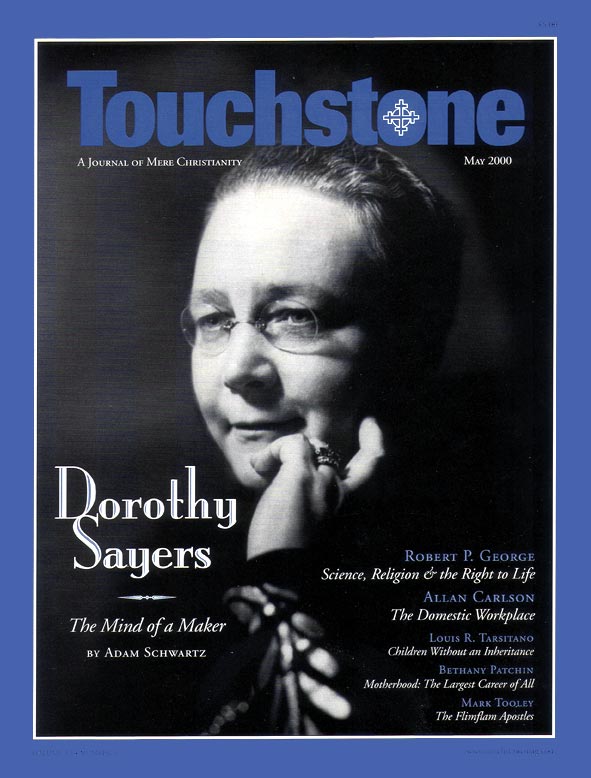
The Mind of a Maker
An Introduction to the Thought of Dorothy L. Sayers Through Her Letters
by Adam Schwartz
C. S. Lewis told Dorothy L. Sayers that “you are one of the great English letter writers,” and he then created a mock eulogy for her: “It is often forgotten that Miss Sayers was known in her day as an Author. We who have been familiar from childhood with the Letters can hardly realize! . . .”1 With the steady publication since 1995 of Sayers’s letters, Lewis’s jest can now be put to the test.
Dorothy L. Sayers (1893–1957) was the most significant female British Christian intellectual of the twentieth century. As a pioneering detective novelist and mystery theorist, a path-breaking playwright, a piquant translator of and commentator on Dante, an incisive apologist, an underappreciated poet, and a mordant literary and social critic, she made a substantial impact on nearly as many fields as G. K. Chesterton or C. S. Lewis. Sayers discussed all these matters at length in her letters.
Happily, there is no need to choose between her published writings and her epistles. Rather, her letters complement Sayers’s efforts in other genres, and the combination is a weighty body of thought that deserves more widespread and serious critical attention than it commonly receives.2 Her published letters enrich understanding of Sayers’s life and deepen comprehension of her intellectual and creative development.
The publication of Sayers’s letters also provokes reflection on her seminal contribution to twentieth-century British thought and culture. What her letters highlight most clearly is the coherence of her outlook. Certain key themes pervade her letters and undergirded her output in diverse genres: a commitment to Catholic Christianity, a belief in the sanctity of work, a devotion to intellectual integrity and vitality, a disdain of sentiment, and a sturdy Christian realism that made her suspicious of many central tenets of modern culture.
Precocious Child, Troubled Adult
Dorothy L. Sayers was born at Oxford in 1893, the only child of an Anglican clergyman and his wife. Henry Sayers accepted a living in East Anglia four and a half years later, so his daughter grew up within the walls of Bluntisham Rectory. A precocious child, Dorothy received extensive tutoring from her father and governesses, beginning Latin lessons at age six and eventually learning French and German too, while also absorbing much classic European literature.
The transition from this happy and stimulating home to English boarding school life was not smooth. Sayers entered the Godolphin school in January 1909 and, like many intellectuals of her generation, she believed that she was considered a “weird freak” by her classmates (1:46). Her letters to her parents are punctuated by frequent expressions of homesickness and boredom, a general tedium relieved by theatricals, excursions, and visits from relatives. On the whole, she was not sorry to see her tenure at Godolphin end when illness caused her to return home in December 1911.
After a few months of recuperation and private study, Sayers went up to Sommerville College at Oxford (to which she had won a Gilchrist Scholarship) in October 1912. Despite some initial homesickness, by 1913 Sayers was confessing a longing for Oxford during a vacation spent at Bluntisham. Whereas she had felt bored and out of place at Godolphin, Sayers flourished both academically and socially at Oxford, earning a First Class degree and attending a steady stream of parties and outings. Oxford would always have a totemic place in Sayers’s imagination (as revealed most powerfully in her finest novel, Gaudy Night), and she found it hard to leave upon graduation in 1915. She pined for Oxford during an unsatisfactory period of teaching in Hull, and returned to it in 1917 to work as a publisher’s apprentice for Basil Blackwell.
By 1919, though, she was dissatisfied with this post, lonely, and in need of “an absolute change of everything,” which prompted her to spend a year in France assisting at a school (1:153). By 1920 she was back in Britain, and following two years of teaching, tutoring, translating, and beginning work on two detective novels, Sayers joined S. H. Benson’s advertising agency in May 1922. Although grateful for the steady work, Sayers thought of herself as primarily an author by this time and yearned to devote more time to writing. It would nevertheless be seven and a half years before she was able to live by her pen.
Adam Schwartz is Assistant Professor of History at Christendom College.
A Journal of Mere Christianity—Delivered to Your Door
- Essays on theology, culture, and the Church
- Contributors from across the Christian traditions

Six print issues (one year) of Touchstone, plus full online access and PDF downloads for only $39.95.

Get a one-year full-access subscription to the Touchstone online archives for only $19.95.
bulk subscriptions
Order Touchstone subscriptions in bulk and save $10 per sub! Each subscription includes 6 issues of Touchstone plus full online access to touchstonemag.com—including archives, videos, and pdf downloads of recent issues for only $29.95 each! Great for churches or study groups.
Transactions will be processed on a secure server.
more on Literature from the online archives

more from the online archives
calling all readers
Please Donate
"There are magazines worth reading but few worth saving . . . Touchstone is just such a magazine."
—Alice von Hildebrand
"Here we do not concede one square millimeter of territory to falsehood, folly, contemporary sentimentality, or fashion. We speak the truth, and let God be our judge. . . . Touchstone is the one committedly Christian conservative journal."
—Anthony Esolen, Touchstone senior editor