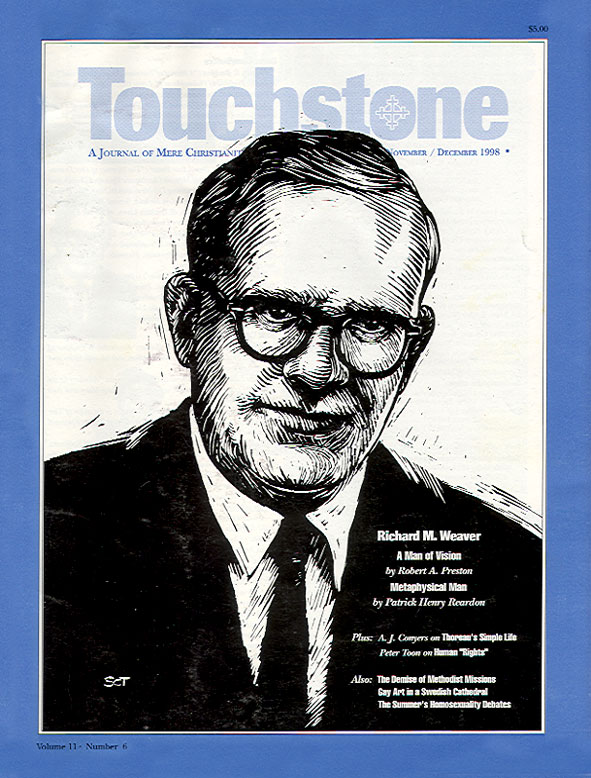
A Metaphysical Prophet by Patrick Henry Reardon

A Metaphysical Prophet

When the turmoil of this century’s final decade has at last been reduced to a memory, it is my personal hope that, of all the works published in these recent days, the most influential will prove to be Fides et Ratio, this year’s encyclical of Pope John Paul II, calling for a strenuous renewal of philosophy along the ancient lines bequeathed us by the philosophia perennis et universalis. Should that hope prove to be justified, let me further suggest, the intellectual life of our children will see a large improvement over the modern world’s morass of subjectivism, relativism, utilitarianism, pragmatism, skepticism, and (to use the Holy Father’s own expressions) “caprice,” “undifferentiated pluralism,” and “lack of confidence in truth,” even to the point that “everything is reduced to opinion” and “many people stumble through life to the very edge of the abyss without knowing where they are going.” Decrying our modern forfeiture of the traditional “core of philosophical insight” that should provide the foundation and structure for a stable social order, the pope ascribes our great loss largely to an excessive and unhealthy preoccupation with critical epistemology and reductionist linguistics in recent times.

Now it is singularly curious (and we hope will also be providential) that this caution and exhortation were solemnly expressed by so high and revered an authority during 1998, the jubilee anniversary of two other publications that had given voice to these identical concerns back in 1948. One of those works was Leisure: The Basis of Culture, by Josef Pieper, an eminent German Thomist. The other was Ideas Have Consequences, the first published book of Richard M. Weaver, then an almost unknown professor of undergraduate English at the University of Chicago. Both of these books this editor of Touchstone regards as absolutely de rigeur, essential reading—even rereading—for anyone anxious to preserve the life and health of the mind in these days of its terrible trial. (For quite different reasons, by the way, the same imperative seems pertinent also to yet another book that appeared in 1948, Thomas Merton’s The Seven Storey Mountain.)

We at Touchstone are not alone in holding such sentiments with regard to these books. For instance, this year St. Augustine’s Press published a jubilee edition of Pieper’s very important and still timely work, while the fiftieth anniversary of Weaver’s volume prompted more than a hundred philosophers, jurists, literary artists, journalists, and scholars to gather this past spring at Belmont Abbey College in North Carolina to consider the abiding significance of his piercing critique of modern philosophy and contemporary culture. The papers from that conference, delivered by the likes of George H. Nash, M. Stanton Evans, Marion Montgomery, Lawrence Prelli, and others, are appearing at the end of this year in the volume Steps Toward Restoration: The Consequences of Richard Weaver’s Ideas, edited by Ted Smith III. Then, during this past October the Indianapolis-based Liberty Fund joined with the Intercollegiate Studies Institute to sponsor a graduate colloquium on “Liberty, Society, and the Individual in the Social Thought of Richard M. Weaver” in Savannah. Moreover, this jubilee of Weaver’s book was celebrated during the year by articles on him in various periodicals, very recently in The Sewanee Review and Modern Age.

In spite of the considerable secondary literature devoted to the thought of Richard Weaver over the past half-century, it is likely that the best is yet to come. Ted Smith’s biography of him, for example, is still eagerly awaited, even more eagerly by those of us who heard his stimulating lecture at the conference in North Carolina this past spring. Smith himself was evidently able to obtain a trove of original Weaver manuscripts and other archival material from the late author’s family, including notebooks and letters. It is to be expected that in due course this material, or much of it, will see publication, thus becoming the object of yet further study. Before many years more have passed, Professor Smith will have made great debtors of us all.

Though some lines in this edition of Touchstone will seem to repeat ideas identical to those contained in the opening pages of the pope’s new encyclical, especially its clarion call for a return to the healthy lines of classical metaphysics, our echo of papal teaching here is not exactly intentional, for we had all along resolved not to let this jubilee year lapse without giving some attention to the thought of Richard Weaver, particularly his treatment of the many social and cultural aberrations necessarily consequent to the modern loss of classical metaphysics. Thus, we are happy to present in the following pages the opening lecture of that North Carolina conference, delivered by Dr. Robert Preston, the President of Belmont Abbey College, as well as an article with some of my own reflections on Weaver, particularly with respect to language. Three recent books about Weaver, two of them somewhat biographical, are likewise reviewed in our Book Review section.

Touchstone is not treating Weaver as a proponent of Lewis’s Mere Christianity. What he called “The Older Religiousness of the South” Weaver regarded as one of that region’s greatest cultural strengths, but those who knew him best seem to disagree somewhat about the level of his explicit commitment to classical Christian orthodoxy. That hard question we will leave to the God who reads hearts. For our part, we are content to learn from Weaver’s deep convictions concerning transcendent truth and its absolute claims on the human mind, his persuasion of man’s radical responsibility to seek that truth in freedom, and the grave concerns for the future of humanity arising from his critical observation of our crass modern materialism.

For all that, many aspects of Weaver’s thought will not be developed in these few pages: much of his teaching on language (The Ethics of Rhetoric and Language is Sermonic), his college stylistic grammar (Composition: A Course in Writing and Rhetoric), his two posthumous books on Southern culture (The Southern Tradition at Bay and The Southern Essays), his later essays of social criticism (Visions of Order and Life Without Prejudice), and the projected “comparative lives” of Southern and Northern leaders, on which he was working when a heart attack cut short his fruitful life on April 3, 1963.

We hope at least, however, to suggest here some of the reasons shaping our impression of his almost prophetic importance in these times. Listening to the voices of our own troubled century to discern whatever things are true, whatever things are noble, whatever things are just, whatever things are pure, whatever things are lovely, whatever things are of good report—if there is any virtue and if there is anything praiseworthy—most eloquent to our ears and highly wise to our hearts seems the message of Richard Malcolm Weaver.

—Patrick Henry Reardon

Patrick Henry Reardon is pastor emeritus of All Saints Antiochian Orthodox Church in Chicago, Illinois, and the author of numerous books, including, most recently, Out of Step with God: Orthodox Christian Reflections on the Book of Numbers (Ancient Faith Publishing, 2019).

A Journal of Mere Christianity—Delivered to Your Door

  • Essays on theology, culture, and the Church
  • Contributors from across the Christian traditions
Subscribe (Print + Online)

Six print issues (one year) of Touchstone, plus full online access and PDF downloads for only $39.95.

Subscribe (Online Only)

Get a one-year full-access subscription to the Touchstone online archives for only $19.95.


bulk subscriptions

Order Touchstone subscriptions in bulk and save $10 per sub! Each subscription includes 6 issues of Touchstone plus full online access to touchstonemag.com—including archives, videos, and pdf downloads of recent issues for only $29.95 each! Great for churches or study groups.

Transactions will be processed on a secure server.


more from the online archives

23.2—March/April 2010

Job’s Progress

on Maturity for a Rising Generation by Peter J. Leithart

24.5—Sept/Oct 2011

Pupils Delighted

on Wondering or Wandering Through College Education by Anthony Esolen

21.4—May 2008

Attention Deficit

on the Absence That Ritalin Can’t Cure by Bruce D. Woodall

calling all readers

Please Donate

"There are magazines worth reading but few worth saving . . . Touchstone is just such a magazine."
—Alice von Hildebrand

"Here we do not concede one square millimeter of territory to falsehood, folly, contemporary sentimentality, or fashion. We speak the truth, and let God be our judge. . . . Touchstone is the one committedly Christian conservative journal."
—Anthony Esolen, Touchstone senior editor

Support Touchstone

00