





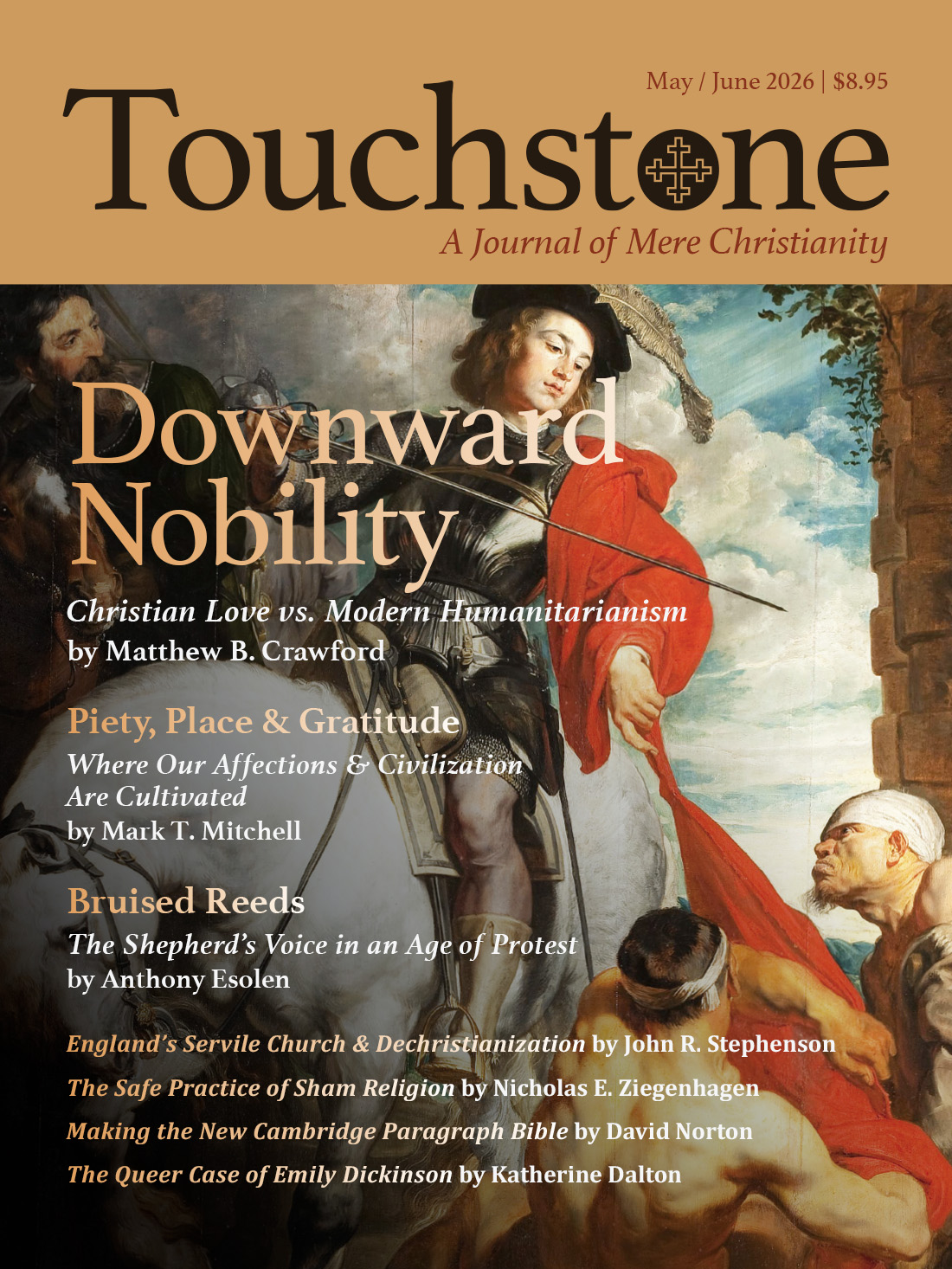
Downward Nobility
Christian Love vs. Modern Humanitarianism
The pre-eminent political question in Europe is mass immigration. Those who regard borders as morally illegitimate generally do so as humanitarians. Humanitarianism looks, from a certain angle, like Christian love. Accordingly, many young right-wingers who object to what they see as a flood of reverse colonization from the “Global South” have begun to suspect that Christianity is at the root of our problems. In this, they are able to invoke Nietzsche’s savage critique of Christian love.
I want to get into this quarrel. The stakes are somewhat personal for me, as a recent convert who as a young man was much impressed with Nietzsche’s description of Christianity as something sickly and effeminate, well suited to serve as an excuse for irresponsible capitulation in the realm of politics. This is connected to a broader cultural issue.
The Problem of the Male
Our time is marked by a crisis of the male. Young men, if their souls are intact, by nature have a longing for greatness. They want some hard path to follow, some high task demanded of them, some call to sacrifice and overcoming. But the surrounding society of consumerism and careerism offers them nothing like this. More than that, the moral outlook of progressivism that prevails in institutions looks with suspicion on their most vital inclinations in this direction. Their resulting frustration has accumulated and come to self-awareness. Hence the rise of the “new right,” with its distinctly masculine energies.
Following Nietzsche, one wing of this new right traces the flattened and degraded moral landscape of the present to the influence of Christianity. I am referring to figures such as the internet personality Bronze Age Pervert. These men have revived the idea of “vitalism,” which has a long pedigree going back to William James and Henri Bergson, among others. Vitalism is a response to the claustrophobia of modern life. It begins with the feeling that some kind of cowardice is being urged upon us from every quarter.
There is a strand in the tradition, call it Christian humanism, that shares some of the intuitions of the vitalists (think of C. S. Lewis’s magnificent essay “Men Without Chests”) but offers as well a much fuller anthropology, and ultimately a cosmology, that today’s vitalists lack, and which is sorely needed if they are to pass beyond rebellion and help rebuild the kind of civilization that supports what is best in the human spirit. My aim here is to bring this anthropology to the surface.
Vitalism and Christianity share a positive intuition that human beings are called out of themselves toward something higher, and that to refuse this call is to lead a diminished life of self-satisfaction. They also share an adversary in modernist metaphysics. Reductive materialism and determinism give us a picture of reality that can make no demand upon us, subsuming man to a realm of dumb causation, from which it is hard to imagine any resplendent deed shining forth. Nor is such a determinate world one into which the divine can intrude, so experiences of grace and wonder are declared unreal.
To be struck by these continuities is a minority position. Nietzsche is, again, one of the figures most associated with vitalism, and he was also the most powerful critic of Christianity in modern times. He found in this religion something profoundly anti-life. At the root of it is what he called ressentiment. This is what we need to dig into, by way of clarifying what is at stake in this emerging quarrel on the right, which has implications that go well beyond politics, in particular for education.
The Idea of Ressentiment
The great discovery of Nietzsche, in his genealogy of morals, is that resentment can become an orienting posture toward the world and achieve a kind of fecundity, generating new tables of values. He uses the French word ressentiment. Whereas in English, “resentment” can be an appropriate response to a discrete episode of injury, in the French usage, one can be “a man of ressentiment”; it can be an enduring disposition.
The basic idea of ressentiment is captured in Aesop’s fable of the fox and the grapes. Driven by hunger, a fox tries to reach some grapes hanging high on the vine but is unable to, although he leaps with all his strength. As he walks away, the fox remarks, “Oh, you aren’t even ripe yet! I don’t need any sour grapes.” To indulge in ressentiment is to deny that something is good, which is one way of responding to one’s impotence to achieve it. Instead of accepting his limitations and preserving his admiration for what he cannot achieve, one’s vain smallness of soul leads him to tear down what is high, placing himself above it. So his ressentiment amounts to an inversion of value, carried out as an act of revenge against those who embody the ideal he is impotent to achieve.
The revenge is accomplished, not straightforwardly by inflicting a reciprocal harm, but through an effort to gain moral leverage over one’s superiors and thereby reverse the humiliation one feels in their presence, by recasting one’s unchosen impotence as virtue and recasting the real virtues of the strong and noble as vices. Nietzsche writes, “Weakness is to be made meritorious.” Likewise, ugliness is to be made beautiful.
Ressentiment turns the objective order of value upside down. One variation of it is the insistence that all values are merely subjective anyway; there is nothing truly higher that stands in judgment over my own character and capacities. This is to collapse the vertical dimension of reality, to efface the good that transcends us. The concept of ressentiment thus helps us see that nihilism may wear an egalitarian mask. More strongly: egalitarianism is itself ultimately nihilistic. Or perhaps we could say that it tends in that direction when a concern for social decency (which in a democratic culture requires the dissimulation of superiority) slips the bounds of polite fiction and becomes a leveling existential postulate. The subjectivist turn of modern culture (“my truth,” etc.) is an expression of this leveling instinct.
It would be an easy matter to trace the operation of ressentiment through today’s various projects of egalitarian leveling: the collapse of standards of assessment, the cult of the victim, and the pointed public depictions of ugliness that one feels enjoined to regard as beautiful.
Christianity’s Fault?
The question is whether Nietzsche is right in laying this inversion of value at the feet of Christianity—or does it have more proximate causes in the modern condition? Nietzsche seems to have made a genuine psychological discovery, but as a historical claim about the effects of Christianity, it is less secure. Christianity began as a minor Semitic sect in a backwater of the Roman Empire—that is, among a subject people, and one that was especially despised. So to call it a slave morality of revenge has a certain plausibility. But the Christian centuries were not noted for their excess of egalitarian leveling, nor for a sickly subjectivism, but rather for such activities as cathedral-building, which point beyond themselves to a realm of transcendent good.
The resentful creature described by Nietzsche more closely resembles the subject of the modern state. As Mark Shiffman has argued, the modern state as conceived by Thomas Hobbes stokes “the victimological imagination” to legitimize itself. The state needs to create a particular kind of subject, one who takes himself to be a vulnerable thing in need of protection, as this becomes an invitation for the state to expand into every domain of life. Think of the guy riding his bicycle double-masked. Mr. N95 is the ideal liberal subject, from Hobbes’s perspective, because there is no aspect of his life that you can’t control by invoking safety, and no element of the world that falls beyond the jurisdiction of experts, so long as they are able to create a sense of emergency in Mr. N95.
In his book Ressentiment, published in 1912, Max Scheler extends and deepens Nietzsche’s treatment of that concept, calling it the greatest discovery in the history of morals in recent times. He then turns on its head Nietzsche’s assertion that it represents the core of Christian psychology. Far from being a slave morality, there is an aristocratic character to Christian love, which Scheler helps us see. He was influential on John Paul II, who wrote his doctoral dissertation on Scheler. Joseph Ratzinger also had some serious engagement with Scheler before he became Pope Benedict.
The Movement of Love
Scheler begins chapter 3 of his book by drawing a sharp distinction between love as it appeared to the pagan Greeks and Christian love. At bottom, it is a difference in the direction of love’s movement. Ancient love is always a striving of the lower towards the higher. In this, the distinction between lover and beloved is basic, and the idea of a reciprocal love is an alien concept. The lover is lower, incomplete, and needy, while the beloved appears (to the lover) as perfect, serenely self-sufficient, and unmoved.
Scheler suggests that this way of thinking about love grew out of social relations in antiquity, and came to inform Greek metaphysics. This is where the question of love’s direction of movement makes contact with the question of God’s nature. For Aristotle, “in all things there is rooted an upward urge . . . towards the deity . . . the self-sufficient thinker who ‘moves’ the world as ‘prime mover.’” This prime mover is himself unmoved. This is the “ancient coolness” at the heart of the pagan conception of love, and a corresponding conception of the deity as one who does not love.
At the heart of Christianity is a reversal in the movement of love. It now flows in the opposite direction, from the higher towards the lower. The “nobler stoops to the vulgar, the healthy to the sick, the rich to the poor, the handsome to the ugly, the good and saintly to the bad and common, the Messiah to the sinners and publicans.”
Let’s pause here to remember that Nietzsche characterized Christian love as a sublimated form of Jewish resentment, an exquisitely sly form of revenge that remade the world by swapping the high and the low. Nietzsche argued that early Christianity arose within a powerless, dominated community (ancient Judaism under imperial rule). He claimed that moral ideals such as humility, meekness, mercy, and love of enemies were not expressions of strength but psychological adaptations by the weak. This is what is meant in calling Christianity a “slave morality.” Read against that backdrop, it is especially bracing to encounter Scheler’s inversion of Nietzsche’s interpretation. It begins thus: “The Christian is not afraid, like the ancient, that he might lose something by [stooping], that he might impair his own nobility.” The cool, ancient nobleman who feared descending to the weak for fear that such contact would diminish his superiority, now looks anxious and fragile, while Christian love looks like magnanimity in the literal sense: greatness of soul.
By imitating the magnanimous condescension of Christ, the Christian becomes like his God. Because “now the very essence of God is to love and serve. Creating, willing, and acting are derived from these original qualities. Aristotle’s passive deity is replaced by the ‘creator’ who created it ‘out of love.’” In the ultimate act of condescension, God actually became a man. This, too, was an act of love.
Act, Not Feeling
A God who loves looks like an oxymoron to the ancient mindset. But a further innovation helps resolve this: here love is not a feeling, but an act of the spirit. Love is something you do; it is both an expression of spiritual abundance and its cause. It doesn’t express a need, lack, or desire; it is not an impulse that could one day be satisfied—and then dissolve. Rather, love grows precisely in and through its action. It is generative.
The reality of this Christian conception of love—it is something you do—may be found in a common experience. When you have a newborn baby, it arrives as something alien. If one is honest, he sees that it is not the sort of thing he could love in the ancient sense. The scandalous secret of parental love, at least in my own case, is that it grows slowly, as a result of doing the necessary acts of love: changing diapers, feeding, strapping into car seats, bathing, brushing teeth—all the patient grunt work that comes to fill the hours and days in your new life. I eventually realized that I liked it when one of my daughters was sick or had a scraped knee and needed extra care, because the small acts of giving comfort that such moments call for generated a fullness between me and her, and recalled me to something basic that was always there beneath the petty resentments that would accumulate under the more routine demands of family life. These were precious moments.
With the Christian reversal in the movement of love, Scheler writes:
the picture has shifted immensely. This is no longer a band of men and things that surpass each other in striving up to the deity. It is a band in which every member looks back toward those who are further removed from God and comes to resemble the deity by helping and serving them—for this great urge to love, to serve, to bend down, is God’s own essence.
Flowing in Both Directions
I would note that in this lies the origin of the hospital, a Christian invention. The word “hospital” is of course connected to hospitality. But Scheler needn’t have drawn a hard distinction between “a band of men . . . that surpass each other in striving up to the deity” and “a band in which every member looks back” toward those who are suffering. Indeed, some of the early chivalric orders were both, such as the Knights Hospitaller. The time of the fullest flowering of Christian polities in the Middle Ages was also a time of cathedral-building, which enlisted every order of society in a collective upward motion comparable to the Apollo moon-landing project.
Like the space program, such efforts recruited every form of human ingenuity and advanced the state of the engineering arts to a degree that is shocking to behold, even from the vantage of the present. Cathedrals might take a century or more to build, binding generations together in a great effort the purpose of which was worship (loving upward). Its fruit was the creation of something new and astonishing in the world. You can still visit these cathedrals today, and cannot but feel awe at what the human spirit is capable of. Bending down, indeed, getting on one’s knees, not only seems compatible with upward ascent but also gives energy and direction to such motion. Christian love flows in both directions, up and down. The commandment is double: Love thy God and love thy neighbor.
Scheler, again, brings out the paradoxically aristocratic character of Christian love in its downward flow. I cite a longer passage. In bending down to the weak, the strong
can be motivated by a powerful feeling of security, strength, and inner salvation, of the invincible fullness of one’s own life and existence. All of this unites into the clear awareness that one is rich enough to share one’s being and possessions. Love, sacrifice, help, the descent to the small and the weak, here spring from a spontaneous overflow of force, accompanied by bliss and deep inner calm. Compared to this readiness for love and sacrifice . . . the concern for oneself and one’s interest, and even the instinct of “self-preservation” are signs of a blocked and weakened life. Life is essentially expansion, development, growth in plenitude, and not “self-preservation,” as a false doctrine has it.
Love increases through its self-sacrificial acts. Thus, self-sacrifice can be, not a morbid or masochistic denial of life, but an advance of it. “There is a form of sacrifice which is a free renunciation of one’s own vital abundance, a beautiful and natural overflow of one’s forces.” “We have an urge to sacrifice before we ever know why, for what, and for whom!”
Jesus understood this. “When he tells us not to worry about eating and drinking, as in the parable of the lilies in the field,” writes Scheler, “it is not because he is indifferent to life and its preservation but because he sees also a vital weakness in all ‘worrying’ about the next day, in all concentration on one’s own physical well-being.” Such anxiety “hampers rather than furthers the creative force which instinctively and beneficently governs all life.”
This kind of indifference to the external means of life (food, clothing, etc.) is not a sign of indifference to life and its value, but rather of a profound and secret confidence in life’s own vigor and of an inner security from the mechanical accidents which may befall it. A gay, light, bold, knightly indifference to external circumstances, drawn from the depth of life itself—that is the feeling which inspires these words!
This would seem to be the very opposite of a slave morality.
Consider St. Francis of Assisi. His attraction to the lepers, his kissing of their wounds, looks from a certain perspective like perversion, indeed, like the kind of inverted valuation that is characteristic of resentment—as though the point of doing what he did was to shock the respectable and assert his superiority over them, a typical revenge move, one that required putting a high value on pus and maggots. But, Scheler writes, “it is not a lack of nausea or a delight in the pus which makes Saint Francis act in this way. He has overcome his nausea through a deeper feeling of life and vigor!”
Bronze Age Pervert (BAP) finds something bug-like in the general run of human beings. But Francis “sees the holiness of ‘life’ even in a bug.” BAP’s natural, I would even say healthy sense of hygiene and rank—what Nietzsche calls “the pathos of distance”—is here not denied out of egalitarian moralism, but rather swamped by a generous overflow of gratitude for existence. This is what makes Francis, through his imitation of Christ, approach the condition of his model, that ultimate Ubermensch.
Neither Benevolence Nor Altruism
Now, maybe this is too fraught and heroic to be pertinent to the lives of us non-saints. So let’s see how these currents might flow through the everyday. Consider again the task of being a parent. Or let us up the ante just a bit and consider the challenge of loving a child with “special needs.” Say you are told by the doctor that the baby who just arrived, this unknown new person, is defective. Maybe he will be mentally retarded or is visibly disfigured. In the pagan world (where unwanted infants were left exposed to die), “the noble fears descent to the less noble, is afraid of being infected and pulled down.” But for the Christian, it is through the downward motion of love that he becomes godlike. His acts of love are fecund; through them he creates love.
The columnist George Will has a son with Down syndrome, which I learned when my own first daughter was born, also with Down syndrome. He said of his son, “He’s just like everybody else, only more so.” In this simple statement is hidden some deep wisdom. The human condition is fundamentally defective. If a child with Down syndrome is just like the rest of us, only more so, to love this person is a heightened version of being a parent, a more intensely human variant of the paradigmatic human activity. To see another through the eyes of God, loving downward, is to participate more fully in the force that created the world. Stooping down, we feel the overflow coursing through us. We come into our own as creatures made in the image and likeness of God.
Scheler insists that such love is not a desire to help, or even benevolence. Helping and benevolence are possible consequences, but the value of love does not lie in its consequences, for “the increase in value originally always lies on the side of him who loves, not on the side of him who is helped.” “The act of helping is the . . . expression of love, not its meaning or ‘purpose.’” Christian love is thus entirely different from altruism. Here we begin to approach the issue of humanitarianism.
A parable from the Gospels illustrates this. Scheler parses it thus:
When the rich youth is told to divest himself of his riches and give them to the poor, it is really not in order to help the poor and to effect a better distribution of property in the interest of general welfare. Nor is it because poverty as such is supposed to be better than wealth. The order is given because the act of giving away, and the spiritual freedom and abundance of love which manifest themselves in this act, ennoble the youth and make him even “richer” than he is.
In this there is no trace of ressentiment; it is an act born of strength. Nor is it done for the sake of a reward that is to come later, in a separate existence. This raises the question, do you really need to posit an afterlife to enjoy the vivifying effects of the Christian commandment of love? Now, it may be that with faith in an afterlife, one is emboldened to take risks, because any failure in this life is not ultimate. But further (and I think one can find warrant for this in C. S. Lewis), maybe the afterlife isn’t only a proposition about what happens to you after you die, in the narrow sense of a sequence. Maybe it is something always present, an “afterlife,” if you will, in which all life is set: a separate-yet-not-separate dimension that reverberates in and saturates the present.
Having one eye on this life and one on eternal life results in a kind of stereoscopy, which you need for depth perception, to see the present world in its fullness. And this is something that we all experience in moments of wonder and grace, regardless of whether we have signed onto a doctrine about the hereafter. Maybe we could even say that that doctrine is a distillation, a concretization in thought, of the experience of erotic creatures such as we are, who point beyond ourselves.
My friend Adrian Walker,a Catholic philosopher and theologian, put it to me like this:
We don’t get the vitality we desire by holding on to bare life. We get it by excellent participation in beautiful activities. It’s in that participation that we come into unity with ourselves and taste wholeness. All our faculties, all the dimensions of our being, are gathered up into an attention that is at once and the same time a living self-integration and a vital communion with the world beyond our head. . . .
This condition is a foretaste and pledge of what Christians call “eternal life.” . . . Eternal life, seen in this way, is neither a repudiation nor a pale duplication of the vitality we experience on earth. Rather, it is the superabundant fulfillment, the hyberbolic intensification, of that vitality.
Anchored Vitalism
So there’s your Christian vitalism, if you are interested in such a thing. One crucial distinction needs to be made, however, and to make this point, one has to resist the homogenizing movement of modern thought. To worship “life” or vitality is too generic, and tends toward the idolatry of mere force. The life of each being has its characteristic form and work, its idiopragia, to use the word of the church father Dionysius. To express in English what it means for a dog to be most fully itself, one has to use a very weird formulation: a dog dogs. To be a dog in full consists in being engaged in the characteristic activity of being a dog.
What is the distinguishing feature that marks out a human being? We are erotic. Meaning that, with whatever degree of self-awareness I am capable of, by my constitution I am alert to a realm of transcendent value that attracts me, that makes a demand on me, into which I fit, or must fit, myself. A vitalism without such an anchor in the transcendent is a dead end.
The Nietzschean will answer thus: talk of transcendence amounts to otherworldliness, which is an expression of nihilism because the good is said to lie somewhere else, in a separate realm. This has the effect of making important distinctions here below seem paltry and unimportant. The rank order of goods and of human beings is flattened.
But the position I have been marking out, which is Platonic, is once again that our erotic faculty, if well developed, induces a kind of stereoscopy of the immanent and transcendent, the temporal and the eternal, and that this lends depth to our perception of this world. Put differently, it provides the vertical dimension without which the world is flat. Eros is the faculty by which we apprehend precisely those standards of excellence and of beauty that the vitalist wants to see no longer slandered by our egalitarians. Vitalists need to acknowledge a transcendent realm of objective value if they want a secure basis on which to resist such slander.
Against Humanitarian Cosmopolitanism
Nietzsche directed his ire at the wrong object when he characterized Christian love as an expression of ressentiment; he failed to distinguish such love from modern humanitarianism, or “love of mankind.” We need to take this up, because humanitarianism in our time has become a weapon that the West wields against itself, in particular on the matter of mass immigration. Experienced as invasion or colonization, it is an affront to the natural desire of men to be defenders of their communities; there is a subterranean current of male humiliation running through the West.
Humanitarianism is a form of political sentimentalism that is markedly feminine. The question is whether it can be blamed on Christianity. As wise a man as Pierre Manent suggests there is something to this, that a certain political vice is easily encouraged by Christianity, namely the “potentially perverse preference for the enemy [other], based upon the order to love our neighbor as ourselves.” The neighbor is someone concrete. He is hard to love. The “other” in an abstraction it is easy to “love” in a merely sentimental way that comes at no cost to oneself. Remember, love is something you do.
We need to get clear on this if the once-Christian societies are to rouse themselves from their slumber. What follows is bracing stuff for such as have democratic souls. I am not suggesting we simply defer to Scheler’s interpretation of the Christian teaching, and I really don’t have the competence to assess it theologically. But let’s hear it. First I’ll cite some longer passages from Scheler, then suggest a historical frame for making sense of it.
He writes:
I insist that love for one’s neighbor, in the Christian sense, is not originally meant to be a political or social principle. . . . There is no idea of “general brotherhood,” no demand for a leveling of national distinctions through the creation of a universal community, corresponding to . . . a universal law of reason and nature.
The forces and laws which rule the evolution of life and the formation and development of political and social communities, even wars between nations, class struggle, and the passions they entail—all those are taken for granted by Jesus as permanent factors of existence. . . .
Jesus does not mean that the struggle should cease and that the instincts which cause it should wither away. Therefore the paradoxical precept that one should love one’s enemy is by no means equivalent to the modern shunning of all conflict. Nor is it meant as a praise of those whose instincts are too weak for enmity. . . .
On the contrary: the precept of loving one’s enemy presupposes the existence of hostility, it accepts the fact that there are constitutive forces in human nature which sometimes necessarily lead to hostile relations and cannot be historically modified.
So these passages are against humanitarian cosmopolitanism, insofar as that disposition regards any actual community that insists on its own borders, and hence its own continuation, as illegitimate. He makes a case, more bracing still, against something related yet distinct: equality.
The notion that all men are equivalent “in God’s eyes,” that . . . the whole value aristocracy of human existence [is] merely based on anthropomorphic prejudice . . . is in radical contradiction with ideas such as “heaven,” “purgatory,” “hell,” and with the whole internally and externally aristocratic structure of Christian-ecclesiastic society—a structure which is continued and culminates in the invisible kingdom of God.
The humanitarian focuses on suffering because the existence of suffering is thought to impugn God’s rule. This animus against God is the real source of the animus against hierarchy.
Humanitarian love is directed to the lowest common denominator, what we have in common with the animals, the mere capacity to suffer. Its cosmopolitanism comes from aversion to the community, a protest against patriotism.
What are we to make of all of this?
A Major Obstacle
Scheler is writing before the Holocaust. As he notes himself, he is continuing a tradition of criticizing humanitarianism that goes back at least as far as Goethe. In the shadow of the Holocaust, Christian thinkers who were grappling with the crisis and its aftermath dropped this critique of humanitarianism, for entirely understandable reasons. What was needed then was a re-articulation of what is common to man as such, the universalist strand in a tradition where the pairing of the universal and the particular, like the pairing of the temporal and the eternal, provides the indispensable stereoscopy that allows us to grasp reality.
But today is not 1945. Today, Europe faces a tide of migrants who are nominally illegal but are actively encouraged to come by NGOs and governments. I wade into this with real trepidation, because if there is a nascent Christian revival, and there is, it would go seriously awry if it were to get too entangled with partisan energies. I think that is the great hazard that surfaced in the Charlie Kirk moment. But I do want to come full circle to the immigration issue, in Europe in particular, because the prevailing Christian stance on the matter is a major obstacle to young men in the West taking the faith seriously.
The migrants are also, overwhelmingly, young, undomesticated men, and they seem to be regarded as politically volatile excess populations by the regimes of their home countries and are encouraged to leave—not least, to become a source of foreign remittances. This money, in the hundreds of millions, helps to shore up those dysfunctional and corrupt regimes, and so prevent needed reform—the very reform that those same young men would likely demand if they stayed. So you can see how this tide of migrants might work to the advantage of rulers in the Global South.
In the West, the arrivals on small boats into England, for example, are recipients of what we would have to call a counterfeit of Christian love, if we accept Scheler’s account. Humanitarianism is solicitous of all mankind. But the community of souls includes the dead, those who came before, and the tradition they handed down, and humanitarianism is hostile to tradition. It regards love for some part of mankind (that is, particular human beings) as an unjust deprivation of what is owed to all without distinction. The pathos of humanitarianism, Scheler says, consists of revolutionary protest against all institutions, traditions, and customs, regarding them as obstacles to the standardization of life.
Held in Trust
The Irish poet John Waters recently wrote:
Look at this: Irish people today have become persuaded that their country does not really belong to them, and therefore that they ought to give it away to the first beggar with a long face who happens along, because Jesus apparently said so. The strange thing is that they are correct in believing that—in a certain sense—Ireland does not “belong” to them: solely in that it belongs also to the dead generations and to generations of Irish people as yet unborn. In this sense, the current generations, while having rights of temporary ownership and occupation, have no rights of disposal which entitle them to give “their” country away. Ireland is “theirs”—“ours”—solely in the sense that we are its caretakers, that we hold it in trust for future generations, and that we should continue to understand at all times that this duty-of-care is sacrosanct and imprescriptible.
The unilateral humanitarian impulses of our leaders toward the whole world begin to look like moral vanity, a case of the present living at the expense of the future. What is needed today is a Christian humanism that recognizes the goodness of mankind being articulated into distinct nations, each with its own genius and its own place on the earth.
With such an understanding in hand, the instincts of young men to love their own, and if necessary to be defenders of their communities in their irreplaceable distinctness, can be seen as generous instincts. Let us acknowledge them as such while keeping at the center of our hearts the need for constant repentance, so well captured in the immortal lines of Solzhenitsyn: “The line separating good from evil runs not between nations, nor between political parties or races, but down the middle of every human heart.”
Matthew B. Crawford is a Senior Fellow of the Institute for Advanced Studies in Culture and the Future of Freedom Fellow at the Independent Institute. This essay is based on his talk at the 2025 Touchstone conference, Great & Wonderful Days.
A Journal of Mere Christianity—Delivered to Your Door
- Essays on theology, culture, and the Church
- Contributors from across the Christian traditions

Six print issues (one year) of Touchstone, plus full online access and PDF downloads for only $39.95.

Get a one-year full-access subscription to the Touchstone online archives for only $19.95.
bulk subscriptions
Order Touchstone subscriptions in bulk and save $10 per sub! Each subscription includes 6 issues of Touchstone plus full online access to touchstonemag.com—including archives, videos, and pdf downloads of recent issues for only $29.95 each! Great for churches or study groups.
Transactions will be processed on a secure server.
more on conference talk from the online archives

36.4—Jul/Aug 2023
Our Political Void & the Disintegration of Truth by Michael Hanby
more from the online archives

22.3—April 2009
Neil Postman's Amusing Ourselves to Death: Public Discourse in the Age of Show Business by J. Daryl Charles

calling all readers
Please Donate
"There are magazines worth reading but few worth saving . . . Touchstone is just such a magazine."
—Alice von Hildebrand
"Here we do not concede one square millimeter of territory to falsehood, folly, contemporary sentimentality, or fashion. We speak the truth, and let God be our judge. . . . Touchstone is the one committedly Christian conservative journal."
—Anthony Esolen, Touchstone senior editor
