





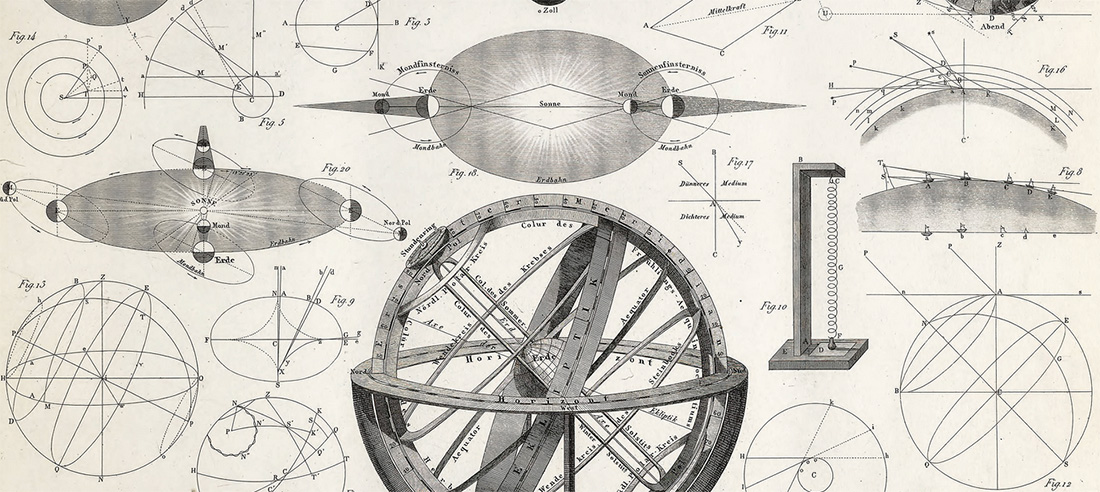
Retro Universe
C. S. Lewis is well known for using symbols associated with the Earth-centered Ptolemaic model of the universe in his fiction. What is generally overlooked is that not only did he employ a symbolic image from modern Big Bang cosmology in great depth in the middle of his science fiction trilogy, but he did so by seizing upon an aspect of that model widely misunderstood by non-scientists.
Most of us are familiar with the contemporary model of an expanding universe, one that began from an initial point. But when we picture this, it’s easy to misconceive the universe as being akin to the air inside an expanding balloon, with some locations closer to the center of the balloon and others closer to the expanding surface of the balloon. But that’s not right.
A better model comes from the astronomer Sir Arthur Eddington, whom Lewis had read and sometimes quoted. In his book The Expanding Universe, Eddington used the following analogy: Our three dimensions are like the two-dimensional surface of a balloon being inflated. You would expect, in an expanding universe, for everything to expand away from one central point. But every point on the surface of the balloon is a point away from which the surface is expanding. So every point on the balloon’s surface has equal claim to being the center, insofar as the word “center” has any meaning here. Scientists referring to this state of affairs sometimes say that every point in the universe is the center, and other times say that the universe has no center. So, while speaking symbolically, does Lewis.
Central but Not Pivotal
Near the end of Perelandra, the second novel in his space trilogy, Lewis has angelic planetary stewards, called oyarsa, expound on the matter. Ransom, the protagonist, asks them which planet should be considered the center according to its place in divine providence, since, according to one perspective, the Incarnation seems to make Earth central, but to another, the glorious future of the unfallen race of Venus seems to make it the center. The oyarsa explain that every world, and every point in the universe, is the center.
“Each grain is at the center. The Dust is at the center. The Worlds are at the center. The beasts are at the center. The ancient peoples are there. The race that sinned is there. . . . Where Maleldil [God] is, there is the center. . . . Each thing was made for Him. He is the center. Because we are with Him, each of us is at the center. . . . Each thing, from the single grain of Dust to the strongest eldil [an angelic being] is the end and final cause of all creation and the mirror in which the beam of His brightness comes to rest and so returns to Him.”
In the space trilogy the planets, until the end of Perelandra, were ruled by the oyarsa, which ancient pagans mistook for gods. Humans named the Ptolemaic planets after those “gods.” After the planet Venus’s Eve-equivalent resists the temptation to sin and thus avoids the Fall for her planet, the angelic, Ptolemaic spirits of Venus hand over their authority to man and immediately describe the structure of the universe in something like modern cosmological, rather than Ptolemaic, terms, explaining that every point is the center of the universe.
The speakers continue:
“He [God] has no need at all of anything that is made. An eldil is not more needful to Him than a grain of the Dust: a peopled world not more needful than a world that is empty: but all needless alike, and what all add to Him is nothing. We also have no need of anything that is made. Love me, my brothers, for I am infinitely superfluous, and your love shall be like His, born neither of your need nor of my deserving, but a plain bounty. Blessed be He!”
Whether it is true or not in the philosophical sense that Lewis’s angels suggest, it is true in a cosmological sense that each point not only has claim to being the center, but also is geometrically unremarkable, not at all pivotal. Lewis accepts this, taking it not as an insult, but rather as an additional reason for love and praise.
No Escaping Metaphor
One might object that Lewis is taking hard-nosed cosmological descriptions and playing fast and loose with them—spinning fanciful metaphors out of hard science. But Lewis insists that there’s no escaping metaphor, even in that hardest of hard sciences, physics. He explains in the epilogue of The Discarded Image:
Without a parable, modern physics speaks not to the multitudes. Even among themselves, when they attempt to verbalize their findings, the scientists begin to speak of this as making “models.” But these models are not, like model ships, small-scale replicas of reality. Sometimes, they do not illustrate but merely suggest, like the sayings of the mystics. An expression such as “the curvature of space” is strictly comparable to the old definition of God as “a circle whose centre is everywhere and whose circumference is nowhere.”
Note too, of course, that Lewis here quotes the idea that the center of God is everywhere, an idea that predates Copernicus by centuries. Pascal in his Pensées modified the idea to apply to nature, rather than God, saying, “Nature is an infinite sphere whose centre is everywhere and circumference nowhere.” That was long before astronomers determined that the universe is expanding away from every point as though every point were a kind of center, akin to a point on the surface of an expanding balloon.
I am left with the unsettling suspicion that Lewis may have been right when he argued in the epilogue of The Discarded Image that scientific models develop at least in part to meet cultural demand, not purely to meet the demands of new scientific evidence. “When changes in the human mind produce a sufficient disrelish of the old Model and a sufficient hankering for some new one, phenomena to support that new one will obediently turn up,” he wrote. “I do not mean that these new phenomena are illusory. Nature has all sorts of phenomena in stock and can suit many different tastes.” Yes, the universe really is expanding away from all points equally. But how we choose to express that—whether by saying that the center of the universe is everywhere, or that everywhere in the universe is equally unremarkable geometrically, or something else—might say as much about our philosophy as it does about our knowledge of physics.
No Idle Experiment
The conversation with the oyarsa about the center of the universe cannot have been an idle thought experiment on Lewis’s part. Popular philosophy looks at modern science and says that Copernicus’s displacement of Earth from the center of the universe proves that Earth and humanity are insignificant. But such thinking assumes that uniqueness—and in particular, geometric uniqueness—is a prerequisite for significance. Lewis provides a different metaphor using the same modern cosmology, one that bespeaks a God neither indifferent to his works nor in need of any of them.
Lewis refused to accept that the heavens do not declare the glory of God. People debate whether cosmology provides evidence for or against the existence of God and of a meaning of life. But I think Christians have done too little to provide an alternative to the symbolism that secular people have drawn from modern cosmology. It is a shame that Lewis’s symbolism at the end of Perelandra seems to have gone largely, if not entirely, unnoticed, because there he is the exception. I suggest we should join him.
Dante Hosseini lives with her husband and sons in central Texas, where she works as a homemaker and freelance writer. She has a bachelor’s degree from the University of North Texas and attends Brentwood Oaks Church of Christ.
A Journal of Mere Christianity—Delivered to Your Door
- Essays on theology, culture, and the Church
- Contributors from across the Christian traditions

Six print issues (one year) of Touchstone, plus full online access and PDF downloads for only $39.95.

Get a one-year full-access subscription to the Touchstone online archives for only $19.95.
bulk subscriptions
Order Touchstone subscriptions in bulk and save $10 per sub! Each subscription includes 6 issues of Touchstone plus full online access to touchstonemag.com—including archives, videos, and pdf downloads of recent issues for only $29.95 each! Great for churches or study groups.
Transactions will be processed on a secure server.
more on C. S. Lewis from the online archives

19.6—July/August 2006
The Three-Fold Cord of Imagination, Reason & Will in C. S. Lewis by Michael Ward

30.6—Nov/Dec 2017
on C. S. Lewis, Brideshead Revisited & the Middle Things by Ben Reinhard
18.3—April 2005
on Being a Free Narnian & the Joy of Subordination by Donald T. Williams
more from the online archives
14.6—July/August 2001
The Transformed Relics of the Fall
on the Fulfillment of History in Christ by Patrick Henry Reardon

27.2—March/April 2014
Higher Education Should Advance the Glorious Liberty of the Sons of God by Anthony Esolen
34.1—January/February 2021
What the World Needs Now It Hardly Knows by Anthony Esolen
calling all readers
Please Donate
"There are magazines worth reading but few worth saving . . . Touchstone is just such a magazine."
—Alice von Hildebrand
"Here we do not concede one square millimeter of territory to falsehood, folly, contemporary sentimentality, or fashion. We speak the truth, and let God be our judge. . . . Touchstone is the one committedly Christian conservative journal."
—Anthony Esolen, Touchstone senior editor
