




Bruised Reeds
The Shepherd’s Voice in an Age of Protest
A few days ago, as I was driving through our small rural town in New Hampshire, I saw a group of women standing opposite the town hall to protest the presence of federal immigration officers somewhere or other in the state, since they were not in town. The ladies seemed to be enjoying themselves. I did not stop to ask them whether they believe our immigration laws are unjust, since I doubt they even know what they are, nor did I ask why it is unfair to expect people within the bounds of the United States to observe the nation’s laws, just as citizens are supposed to.
There is only one church in our town, a small Congregationalist church, well kept, but I doubt that more than a few dozen of our 1,800 residents go there. You can hear Mass said at the chapel of what used to be Magdalen College, which is where my family and I go, and where my son David plays the organ. Other people may attend church services in this or that town five to fifteen miles away. I would be stunned to learn that even ten percent do so. We are like Maine in this regard, unchurched, with the category of the sacred nearly obliterated from the human soul; gray spiritual skies at all seasons; Robert Frost in his guise as the resigned and sober skeptic.
And yet there the women were, making noise. And I ask myself, “How do you evangelize such people?” It is a question all the churches must face, when the political has supplanted the religious, and when a theater of self-expression and self-justification has supplanted the political. We are of all utilitarians the most inept.
Vanity of Vanities
When Jesus healed the people, we are told that he often commanded them not to bruit his name abroad; and we know how often he retired to the mountains to pray, to enjoy that full and rich silence of communion with the Father. Matthew sees in his actions a confirmation of Isaiah’s Messianic prophecy: “He shall not strive, nor cry; neither shall any man hear his voice in the streets. A bruised reed shall he not break, and smoking flax shall he not quench till he send forth judgment unto victory. And in his name shall the Gentiles trust” (Matt. 12:19–21; cf. Is. 42:1–4).
The work of the Spirit is not “a jangling noise of words unknown,” as Milton describes what suddenly besets the builders of Babel. It does not come marching in earthly glory, nor, I will add, does it primp and preen itself for a theater of protest and self-righteousness. Vanity of vanities, saith the Preacher.
“A bruised reed shall he not break,” says the evangelist. Let us thank the Lord for that. We are all bruised reeds and flickering candles. If our bodies were to reflect the state of our souls, what hunchbacks and cripples would we be, what lumpish shadows would we cast! Yet we long to stand justified in our own eyes, and in the eyes of other people, to shame them with our righteousness, to spread our fans like peacocks—even the peahens now, adopting as their own the worst vices of the opposite sex, while missing the virtues of male and female both. “You are showing off,” I would like to say. That is a vice, the commonest of all, that no one wants to admit to.
The Main Question
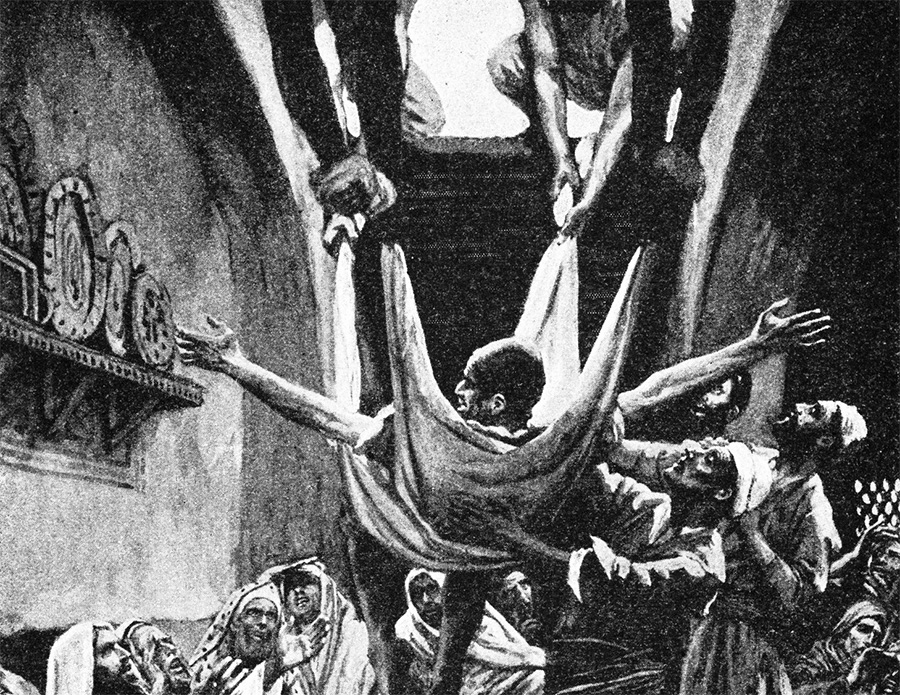
Yet, somehow, even the Pharisee must feel the wound of sin. Who knows what kind of man the paralytic was, before the people lowered him on a pallet through a hole in the roof, to hear the Lord say, “Man, thy sins are forgiven thee” (Luke 5:20)? Those words of Jesus may have surprised and dismayed him more than they angered the man whose house it was.
“Your sins are many and great,” I imagine a quiet and courageous evangelist in our time saying to one of us after having taken him or her aside from our public fanfare, whatever it may be. “You are a human being, after all, and depend upon it, you may fool other people by your display of virtue, and you may fool yourself, but you cannot fool God. There will come a time when all these things that exercise your righteous indignation will have passed away; no more stage, no props, no audience, no reviews in the Times, for the Times will have passed into eternity. All these things are dust. But your soul is not dust. What you are, which you yourself do not know, but God knows, and God is not impressed by the theater, will remain.
“Your sins are many and great. Leave the noise, and consider what you are, a lump of pride, soured with envy, bristling with anger, clotted and sludged with spiritual sloth and physical lusts. Be honest. Come away. This here is not life. Whether you are right or wrong in your political aims, or some of both, is not the main question now. Do not be deceived. The Lord has come to heal you, but he will not let his patience be held hostage forever.”
Anthony Esolen is Distinguished Professor of Humanities at Thales College and the author of over 30 books, including Real Music: A Guide to the Timeless Hymns of the Church (Tan, with a CD), Out of the Ashes: Rebuilding American Culture (Regnery), and The Hundredfold: Songs for the Lord (Ignatius). He has also translated Dante’s Divine Comedy (Random House) and, with his wife Debra, publishes the web magazine Word and Song (anthonyesolen.substack.com). He is a senior editor of Touchstone.
A Journal of Mere Christianity—Delivered to Your Door
- Essays on theology, culture, and the Church
- Contributors from across the Christian traditions

Six print issues (one year) of Touchstone, plus full online access and PDF downloads for only $39.95.

Get a one-year full-access subscription to the Touchstone online archives for only $19.95.
bulk subscriptions
Order Touchstone subscriptions in bulk and save $10 per sub! Each subscription includes 6 issues of Touchstone plus full online access to touchstonemag.com—including archives, videos, and pdf downloads of recent issues for only $29.95 each! Great for churches or study groups.
Transactions will be processed on a secure server.
more on Politics from the online archives
29.5—Sept/Oct 2016
on the Loss of True Community & Rising Political Desperation by Karl D. Stephan


more from the online archives

23.5—September/October 2010
The Loss of a Christian Understanding of Virginity Is Pure Tragedy by Eleanor Bourg Donlon
20.6—July/August 2007
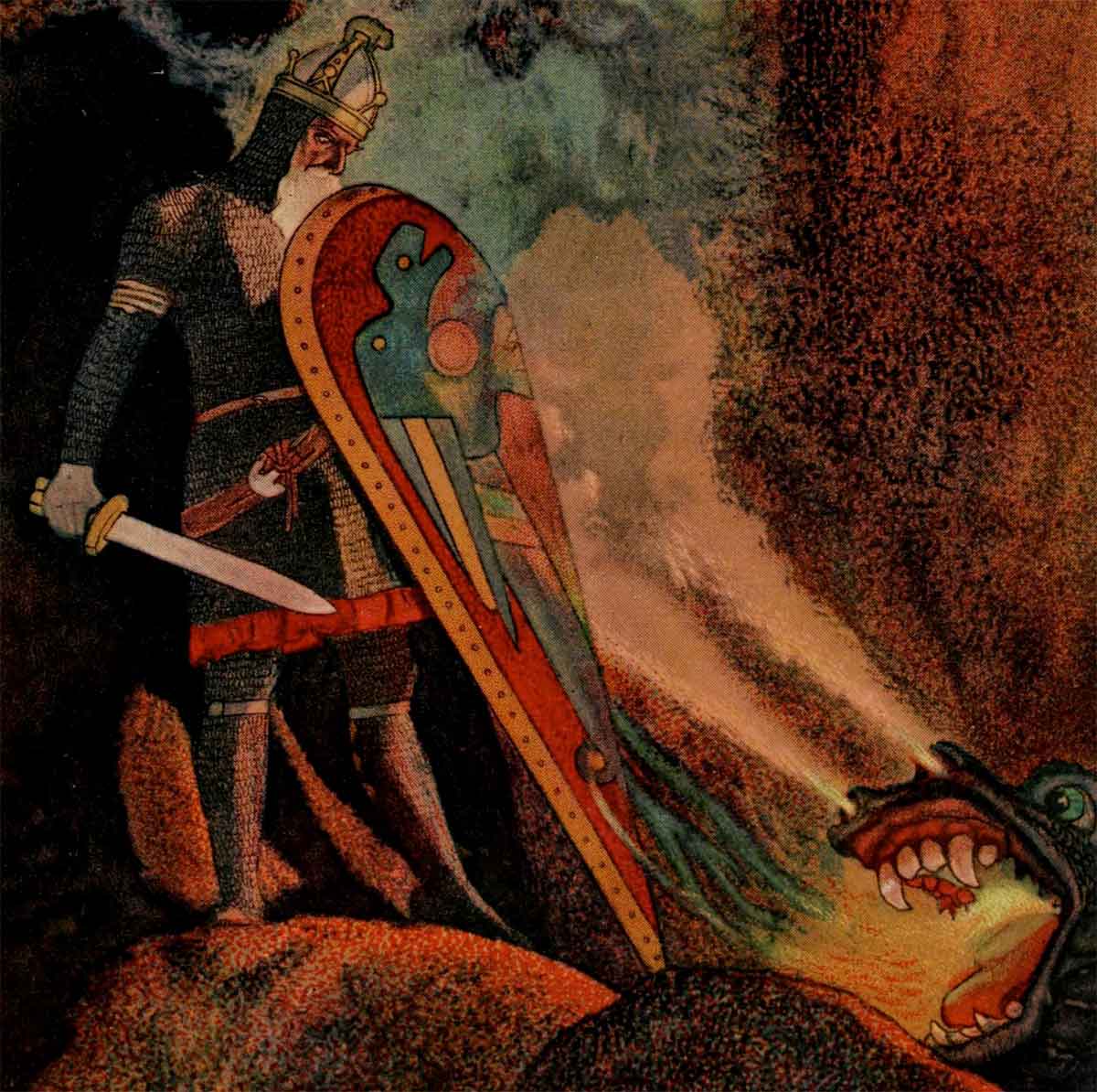
The Beowulf Poet Was a Shrewd Christian Apologist by Douglas Wilson

24.5—Sept/Oct 2011
on Wondering or Wandering Through College Education by Anthony Esolen
calling all readers
Please Donate
"There are magazines worth reading but few worth saving . . . Touchstone is just such a magazine."
—Alice von Hildebrand
"Here we do not concede one square millimeter of territory to falsehood, folly, contemporary sentimentality, or fashion. We speak the truth, and let God be our judge. . . . Touchstone is the one committedly Christian conservative journal."
—Anthony Esolen, Touchstone senior editor
