





Contradictory Man
The Sobering Lessons of Dr. Jekyll & Dorian Gray
What a chimera then is man! What a novelty! What a monster, what a chaos, what a contradiction, what a prodigy! Judge of all things, imbecile worm of the earth; depositary of truth, a sink of uncertainty and error; the pride and refuse of the universe!
. . . if man had never been corrupt, he would enjoy in his innocence both truth and happiness with assurance; and if man had always been corrupt, he would have no idea of truth or bliss. But, wretched as we are, and more so than if there were no greatness in our condition, we have an idea of happiness, and cannot reach it.
. . . there are two truths of faith equally certain: the one, that man, in the state of creation, or in that of grace, is raised above all nature, made like unto God and sharing in His divinity; the other, that in the state of corruption and sin, he is fallen from this state and made like unto the beasts.
—Blaise Pascal
So wrote Pascal in his Pensées (trans. William Finlayson Trotter), and what he wrote is as true today as when he wrote it. It was equally true at the time of Shakespeare, of Dante, of Augustine, of Plato, of Homer, of Moses, and of Abraham. For what Pascal describes is the human condition in all its sad and painful perplexity.
Had we remained in our original state of innocence, or had we always known nothing but corruption, we would not feel so torn, so confused, so displaced. Alas, we are neither; we are creatures created good in the image of God but fallen and depraved. We cannot, at least on this side of the grave, tear asunder within us the good and the bad, the righteous and the unrighteous.
I would go so far as to suggest that every person in every culture since time began has felt, if briefly, the temptation to divide, or even detach, his good side from the bad, his better angel from the baser beast. Some may wish to soar, while others wish to sink, but most are uncomfortable with their dual nature and would escape the wrestling if they could. In our fallen state of sin and separation, we want to dictate how our bodies will shape our souls and our souls our bodies, how the external will shape the internal and the internal the external.
Thankfully, for those who have felt that deep-set discontent over our status as creatures made good but fallen, the late nineteenth century gifted us with two fictional explorations of our dual nature that are at once captivating and convicting, stimulating and sobering. By reading closely those two tales, I hope to draw out the dangers of thinking that we can, by our own reason and volition—two of God’s greatest gifts to man—“free” innocence from experience, spirit from flesh.
Jekyll & His Potion
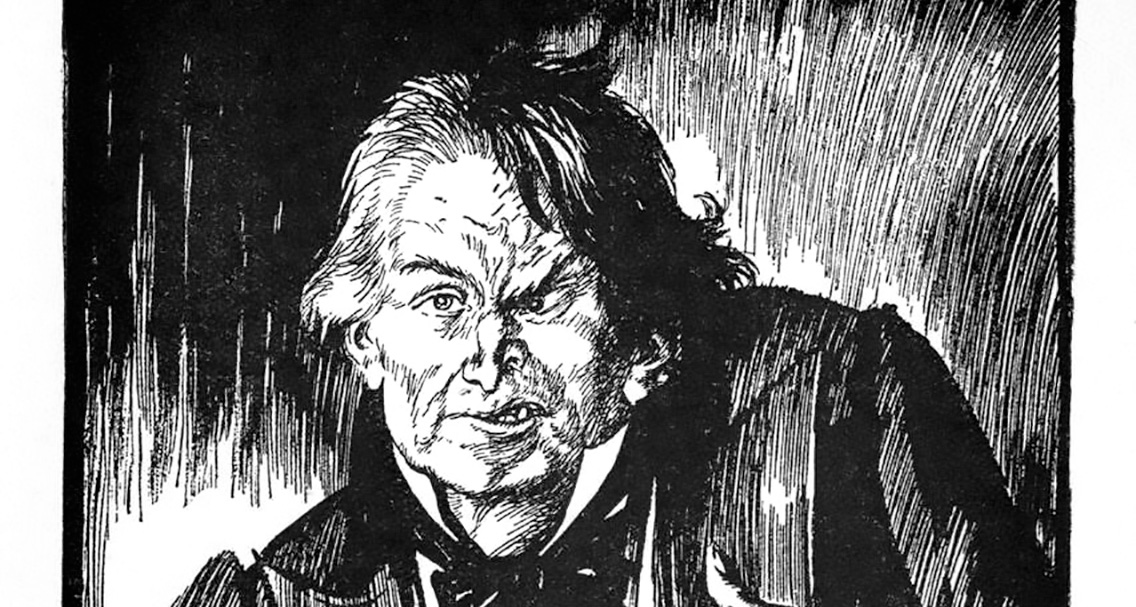
Robert Louis Stevenson’s The Strange Case of Dr. Jekyll and Mr. Hyde (1886) is a cautionary moral tale. It centers on an upright, respectable physician who thinks he can, by drinking a potion, separate his angelic side from his bestial side. His goal may seem noble at first, but he quickly learns that while he (Dr. Jekyll) remains a mixture of good and evil, the fiend that he sets free (Mr. Hyde) is wholly evil and cannot so easily be put back inside him.
Only in the last chapter of his disturbing novella (“Henry Jekyll’s Full Statement of the Case”) does Stevenson allow us to hear Jekyll’s motives and what he learns, to his sorrow, about man’s dual nature. Obsessed with “the thorough and primitive duality of man,” Jekyll decides that if the two sides of his nature
could be housed in separate identities, life would be relieved of all that was unbearable; the unjust might go his way, delivered from the aspirations and remorse of his more upright twin; and the just could walk steadfastly and securely on his upward path, doing the good things in which he found his pleasure, and no longer exposed to disgrace and penitence by the hands of this extraneous evil.
Jekyll is recklessly and sinfully wrong to think that he can so easily separate the wheat (the nobility of man) from the tares (his depravity). Jesus, in his parable (Matt. 13:24–30, 36–43), says that it is dangerous to try to do such a thing on the societal level, for, in the effort to pull out the tares, good wheat will be ripped out as well. But the same danger applies on the individual level. The mingled duality of man’s goodness and evil is an undeniable part of the fabric of our reality. Indeed, in Milton’s essay “Areopagitica” (1644), the author of Paradise Lost argues that, in our fallen world, “the knowledge of good is so involved and interwoven with the knowledge of evil” that we can only know good through evil.
But Jekyll the “mad scientist” refuses to abide by such limits; he does not like the nature of reality and will use his technology to change it. He takes the potion and is immediately transformed into Hyde:
“I felt younger, lighter, happier in body; within I was conscious of a heady recklessness, a current of disordered sensual images running like a mill race in my fancy, a solution of the bonds of obligation, an unknown but not an innocent freedom of the soul. I knew myself, at the first breath of this new life, to be more wicked, tenfold more wicked, sold a slave to my original evil; and the thought, in that moment, braced and delighted me like wine. I stretched out my hands, exulting in the freshness of these sensations; and in the act, I was suddenly aware that I had lost in stature.”
By releasing the evil within, Jekyll does not become the noble savage of Rousseau’s feverish imagination; neither does he become the Eden-dwelling Adam of Genesis 2. A savage and a primitive he does become, but a postlapsarian one, utterly enslaved to original sin, whose desires are disordered and whose every thought and impulse are evil. He gains a kind of freedom, but it is not the freedom of the innocent child delighting in the freshness of the world. He opens the door to license, not to liberty.
Overtaken by Hyde
Many times Jekyll initiates the transformation and then sends out his wholly evil other to enjoy himself, taking solace in the ad hoc justification that it is not really he (Jekyll) who is performing the evil acts: “Henry Jekyll stood at times aghast before the acts of Edward Hyde; but the situation was apart from ordinary laws, and insidiously relaxed the grasp of conscience. It was Hyde, after all, and Hyde alone, that was guilty.” Although the speaker of this passage is Jekyll, he continually distances himself, not only from Hyde but even from Jekyll, by employing the third person. He thinks he can control and tame the depravity within him, but he cannot.
Eventually, Jekyll comes to his senses and stops taking the potion, but he has gone too far to escape the consequences of his actions. Once during sleep, again while sitting on a park bench, and many times after that, Hyde finds a way to break out of his cage and take over Jekyll’s body without the potion. The attempt to separate out his fallen nature does not turn Jekyll into an angel; he remains “the old Henry Jekyll, that incongruous compound of whose reformation and improvement I had already learned to despair.” All he accomplishes through his dark meddling with fallen human nature is to drag himself down to the level of the beasts—only worse, since he continues to be morally conscious of the evil he commits.
Stevenson adds a vital detail to the climactic scene when Jekyll transforms into Hyde on the park bench, a detail that drives home his message. “I sat in the sun on a bench,” Jekyll recounts,
“the animal within me licking the chops of memory; the spiritual side a little drowsed, promising subsequent penitence, but not yet moved to begin. After all, I reflected, I was like my neighbours; and then I smiled, comparing myself with other men, comparing my active good-will with the lazy cruelty of their neglect. And at the very moment of that vainglorious thought, a qualm came over me, a horrid nausea and the most deadly shuddering. These passed away, and left me faint; and then as in its turn faintness subsided, I began to be aware of a change in the temper of my thoughts, a greater boldness, a contempt of danger, a solution of the bonds of obligation. I looked down; my clothes hung formlessly on my shrunken limbs; the hand that lay on my knee was corded and hairy. I was once more Edward Hyde.”
Just like Herod Agrippa’s vainglorious refusal to give God the glory when the people hail his speech as the voice of a god leads to immediate divine judgment (Acts 12:21–23), so Jekyll’s smug, arrogant assertion of his own superiority over his fellow men leads to the immediate emergence of what Paul calls the “old man” (Rom. 6:6; Eph. 4:22; Col. 3:9), the unregenerate sinner who hides (“hydes”) within and whose god is his belly (Phil. 3:19). Jekyll’s self-righteousness does not exalt him above either the moral depravity or the indifference of others; it only blinds him to his true nature and status.
In the end, the only way Jekyll can stop Hyde and reunite the two sides of his dual nature is to kill himself. But he already killed himself when he dared to pull on the thread that weaves together the pre- and postlapsarian Adam into a single tapestry. Jekyll was right that within him, as within all men, lies a mixture of good and evil; but he was wrong to think that he could, of his own will, separate that mixture. Our depravity is as deeply imbedded in our bodies and souls as is our nobility. The former can be forgiven and redeemed, but it will nevertheless remain until body and soul together are set free from bondage to sin and decay and all is restored and made new.
Dorian & His Portrait
Published five years later, Oscar Wilde’s timeless novel The Picture of Dorian Gray (1891) is the tale of a handsome, innocent young man who sells his soul to the devil in return for what seems at first a glorious boon: Dorian’s portrait will grow old for him while he remains perennially young. Most people who have not read the novel think that the portrait only bears the signs of Dorian’s aging. In fact, Wilde’s novel, like Stevenson’s novella, is, for all its fantastical trappings, a cautionary moral tale. Along with his aging, the portrait bears on its face the outward marks of the inner depravity to which Dorian turns himself over. Indeed, in a powerful refutation of the dualistic error that says body is bad and soul good, Wilde shows that one’s body can present to the world the visage of innocence, kindness, and charity while one’s soul grows increasingly twisted and perverse.
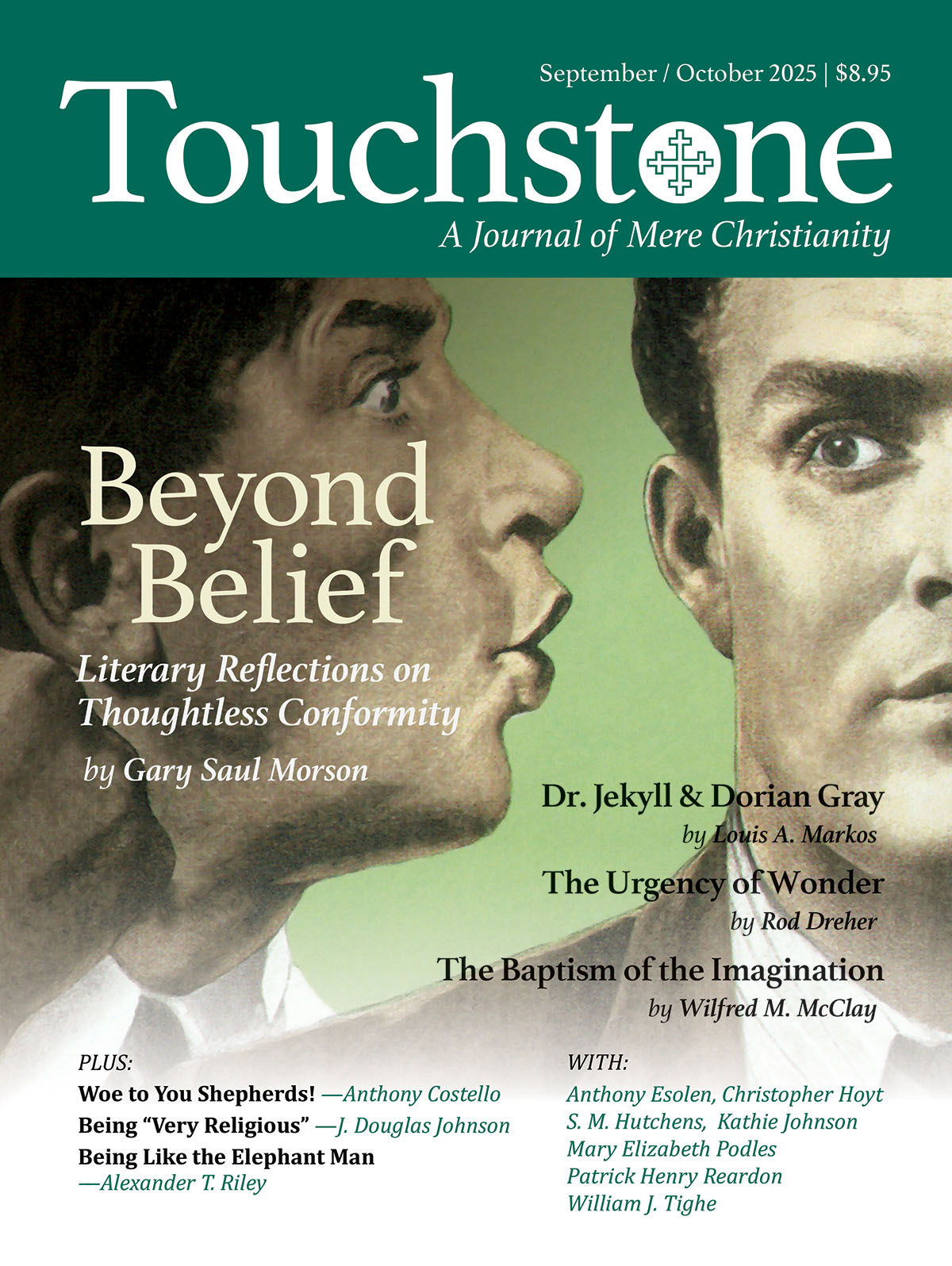
A classic way of depicting the duality of man and the inner wrestling caused by that duality is to picture an angel and a devil poised on opposite shoulders of a man, each whispering in his ear to follow the way of virtue or of vice. In the novel, Dorian’s angel is played by Basil, the artist who paints the portrait with which Dorian switches places; Lord Henry Wotton, a bored, amoral aesthete, plays the role of the devil. Each character exerts an influence on Dorian for good or ill, appealing now to his nobility, now to his depravity.
Basil idolizes Dorian, discerning in him the perfect balance of body and soul, real and ideal, classical and romantic. It is that which prompts him to paint the portrait, and that which makes the portrait so haunting and captivating. It also presents the young Dorian to the reader as a whole and integrated person, innocent of the ways of the world and barely conscious of his own beauty.
All of that changes in chapter 2, when Henry speaks with Dorian in the garden outside Basil’s studio. Like the serpent that tempts Adam and Eve in the Garden, the callous and cynical Henry makes it his goal to open Dorian’s eyes. He challenges the young man to have the “courage” to live out his hidden desires. Dorian blushes, stung by Henry’s challenge. Pushing his advantage, Henry assures Dorian that the “only way to get rid of a temptation is to yield to it. Resist it, and your soul grows sick with longing for the things it has forbidden to itself, with desire for what its monstrous laws have made monstrous and unlawful.” Dorian falters under Henry’s poisonous words, feeling almost as if they have proceeded from his own soul. A hunger rises within him for the kind of forbidden knowledge promised by the life of hedonism that Henry dangles before him.
Having lured his prey into a corner, Henry rushes in for the kill. “Time is jealous of you,” he warns Dorian, “and wars against your lilies and your roses. You will become sallow, and hollow-cheeked, and dull-eyed. You will suffer horribly. . . . Ah! realize your youth while you have it.” It is then, his vanity piqued, that Dorian blurts out his terrible wish to trade places with his portrait.
His craving divulged, Dorian falls further and further under the spell of Henry’s cynicism and apathy. Basil notices the change but is at first hopeful that Dorian’s love for a poor, guileless actress named Sibyl Vane will restore him and shield him from Henry’s corrupting influence. When Dorian seems poised to marry Sibyl, Henry tries to talk him out of it, prompting Basil to confront Henry with the necessary reality check: “But, surely, if one lives merely for one’s self, Harry, one pays a terrible price for doing so?”
While Dorian teeters on the edge of choices that will tear apart the Jekyll-and-Hyde nature of his soul, Basil and Henry go to see Sibyl act in a performance of Romeo and Juliet. To everyone’s surprise and disgust, Sibyl delivers a terrible performance. She explains to Dorian that the reason her acting was so bad is that her real love for him has taught her how phony the theater is. She is sick of shadows and illusions and wants only to give her life and love to him. In response, Dorian, who has never really loved Sibyl but only his ideal image of her, dismisses and rejects her. Their love is over, he heartlessly proclaims, and he never wants to see her again.
That night, Dorian returns home and looks at the portrait, finding a change in its expression. There is now a cruel twist to the mouth that was not there before. As leprosy in the Old Testament functions, in part, as an external manifestation of human depravity, showing in the skin what sin does to the soul, so Dorian’s portrait makes visible the scar that Dorian has put on his conscience by his callous treatment of Sibyl. Forced to gaze directly upon the corruption of his soul, Dorian comes close to repenting, casting off his friendship with Henry, and swearing to marry Sibyl. Alas, he is not given the chance to follow through, for that very night Sibyl kills herself in despair.
Dorian’s remorse proves short-lived, and, to the horror of Basil, he attends the opera with Henry on the same day he hears of Sibyl’s death. It is at this point that Dorian’s impulsive wish in Basil’s garden becomes a fully conscious and willing act of moral agency; whatever the cost, he will allow the portrait to bear the weight of his age, guilt, and depravity. When Basil requests to see the portrait, Dorian refuses and then locks it away in an old, abandoned schoolroom where he used to play as a boy. In the same room where the innocent boy used to hide, the adult now hides away his sin and shame.
Dorian now throws himself fully into a life of decadence. Inspired by a pornographic book given to him by Henry and likely written by the Marquis de Sade, he makes frequent clandestine visits to unnamed dens of iniquity. As he leads his hidden life of moral corruption, he makes frequent trips to the schoolroom so he can study, scientifically and dispassionately, the ugliness that slowly creeps over the portrait. Rumors begin to circulate of his nocturnal activities, but no one believes them, for Dorian’s face continues to look young, noble, and pure.
In a very real sense, Dorian becomes the perfectly unjust man described in Book II of Plato’s Republic: one who is motivated only by greed, lust, and ambition, but who everyone thinks is honorable and virtuous. Plato says that such a man will end up enslaved to his own base lusts and passions, and that is exactly what happens to Dorian. With each passing year, Dorian seeks out newer and viler pleasures, all the while staring with fascination at the growing hideousness of his portrait. But nothing satisfies, and he ends up as bored and jaded as Henry. He finds, as Adam did before him, that the Tree of Knowledge does not give life.
The Face He Deserves
Some two decades later, Dorian runs into Basil in the fog. Basil confronts him with rumors that he (Dorian) has destroyed many young women and men, often provoking them to suicide, but when he looks at Dorian’s unspoiled face, he finds the rumors impossible to believe. “Mind you,” he explains,
“I don’t believe these rumors at all. At least, I can’t believe them when I see you. Sin is a thing that writes itself across a man’s face. It cannot be concealed. People talk sometimes of secret vices. There are no such things. If a wretched man has a vice, it shows itself in the lines of his mouth, the droop of his eyelid, the molding of his hands even.”
“At age 50,” George Orwell once quipped, “every man has the face he deserves.” When we continually choose the pathways of vice, selfishness, and narcissism, we slowly remake ourselves until we quite literally become our sin. The consequences that follow in the wake of our choices affect the physical, emotional, and spiritual realms alike. As moral agents, we do not act in a vacuum; our choices affect the very fabric of reality.
Confused by the rumors about Dorian and their disparity with his manner and visage, Basil expresses a wish to see Dorian’s soul, even though he knows only God can see such things. Dorian replies with glee that Basil can see his soul, that Basil has, in fact, supplied the means of doing what would otherwise be impossible. “You have chattered enough about corruption,” taunts Dorian, “Now you shall look on it face to face.”
Dorian takes Basil to the schoolroom and pulls back the curtain to reveal the concrete and external image of his festering soul. Basil is horrified and revolted by the portrait, which he can hardly recognize as the one he had painted so long ago.
The surface seemed to be quite undisturbed and as he had left it. It was from within, apparently, that the foulness and horror had come. Through some strange quickening of inner life the leprosies of sin were slowly eating the thing away. The rotting of a corpse in a watery grave was not so fearful.
Still, Basil will not let his repugnance cause him to give up on Dorian’s soul. “Pray, Dorian, pray,” he exhorts him:
“What is it that one was taught to say in one’s boyhood? ‘Lead us not into temptation. Forgive us our sins. Wash away our iniquities.’ Let us say that together. The prayer of your pride has been answered. The prayer of your repentance will be answered also. I worshipped you too much. I am punished for it. You worshipped yourself too much. We are both punished.”
Dorian says that it is too late, but Basil presses him again: “It is never too late, Dorian. Let us kneel down and try if we cannot remember a prayer. Isn’t there a verse somewhere, ‘Though your sins be as scarlet, yet I will make them as white as snow’?”
But Dorian has sunk too far in his depravity. Rather than be convicted by Basil’s words, he is filled with a sudden and intense loathing and hatred for Basil, who has now looked on the corruption of his soul. In a fit of rage, he stabs him in the neck repeatedly, all the while blaming Basil for making the portrait and his own dark fate for entrapping him. Even when the sun rises the next morning, he feels no guilt, reflecting instead on how much he suffered the night before. He then blackmails one of his scorned lovers into using secret and forbidden chemicals to dissolve all traces of Basil’s body.
Dorian now spirals out of control, traveling from one opium den to the next in hopes that his indulgences will erase the memory of what he has done. But he can find no relief, only the living death of a man whose conscience has been seared. Here is how Wilde describes the effects of surrendering one’s moral agency to sin:
There are moments, psychologists tell us, when the passion for sin, or for what the world calls sin, so dominates a nature that every fibre of the body, as every cell of the brain, seems to be instinct with fearful impulses. Men and women at such moments lose the freedom of their will. They move to their terrible end as automatons move.
As for his protagonist, Wilde sums up his condition with almost scientific precision: “Callous, concentrated on evil, with stained mind, and soul hungry for rebellion, Dorian Gray hastened on.”
Like Dr. Jekyll, Dorian Gray has lost the freedom he once possessed as a volitional being and moral agent. He has rebelled against his status as a creature made in God’s image but fallen and, in the process, has succumbed fully to his dark side. Thinking he could bypass his conscience, he has so weakened and poisoned it that it can only sit by idly, taking a passive but perverse pleasure in its own corruption.
In a final attempt to change his fate and regain his lost humanity, Dorian pulls back just in time before ruining a peasant girl he has seduced. He hopes that when he looks at his portrait, it will show signs of recovery, some glimmer of goodness. Instead, he sees more blood on its hands and discovers, by studying the look in its eyes and mouth, that his supposed act of charity toward the girl was not done out of goodness, kindness, or mercy. To the contrary: “Through vanity he had spared her. In hypocrisy he had worn the mask of goodness. For curiosity’s sake he had tried the denial of self.”
In desperation, Dorian takes up the knife with which he killed Basil and approaches the portrait.
As it had killed the painter, so it would kill the painter’s work, and all that that meant. It would kill the past, and when that was dead, he would be free. It would kill this monstrous soul-life, and without its hideous warnings, he would be at peace. He seized the thing, and stabbed the picture with it.
But Dorian is not set free; he can no more cut out his soul and live than he can cut out his heart or his brain and live. Dorian lets out a terrible cry and collapses. The portrait is restored to its original beauty, and the dead body of Dorian is found with the blade in his own heart, his face “withered, wrinkled, and loathsome of visage.”
Like Jekyll, Dorian learns too late that he can neither rebel without ramifications nor act without accountability. We live in a natural and moral world of cause and effect where the consequences of our choices are as real and concrete as the laws of gravity or entropy.
The Greater Sin
Despite the physical sins of the flesh committed by Hyde and Dorian, Jekyll and Dorian are ultimately guilty of a more severe sin of the soul. Both refuse to accept who they are ontologically as creatures made in the image of God but fallen. They take upon themselves the power to remake their fallen nature—by the mediation of either science (Jekyll’s potion) or magic (Dorian’s pact with the devil). That science and magic can function as instruments of domination to bend reality to the will of man was seen clearly by C. S. Lewis, who connected the former with Francis Bacon (who said that knowledge is power) and the latter with Faust (who sold his soul to the devil for forbidden wisdom).
“The serious magical endeavor,” Lewis argues in chapter 3 of The Abolition of Man, “and the serious scientific endeavor are twins: one was sickly and died, the other strong and throve. But they were twins.” He then goes on to explain exactly how they changed man’s orientation toward reality:
For the wise men of old the cardinal problem had been how to conform the soul to reality, and the solution had been knowledge, self-discipline, and virtue. For magic and applied science alike the problem is how to subdue reality to the wishes of men: the solution is a technique and both, in the practice of this technique, are ready to do things hitherto regarded as disgusting and impious—such as digging up and mutilating the dead.
Refusing the hard path of conformity, obedience, and discipline, Jekyll and Dorian choose the easy way of resistance, rebellion, and technology. For wisdom and virtue, they substitute amoral experimentation and immoral methods. They sow impiety, and they reap the whirlwind. They think their chosen path will leave them more integrated and self-actualized; instead, it tears them to pieces. They will not be defined by the truth about their nature and so have that nature taken away from them.
Both Jekyll and Dorian seek to transcend the limits of their fallen humanity in a way that violates the laws of God and nature alike. In that, they foreshadow the dystopian social engineers of the transgender and transhumanist movements. These modern-day Fausts use technological advancements that are more magic than medicine, more science fiction than science, to alter our essential identities as men and women, and even as flesh-and-blood human beings.
Stevenson’s Jekyll at least stops taking his potion when he realizes he cannot control Hyde; the Jekylls of today feel no moral qualms as they move from puberty blockers to cross-sex hormones to the removal of healthy tissue. Wilde’s Dorian uses disgusting and impious chemicals to dissolve the body of Basil; the Dorians of today use even more disgusting and impious chemicals to dissolve the sexual and/or human nature of their patients. For these manipulators of magic and applied science, a discomfort or dissatisfaction with the way one is made morphs into a direct challenge to the Creator for making us the way he did. Let us not disguise human pride, rebellion, and disobedience under the false labels of self-realization, self-fulfillment, and self-expression. Sin is sin, however prettily we dress it up.
What Awaits Us in Christ
I have compared Jekyll’s vainglorious thought followed by his transformation into Hyde to God’s swift judgment of Herod Agrippa. But it also calls up a second story from the Old Testament that Stevenson likely had in mind. The incident takes place in Babylon as Nebuchadnezzar surveys the glory and splendor of his palace—perhaps especially of his hanging gardens, one of the seven wonders of the ancient world. The moment he gives himself over to hubris, he is, as he had been warned in a dream that Daniel had interpreted for him, struck down and transformed into a beast: “and he was driven from men, and did eat grass as oxen, and his body was wet with the dew of heaven, till his hairs were grown like eagles’ feathers, and his nails like birds’ claws” (Dan. 4:33).
Though Nebuchadnezzar does not literally become a wild animal—this is the Bible, after all, and not Ovid’s Metamorphoses—the change is as profound and terrifying as that of Jekyll into Hyde or of Dorian’s portrait into the embodiment of human depravity. Whether so intended by their authors or not, all three incidents mark the categorical opposite of Jesus’ Transfiguration or his appearances in his resurrected body. As such, they also mark the opposite of what awaits those who are in Christ:
• For I reckon that the sufferings of this present time are not worthy to be compared with the glory which shall be revealed in us. For the earnest expectation of the creature waiteth for the manifestation of the sons of God. (Rom. 8:18–19)
• For this corruptible must put on incorruption, and this mortal must put on immortality. So when this corruptible shall have put on incorruption, and this mortal shall have put on immortality, then shall be brought to pass the saying that is written, Death is swallowed up in victory. O death, where is thy sting? O grave, where is thy victory? (1 Cor. 15:53–55)
• But we all, with open face beholding as in a glass the glory of the Lord, are changed into the same image from glory to glory, even as by the Spirit of the Lord. (2 Cor. 3:18)
Jekyll and Dorian, it turns out, were right to feel uncomfortable with their duality. God does have something better in store for us, but it will be by restoring and perfecting, not tearing asunder, what has been corrupted in us by the Fall. In the New Jerusalem, the evil in us will be gone, not because we have extracted it by our own efforts, but because God in Christ has redeemed us: body and soul, flesh and spirit.
Our restlessness to transcend our current condition is real and God-given, but it is not up to us to take things into our own hands. God has his plans, and those plans point to the exaltation and consummation of our created nature in Christ, not its deconstruction.
Louis Markos , Professor in English and Scholar in Residence at Houston Baptist University, holds the Robert H. Ray Chair in Humanities. His 19 books include Lewis Agonistes; Restoring Beauty: The Good, the True, and the Beautiful in the Writings of C. S. Lewis; On the Shoulders of Hobbits: The Road to Virtue with Tolkien and Lewis; and From A to Z to Narnia with C. S. Lewis.
A Journal of Mere Christianity—Delivered to Your Door
- Essays on theology, culture, and the Church
- Contributors from across the Christian traditions

Six print issues (one year) of Touchstone, plus full online access and PDF downloads for only $39.95.

Get a one-year full-access subscription to the Touchstone online archives for only $19.95.
bulk subscriptions
Order Touchstone subscriptions in bulk and save $10 per sub! Each subscription includes 6 issues of Touchstone plus full online access to touchstonemag.com—including archives, videos, and pdf downloads of recent issues for only $29.95 each! Great for churches or study groups.
Transactions will be processed on a secure server.
more on literature from the online archives

24.1—January/February 2011
Ruminations on the Monstrous Envy of the Soul-Devouring State by Anthony Esolen
32.2—March/April 2019
Misguided Mercy & Dante's Infernal Purgation by Joshua Hren
30.5—Sept/Oct 2017
on Costly Grace in Breece D'J Pancake's Flyover Country by Casey Chalk
more from the online archives
30.5—Sept/Oct 2017
The Critical History Before, During & After Martin Luther by James Hitchcock
36.4—Jul/Aug 2023
Our Political Void & the Disintegration of Truth by Michael Hanby
calling all readers
Please Donate
"There are magazines worth reading but few worth saving . . . Touchstone is just such a magazine."
—Alice von Hildebrand
"Here we do not concede one square millimeter of territory to falsehood, folly, contemporary sentimentality, or fashion. We speak the truth, and let God be our judge. . . . Touchstone is the one committedly Christian conservative journal."
—Anthony Esolen, Touchstone senior editor
