




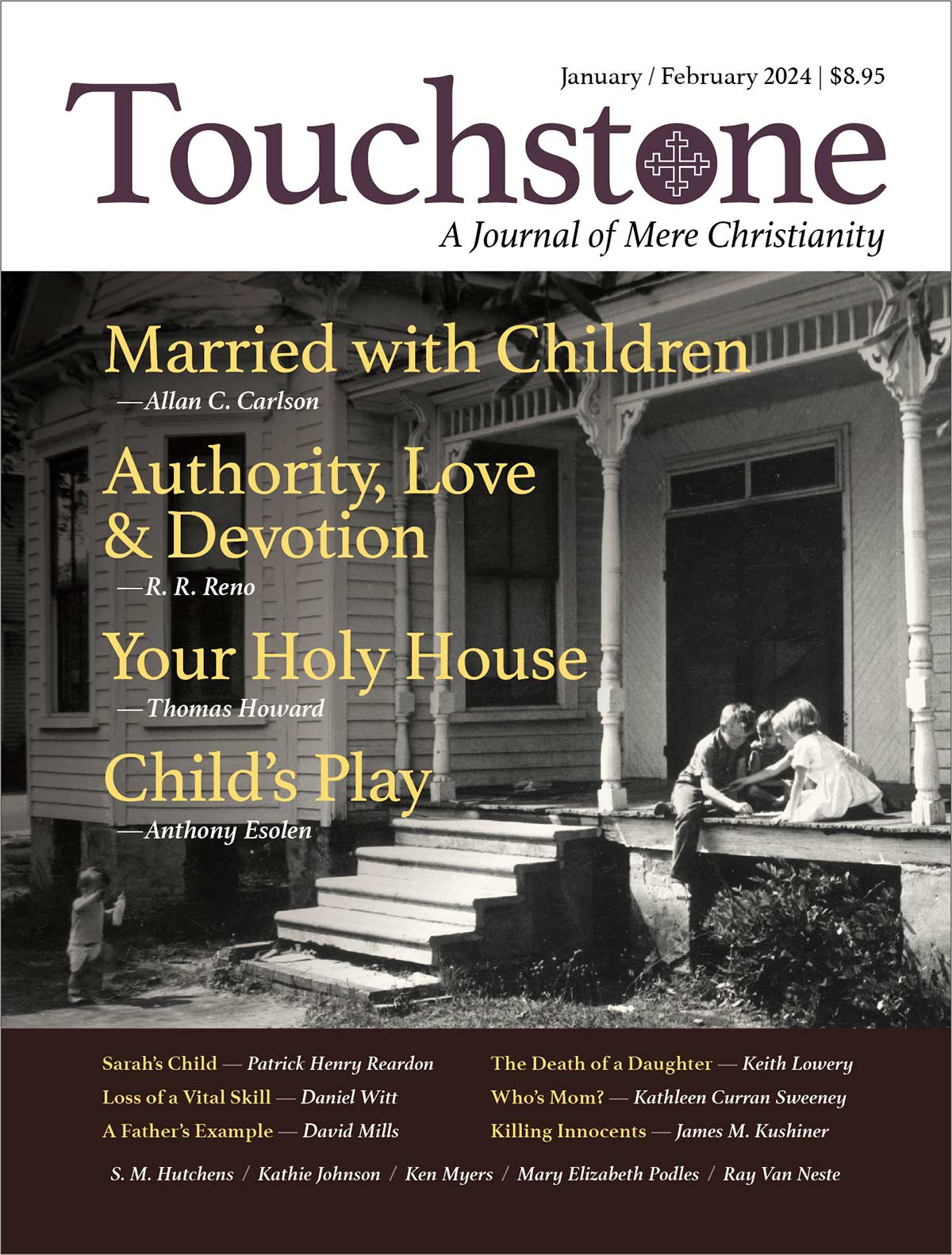
My Father’s Example
on Appreciating Paternal Influence in the Right Direction
I’m not really sure what my dad believed. He was a Christian, though one I think more of commitment than conviction. A Protestant, he couldn’t have conceived of being a Catholic or even an Episcopalian or Lutheran, no more than I as a New Englander could conceive of being a Yankees fan. For the last twenty-some years of his life, he was an elder in a congregationalist-style church, heavily involved, but then he was the pastor’s best friend.
My parents started going to church when I was eight or so, I think for the usual middle-class reasons. They wanted help raising their children, and they saw going to church as the respectable thing to do, something people like them did. At least my mother did. She had grown up in a family half-secular (grandfather was an active Mason) and half irregularly practicing Methodists (grandmother was a Methodist). My father’s family had not gone to church at all.
I’m thinking now that my mother much more than my father wanted to go to church, and I wonder if we ever would have gone had the decision been left to him alone. It’s humbling to think that the thing that drives my life now, I may not have known at all, if my dad had not wanted to make his wife happy.
We attended church off and on for some years, meaning I didn’t grow up with the idea that church was normal and normative. It was something we did when my parents felt like it, like going out to dinner when we could afford it. They eventually started going every week, to a small church in the country, but by then my attitude to the whole enterprise had been formed. It was their thing, not mine.
The church they were going to when I turned twelve expected everyone at that age to get baptized, and I refused. I didn’t believe in it, and I wasn’t going to get soaking wet for a show. My dad never said a word about it, and I have no idea if my refusal bothered him or not.
An Engineer’s Mind
As far as I remember, my parents had no theological commitments. My mother would have had them if either parent did, and hers would have been broad and affirming. It was a religion of Jesus as savior and not much else, beyond some cultural rules the people in their circles took as Christian teaching.
Only years later, when I started reading on my own, did I find that Christianity had set beliefs, that it had a structure with hard angles and edges, and a shape that didn’t bend and didn’t fold up for convenience. Smart people thought about the ultimate questions in a rigorous, systematic way, a way that offered some chance of finding an answer, not leaving us with tastes and preferences.
It baffles me that my dad didn’t find theology interesting, at least for the systematic way theologians worked it all out and for the applications. He was a civil engineer, with an engineer’s mind for systems and structures, and with the civil engineer’s pleasure in making things work in the real world.
Intellectually, I went my own way. I read a lot, and for much of my teenage years was absorbed in secular writers. Camus especially I loved for his belief that the world had no meaning, but that he would live as if it did. He was one of my heroes for that, as was George Orwell. I enjoyed Thomas Hardy’s novels for their pessimism. I saw no need for religion in my life. My dad gave me no reason to feel I needed it or should want it.
I also loved Tolkien’s The Lord of the Rings, which I first read at twelve. What I loved then, I see now, was its implicit Catholicism. My dad read it, once. With the zeal of the fan, I asked him how he liked it, and he said, tactfully, “It’s a good story.” He certainly didn’t get the Catholic elements. It was an adventure story with funny creatures, the kind of thing his artsy son liked.
The Job of Dying
David Mills has been editor of Touchstone and executive editor of First Things. He edits the opinion page of the Pittsburgh Post-Gazette.
A Journal of Mere Christianity—Delivered to Your Door
- Essays on theology, culture, and the Church
- Contributors from across the Christian traditions

Six print issues (one year) of Touchstone, plus full online access and PDF downloads for only $39.95.

Get a one-year full-access subscription to the Touchstone online archives for only $19.95.
bulk subscriptions
Order Touchstone subscriptions in bulk and save $10 per sub! Each subscription includes 6 issues of Touchstone plus full online access to touchstonemag.com—including archives, videos, and pdf downloads of recent issues for only $29.95 each! Great for churches or study groups.
Transactions will be processed on a secure server.
more on Family from the online archives

33.2—March/April 2020
Encounters with Faith & Forgiveness in Communities of Faith by Nicole M. King

33.3—May/June 2020
Maternal Body: A Theology of Incarnation from the Christian East by Carrie Frederick Frost
Fertile Ground: A Pilgrimage Through Pregnancy by Laura S. Jansson by Agnes R. Howard

more from the online archives

31.6—November/December 2018
Victimhood Culture Scapegoats Its Very Source by Michael P. Foley
30.6—Nov/Dec 2017
Christ, Individualism & the Meaning of Cultural Diversity by Anthony Esolen

16.5—June 2003
on the Importance of Fathers to Churchgoing by Robbie Low
calling all readers
Please Donate
"There are magazines worth reading but few worth saving . . . Touchstone is just such a magazine."
—Alice von Hildebrand
"Here we do not concede one square millimeter of territory to falsehood, folly, contemporary sentimentality, or fashion. We speak the truth, and let God be our judge. . . . Touchstone is the one committedly Christian conservative journal."
—Anthony Esolen, Touchstone senior editor
