




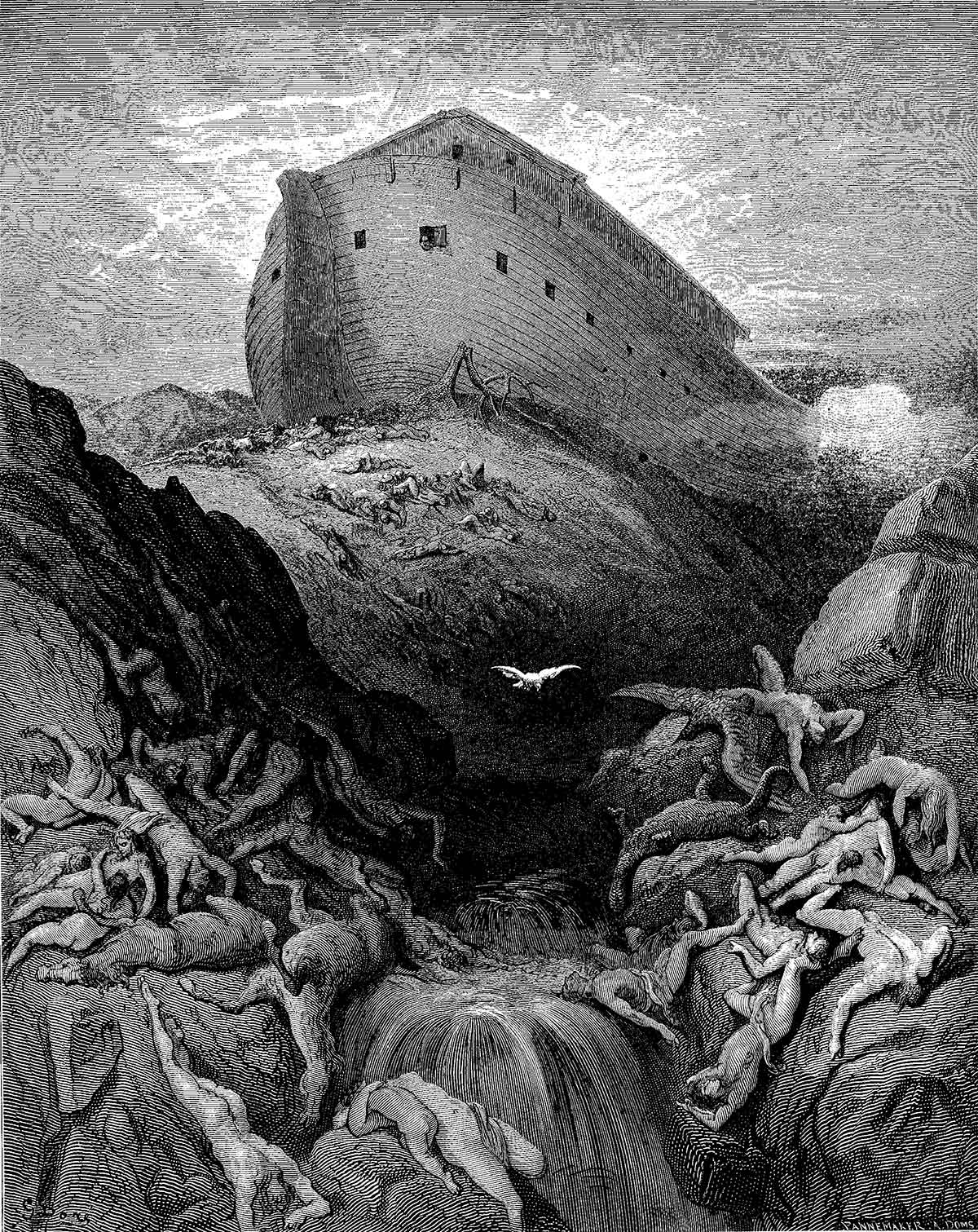
Gustave Doré’s The Dove Sent Forth from the Ark
In 1843, Jean Jacques Bourassé and Pierre Janvier published a French translation of the Latin Vulgate Bible, and in 1866 a deluxe, folio-sized, two-volume edition was issued, containing 241 illustrations by Gustave Doré, of which this is one. Many of them, like this one, were novel treatments of familiar subjects, and all of them were immensely successful and influential.
In this picture, it was a dark and stormy night. In the ark, Noah is just visible in the one opened window, at the top center, watching in hope as the dove departs. The rest of the image is pretty hopeless. The ground is littered with the bodies of the drowned—people, birds, and animals. The dark, V-shaped composition shows the floodwaters still pouring off the shadowed valley. But the dove is a stark contrast: brilliantly lit, it is a beacon of hope, and behind the looming form of the ark, light is breaking through and illuminating the clouds from below as they begin to disperse.
Doré was (and is) famous for his lighting effects, especially his skies. My father, not a man well-versed in art history, loved the effect of the sun’s rays slanting through the clouds on a dark day, and would always say to us, “Look! A Doré sky.” Here, and in many of his biblical illustrations, Doré uses slanting rays of light to signal the presence of the divine breaking through into this world: God has saved mankind and will never send such a flood again. The dove, too, takes the traditional pose of the Holy Spirit’s dove, looking down with its wings outspread, as it moves across the face of the remaining waters. In all of Doré’s illustrations, the interplay of light and dark, and especially of sunlight, symbolizes the dynamic intervention of the divine, the supernatural, into the realm of the natural world.
Woodcut Artistry
Doré’s effects of light are especially impressive considering the intractable medium of wood engraving that produced them, a complicated passage from the artist’s first idea to actual publication. All of the biblical illustrations follow Doré’s designs. The artist was something of a child prodigy, rare in the visual arts, and his output was certainly prodigious. It is estimated that he created over 10,000 illustrations, as well as paintings, cartoons, comics, and sculptures.
It is likely that the biblical illustrations began as pen and watercolor drawings with white highlights, which had to be translated into printable form. The drawings had to be transferred to a wood block, which was cut into a relief design suitable for inking and printing. This left a certain amount of leeway for the next artist in the process to interpret the drawing.
In a wood engraving, all of the whites of the original drawing are cut away, leaving the blacks as raised surfaces. Earlier woodcut artists, like Albrecht Dürer, had used hardwood boards cut along the grain, and had cut away all the parts that were to print as white. Such a block could be locked into a press and printed with raised type, but after a limited run of printing, the raised lines would break down under pressure and leave gaps in the image.
In the nineteenth century, woodcut artists turned the block on its end and used sharp metal engravers’ tools to cut the end grain’s harder surface and denser texture into ever finer lines. Doré’s engravers were highly skilled artisans, and it was really their skill that created Doré’s dramatic contrasts of dark and light. They cut his signature into each engraving at the lower left, but were often permitted to sign their own names at the right. (By 1866, the final printing of such a carved relief block involved still another step, the electrotype. The woodblock relief was mechanically reproduced in metal, which could either be printed in a letterpress form or transferred to a cylindrical roller press. The durable metal plates allowed a much greater, almost infinite, run of prints.)
A Romantic Artist
Doré is in every way a nineteenth-century artist, an exponent of the Romantic revolution. Prior to this, conventional pictures of Noah’s ark provided artists an opportunity to show off their skill in painting animals familiar and exotic, coming and going from the ark. The animals here, apart from the dove, are dead and sprawled among the drowned.
Doré looks instead to Michelangelo’s Deluge, the first large scene one encounters upon entering the Sistine Chapel (Figure 1).
There, the artist builds a V-shaped composition out of human figures, with the ark framed by the V; he has chosen the moment of departure of the ark, showing the desperation of those left behind as they head for high ground, push their fellows off a lifeboat, and even cling to the ark as others beat them away. In Doré’s version, the figures are piled in a V, but it is all over; it is a scene of deliberate horror.
Thus Doré places himself firmly among the Romantics’ reaction against the order and reason of the Enlightenment and against the academic artistic tradition in general. In his art, imagination and emotion hold sway as he conjures up powerful images like this one, that are outside the spare biblical narrative. Doré’s imagining of the ungovernable forces of nature, the flood, fills us with awe and even terror, and gives us an experience of the visionary, the transcendent, and what the Romantics called the sublime. But while his image fills us with pity and terror, still the light of a new dawn breaks through beyond the ark. God is present, and his Spirit, the dove, moves across the receding waters that promise a new beginning for sinful mankind.
Gustave Doré’s reimagining of biblical imagery has had an enormous impact on later religious art, not all of it good. As one of increasingly fewer artists dealing with religious subjects, he did shape much of the modern world’s way of thinking of biblical scenes. But the same scenes in the hands of lesser artists have tended to shade from the powerful and emotional to the merely sentimental, from the sublime to the mawkish, and from the dramatic to the merely lurid and sensational, an unfortunate trend that does not detract from Doré’s achievement.
Mary Elizabeth Podles is the retired curator of Renaissance and Baroque art at the Walters Art Museum in Baltimore, Maryland. She is the author of A Thousand Words: Reflections on Art and Christianity (St. James Press, 2023). She and her husband Leon, a Touchstone senior editor, have six children and live in Baltimore, Maryland. She is a contributing editor for Touchstone.
A Journal of Mere Christianity—Delivered to Your Door
- Essays on theology, culture, and the Church
- Contributors from across the Christian traditions

Six print issues (one year) of Touchstone, plus full online access and PDF downloads for only $39.95.

Get a one-year full-access subscription to the Touchstone online archives for only $19.95.
bulk subscriptions
Order Touchstone subscriptions in bulk and save $10 per sub! Each subscription includes 6 issues of Touchstone plus full online access to touchstonemag.com—including archives, videos, and pdf downloads of recent issues for only $29.95 each! Great for churches or study groups.
Transactions will be processed on a secure server.
more from the online archives
5.3—Summer 1992
Everything You Need to Know About Morality & the Bible by David Mills

32.4—July/August 2019
Will Islamicization Become Its New Future by Peter Riddell
32.6—November/December 2019
The Year of Our Lord 1943: Christian Humanism in an Age of Crisis by Alan Jacobs by Jesse Russell
calling all readers
Please Donate
"There are magazines worth reading but few worth saving . . . Touchstone is just such a magazine."
—Alice von Hildebrand
"Here we do not concede one square millimeter of territory to falsehood, folly, contemporary sentimentality, or fashion. We speak the truth, and let God be our judge. . . . Touchstone is the one committedly Christian conservative journal."
—Anthony Esolen, Touchstone senior editor
