





Male Factors
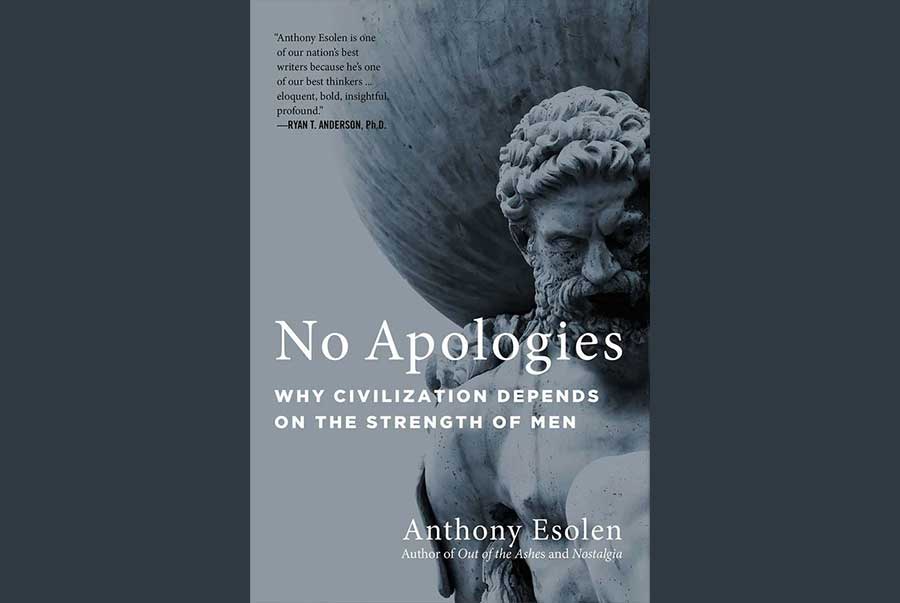
No Apologies: Why Civilization Depends on the Strength of Men by Anthony Esolen
reviewed by Alexander Riley
A few months ago, a team of men replaced the roof on my house. There were perhaps eight in total, including those who were not there for the whole five or so hours of the operation, but only long enough to, for example, deliver shingles.
Roofing work is physically difficult and dangerous. You climb about twenty feet up a ladder, then walk and sometimes crawl around on top of a house, and expertly wield a range of tools from shingle strippers to powerful nail guns. I watched these men as they marched up from the ground to the top, holding the ladder with one hand, or none at all, while carrying various needed and often heavy objects up with them. On the rooftop, they picked up and carried packs of asphalt shingles weighing around 75 pounds apiece from the apex of the roof, where they’d been deposited by the truck, to the four corners of the structure. The sun’s rays were beating down ferociously on them while they performed these impressive physical feats.
The arduousness of the work did not at all dampen their enthusiasm. Only minutes after they started, one of them began singing. Another immediately joined him. Those two sang intermittently throughout the day, with real gusto, sometimes briefly accompanied by others among their comrades. From time to time, I came outside to admire their labor and hear their song.
Men’s Work
In his latest book, No Apologies, Anthony Esolen poses fundamental questions about this kind of activity and the men who do it. Why is it almost always men who are doing such things? Perhaps you’ve seen the rare female roofer—I cannot recall ever having observed one—but ask yourself how many women are physically capable of it. And how many of those women with the requisite strength and stamina do you believe would willingly choose to do this kind of work?
If you are being honest, you know these numbers are vanishingly small. They could doubtless be increased at least slightly. We could work hard as a society to tell girls from early on in life that roofing is something they should fervently desire to do. We might also subject girls to vigorous physical training to increase the number with the requisite strength.
But again, if you are being honest, you suspect that it would be next to impossible to change the overwhelmingly male skew of roofers more than marginally, even with all this effort. Many, many more men than women are both interested in the work and physically capable of doing it. But we could make a social engineering effort at considerable cost to move the balance a bit if we so desired.
But what exactly would we stand to gain by spending a lot of time, energy, and resources trying to get more women to do roofing? And what would we lose?
Now multiply the physical difficulty and danger of the work still more. Think of the last time you were in a big city and saw workers several stories up on a building frame or operating heavy equipment on the roadway. Did you see women among them? How many? Why do you think men are so much more in evidence in this kind of labor? Be honest.
Ask yourself if we need such work to be done and, if we do, how we might best ensure that men will continue to do it. Do you think it is productive to that end to think and talk about men as we increasingly do in this society? To be constantly denigrating them, telling them that their entire way of being in the world is contemptible and in need of immediate and radical adjustment, punishing them if they resist these efforts at social engineering, and reminding them on every occasion of all the wrongs purportedly committed by their sex and of their responsibility for all of it?
Profound Differences
The feminist answer to all these questions starts from the view that the interests and abilities of men and women are not very different. Esolen rightly begins his response to that perspective with a topic that is increasingly being closed off altogether in contemporary discussions of the nature of men and women: biology. Men and women do not differ solely because particular social groups have decided to differentiate them, based on their cultural values. There is a material foundation that all cultures must build on, and this helps explain why there is so much continuity throughout the diversity of human societies on this topic.
Men are on one side of a sex binary, with women on the other side. And it is a binary, not a continuum. The overwhelming majority of human beings fit obviously into one or the other position. Genuinely intersex individuals make up only about 0.018 percent of our species, or under 2 in 10,000. A man is an individual in a sexually reproducing species with male gametes, or sex cells. Natural selection operates on a “him” quite differently than it does on a “her.” Much of the sex difference can be explained just by reference to these basic mechanisms.
Men and women are similar in many ways, but they differ profoundly in many, too. The roofing example shows us some of the most basic differences. Men are, on average, larger and stronger in both upper and lower body strength, and considerably so. The man at the 50th percentile among his sex in strength—that is, half of all men are weaker and half are stronger than he—is physically stronger than more than 99 percent of women. This alone has enormous consequences.
A Positive Good
Men are also more personally assertive, more attracted to adventure and risk, and more driven by what Esolen calls the “rage to mastery” than women. The rage to mastery—the single-minded focus on one task in order to perfect performance or design—is certainly found in women as well as in men, but not to the same degree. When you look for the humans who are most prone to obsessive preoccupation with one task to the exclusion of all other concerns—and note that this is a propensity with both potentially positive and negative consequences—you almost always find men.
Men by their nature seek unsafe spaces, Esolen argues, and all of humanity has profited immensely from this fact. The world in which we live—with all that provides for natural needs, protects against omnipresent natural threats, and allows us to suffer less and live longer and more comfortably—would not exist without men. The work of women, too, is necessary for our present condition to be. But to imagine that you could remove men, or make them indistinguishable from women, and still have all that we have now is the purest fantasy.
Esolen provides detailed and artfully rendered examples in the conception and construction of the Roman aqueducts and the water system in any American city. The seeming magic of potable water appearing in a place far from its origin is produced not by emotive incantations or outsized concern for social justice, but by the painstaking logic and back-breaking work of men dedicated single-mindedly to that task.
We need men who will do such work. Many men will pursue it no matter what surrounds them. But if we maintain a culture that devalues them, we will have many fewer of them. The women’s studies professors will then have to shriek their fury at the imagined patriarchy in a world without the lighted and air-conditioned faculty offices in which they currently sit.
Esolen recognizes that the basic misstep of feminism is the same one taken by the other major revolutionary ideologies of the past several centuries. It is the assumption that total equality is not only a desirable end but also an achievable one, given the right social program. The truth is that the sex difference, which begins as biological, inevitably produces myriad consequences in the division of labor and the social spaces in which men and women tend to desire to be. But the differences between the sexes are not something to regret or disparage, he argues. They ought to be embraced and celebrated. We collectively benefit from them in innumerable ways. They are a positive good.
The feminist caricature of men would have it that they unite as a class against the class of women. Men seek to govern, in this view, because they want to exercise power over women, not because they want to protect their social groups against the possible depredations of rogue males in their own or other societies. But history is replete with the evidence of how much of male work is dedicated to protection of and self-sacrifice for women and children. This sacrificial element of traditional masculinity is a crucial aspect of a viable social order for which feminist political theory offers no substitute.
Detriments of Feminism
As readers of this journal well know, Esolen is a bold writer, unafraid of running afoul of those who attempt to police the boundaries of discourse and argument. An example is his case for suffrage as based on households rather than individuals. He even suggests that what women believe to have been won by the Nineteenth Amendment to the Constitution may be something less positive than they believe, even for themselves. He asserts that he would give up his own individual right to vote if he could only have back some of the freedoms that women and men had in the days before that amendment was passed and that have subsequently been lost because our government extended its power against us in the interest of social justice. These lost freedoms include the right to keep one’s money from the redistributionist tax collectors and freedom of association.
Esolen also argues that the entry of women into the political realm has disturbed its productive dynamic. In the time when only men occupied it, it was understood that emotional displays such as the sneering “How dare you?” of Greta Thunberg had no place there. It was an agonistic field in which only cases supported by reference to reality and argument stood a chance of swaying enough support to achieve practical action. Allowing women into the realm of politics, he writes, “has rewarded the shrew at the expense of the lady and it has short-circuited the dynamism of the duel of men against men in the arena.”
In academia too, the ethic of feminism has gained considerable traction, to the detriment of scholarly pursuit. Men are more comfortable with the competitive game of academic debate and more capable of engaging in it without its ending in bitterness and personal enmity. Open discourse in the pursuit of truth requires such an attitude. But free debate is destroyed by the victory of feminist culture because this injects a personalist, moralizing standpoint that will not permit vigorous argumentative engagement.
In general terms, Esolen suggests, we might speak of a central male value of Truth and a core female value of Compassion. Both are necessary for our thriving, but there are realms of human endeavor where one or the other is privileged for very excellent reasons. In caring for infants, the dedication to objective truth is sidelined in the interest of the emotional nurturance that is crucial to the child’s development. In science, truth has to be the central concern, or we quickly fall into error and our science will no longer provide the goods we desire of it. Scholarship driven by social justice concerns cannot hope to be anything more than propaganda.
Anthony Esolen has given us an invaluable book on an essential topic. I will recommend it widely, and I intend to use it in my teaching. I am as grateful that he wrote it as I am constantly amazed that we are in such a strange and dangerous time that we now require such books to remind us of what we all once knew as a simple correlate of being human.
Alexander T. Riley is a senior fellow at the Alexander Hamilton Institute for the Study of Western Civilization and a member of the board of directors of the National Association of Scholars.
A Journal of Mere Christianity—Delivered to Your Door
- Essays on theology, culture, and the Church
- Contributors from across the Christian traditions

Six print issues (one year) of Touchstone, plus full online access and PDF downloads for only $39.95.

Get a one-year full-access subscription to the Touchstone online archives for only $19.95.
bulk subscriptions
Order Touchstone subscriptions in bulk and save $10 per sub! Each subscription includes 6 issues of Touchstone plus full online access to touchstonemag.com—including archives, videos, and pdf downloads of recent issues for only $29.95 each! Great for churches or study groups.
Transactions will be processed on a secure server.
more from the online archives

37.5—Sept/Oct 2024
Why Law Schools Can't Teach Law
A sidebar to How Law Lost Its Way by Adam MacLeod


calling all readers
Please Donate
"There are magazines worth reading but few worth saving . . . Touchstone is just such a magazine."
—Alice von Hildebrand
"Here we do not concede one square millimeter of territory to falsehood, folly, contemporary sentimentality, or fashion. We speak the truth, and let God be our judge. . . . Touchstone is the one committedly Christian conservative journal."
—Anthony Esolen, Touchstone senior editor
