




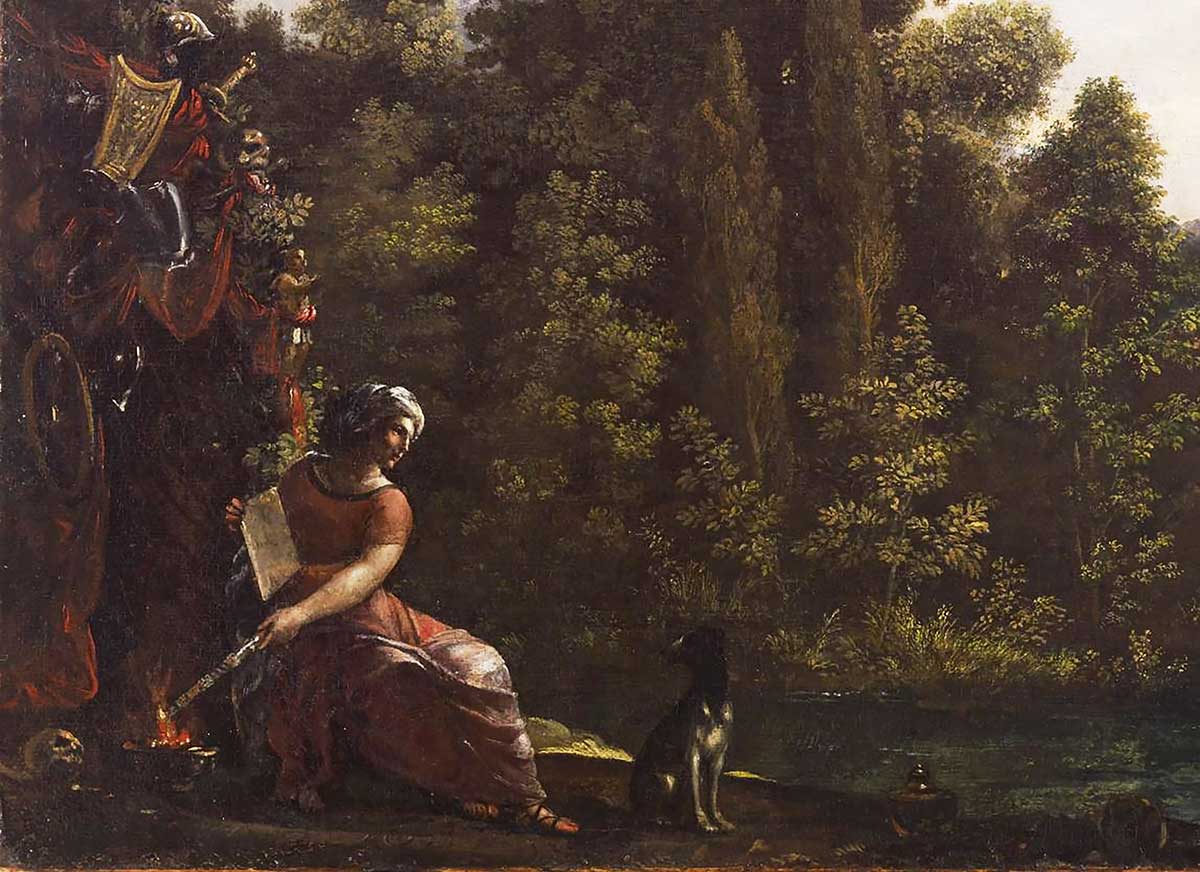
Toil & Trouble
A Brief Account of the Occult at the End of Western Civilization
Newsweek magazine reports that the number of self-identified witches in the United States now exceeds 1.5 million, up from a mere 8,000 in 1990. At that high and growing number, the magazine continues, the devotees of witchcraft far exceed the shriveling membership of the “mainline” Presbyterian Church USA and just about equal the count of Episcopalians.
I am unsure what to make of such comparisons between the witches and the “mainline” Protestants. A cynic of the “Old Believer” sort might see here merely a distinction without a difference, or a welcome clarification of identities.
Certainly, this surge in the popularity of witchcraft finds confirmation in the broader American culture. In recent years, television series featuring witches have included Charmed, Legacies, Salem, A Discovery of Witches, The Chilling Adventures of Sabrina, Motherland: Fort Salem, American Horror Story: Coven FX, The Secret Circle, Always a Witch, The Witcher, and Grimm. If you add to this list those serials focused on vampires, zombies, demons, and Satan himself, the count of occult productions climbs to near fifty—and that does not include feature films. The contemporary American fascination with the diabolical seems clear; authentic and effective Christian counterparts are almost non-existent.
On a related matter, there is now a somewhat serious campaign to make Halloween “America’s Federal Holiday of Death.” The commercial case for this is evident. The sale of Halloween merchandise in the USA far exceeds that in any other nation, both absolutely and on a per-capita basis. And the total spent on Halloween gear is second only to that spent for Christmas. Whatever Christian influence might once have been present in the celebration of All Hallows Eve, the diabolical has largely won out.
Theological & Secular Views
Christians, of course, are deeply troubled by the very subject of witches and warlocks. The Christian witch-hunters of the late medieval and early modern eras hold a reputation for ruthlessness, astonishing cruelty, and arbitrary executions—judgments only amplified in contemporary tellings. Such witch-hunts stand in the popular mind as indelible, even crippling, indictments of the followers of Jesus.
Still, the theological record on these matters should be confronted. Early medieval writers commonly dismissed witchcraft as but a figment of the imagination. However, while never directly addressing “witches,” Thomas Aquinas did describe the reality of demonic sorcery, involving pacts between a sorcerer and the devil. His concern focused especially on the marital and sexual realms, where agents of the diabolical sought to impede carnal union and prevent the consummation of matrimony. Sterility—the absence of generative life—seems to have been the goal.
In 1495, the Dominicans Heinrich Kramer and James Sprenger drew extensively on Thomistic writings and produced the now-infamous volume Malleus Maleficarum (The Witch Hammer). This hefty book came in response to Pope Innocent VIII’s prior bull, Summis desiderantes affectibus, which lamented the growing prevalence and power of the witch cult. As the two friars amplified, the reality was “that the Devil is gaining ground; in other words that God is losing it; that the human race, saved by Jesus Christ, is becoming the conquest and prey of Satan.” They described in remarkable detail all “the methods by which the works of witchcraft are wrought and developed and how they may be successfully annulled and dissolved.”
Martin Luther and his fellow reformers were no less clear in their denunciation of Satan and his warlocks and witches. As Luther explained:
When God’s holy word arises, it is always its lot that Satan opposes it with all his might. At first he rages against it with force and wicked power. . . . What he is unable to crush by force he thus seeks to suppress by cunning and lies. . . . At all hours the Devil is seeking to kill us all. . . . If he could kill you in your mother’s body, he would do it.
What, according to secular analysis, actually lay behind the witch scare in late medieval and early modern Europe? Today’s dominant explanation comes from feminists. It holds that patriarchal efforts to control women—especially intelligent and independent women—have commonly masqueraded as crackdowns on witchcraft. Satan was not the problem then and there; men were. As Gabriela Herstik—author of the books Inner Witch, Bewitching the Elements, and Sacred Sex and the Priestess of Kink Coven in Los Angeles—summarized in Sabbat magazine: “Witchcraft is feminism; it’s inherently political. It’s always been about the outsider, about the woman who doesn’t do what the church or patriarchy wants.”
This feminist view actually fits fairly well with an older and recurring explanation. It holds that the entire witch episode was but one of the many delusions to be found in the ignorant, benighted Middle Ages. Some have even argued that no one at the time even tried to engage in witchcraft. As one commentator wrote in the Saturday Review [1957], “The fear of witches was the main cause of their persecution and the persecution increased the fears. There appeared and spread everywhere a mass psychosis,” which resulted in thousands of innocent victims.
Theories of Real Witchcraft
However, some scholars have argued that the witches were very real. One explanation sees late medieval witchcraft in “green” colors, as the underground remnant of a religion older than Christianity. As explained by anthropologist Margaret Murray in her book The Witch-Cult in Western Europe, the witches held on to a paganism that worshiped a horned god—Dianus or, among the Celts, Cernunnos—which Christian witch-hunters confused with Satan. This was a nature god, a god of the seasons. Its rituals re-enacted death and rebirth. Throughout the Middle Ages, Murray argues, kings maintained Christianity as the faith of elites, a religious veneer beneath which this cult of the people thrived. Only after 1,500 years did Christian kings and prelates feel strong enough to crush this old religion of the lower classes, now identified as witchcraft.
A variation of this argument comes from Canadian historian James Rose, in his book A Razor for a Goat. He borrows from James George Frazer’s massive text The Golden Bough, to describe a pre-Christian cult of tree worship, complete with sacred groves and wise women distinguished by their knowledge of herbs. The highest development of this pagan faith came among the Druids, with their Celtic cult of the oak and the mistletoe. According to Rose, the wise women involved commonly employed the drugs belladonna and aconite. These hallucinogens numbed sensory perception and conferred illusions of freedom from the constraints of gravity and limits on distance, as in flight. As Rose writes, their “transports when under [the drugs’] influence were largely erotic and their rituals partly phallic, because that was the effect of the drug.”
Rose also argues that these drug-addled, sexually excited herbalists fell under the sway of male sorcerers, the goliards. These were men who had studied at the early Christian universities but proved unable to find clerical posts or teaching jobs. They turned instead to the life of the vagabond, at first combining begging, tumbling, and clowning with fortune-telling, card games, and quack doctoring. In a way, they were the pathetic, peripatetic, angry adjunct professors of their day, living on starvation incomes.
Rose gathers evidence to show how these wounded men founded the Ordo Vagorum, a mocking replica of the Church, a secret band that gained acceptance from and control over the witch-women. The men organized them into covens and welded these into “a ramifying international secret society” which amplified the place of Satan within the cult and engaged in covert warfare against the Christian Church.
Another thesis holding that the witch cult was real comes from Montague Summers in his best-selling 1926 book, History of Witchcraft and Demonology. A historian and an Anglican deacon who became a Catholic priest, Summers pulls no punches. As he writes in his introduction:
I have endeavored to show the witch as she really was . . . social pest and parasite; the devotee of a loathly and obscene creed; an adept at poisoning, blackmail, and other creeping crimes; a member of a powerful secret organization inimical to Church and State . . . a charlatan and a quack sometimes; a bawd; an abortionist . . . a minister to vice and inconceivable corruption.
In a way, Summers’s volume came back full circle to Malleus Maleficarum: these were women and men who had chosen, to borrow a phrase, the dark side.
Theories of Salem
What about the infamous American episode: the Salem witch trials of 1692 in Puritan Massachusetts, which ended in the execution of 21 persons? What happened then and there? Again, explanations abound.
Eighty years ago, historians favored Freudian causes, such as the “multiple repressions” of “youthful gusto” imposed by Puritan doctrines of damnation and predestination;menopausal hysteria among the older women; or the Oedipal complex among young men, with the witch as a stand-in for the mother object. More recently, another historian traces the Salem trials to a real illness: encephalitis lethargica, a rare, bird-borne ailment that produces convulsions, hallucinations, the involuntary twitching of muscles, twisted eyes and necks, partial paralysis, and language confusion—the very symptoms shown by the “possessed” Salem girls. And, of course, feminist arguments hold that witchcraft in Salem offered “an avenue for female resistance and for the assertion of female power,” while the fits, trances, and paralyzed limbs of the accusers allowed them to express “their inner rage toward patriarchal authority.”
And yet, Chadwick Hansen—professor of history at Pennsylvania State University—argues in his book Witchcraft at Salem that the crisis there was real: “witchcraft did exist and was widely practiced in seventeenth-century New England,” and the behavior of the afflicted girls “was not fraudulent but pathological.” Specifically, Bridget Bishop “was in all probability a practicing witch” who, according to her husband, “was familiar with the devil.” Others who practiced malefic witchcraft included Candy, a slave from Barbados, “Mammy” Redd, and even the Rev. George Burrough, apparently a true warlock. Their activities included fortune telling, casting spells, sticking dolls with pins, relying on “the sieve and sheers” [an early Ouija board], boiling urine, the lighting of “mares’ farts,” and poltergeist activities.
Still, much of this seems fairly harmless. Can Ouija boards, herbal potions, Voodoo dolls, ritual incantations, and the equivalent of frat-boy pranks cause real trouble?
The Thule Society & Nazism
Then again, what if members of a Satanic cult managed to seize control of a major nation and then carried out a deliberate agenda of mass death? Might that clarify the danger?
Although few realize it, this has occurred. My primary references here are two: the book The Occult Roots of Nazism, written by Nicholas Goodrick-Clarke, until his death in 2012 a professor of history at the University of Exeter in Great Britain; and Hammer of the Gods, authored by David Luhrssen, which began as his doctoral dissertation at the University of Wisconsin.
In brief, these historians trace the origins of the National Socialist German Workers Party (the NSDAP or “the Nazis”) to the Thule Society of Munich. This group grew out of the late nineteenth-century philosophy of Madame Blavatsky, known as Theosophy. Embracing Tibetan mysticism alongside occult practices native to Europe, Theosophy absorbed German racialism and anti-Semitism in the 1890s and was reborn as Ariosophy. Activities included high-end seances, the spiritualism of Ouija, rituals linking witches’ Sabbats to Masonic incantations, and “sex magic” to attain union with the divine through orgasm.
These were tied in turn to fabulous visions of the primal fire of the presumed ancient Nordic faith. Thule was the refuge for the “lost race” of Atlanteans, now buried under arctic ice, and the “magic center” of the Aryan civilization to come. Ariosophy would now use the evolutionary laws of nature to “bring into being a noble race,” the great leap forward in human evolution. Lesser beings who stood in the way would, of necessity, be eliminated.
In 1907, Jörg Lanz von Liebenfels—a former Cistercian monk expelled from the venerable Heiligenkreuz Abbey in Austria “for carnal and worldly desires”—formed the Order of the New Temple, with the swastika as its symbol. Occult behaviors abounded, as did prominent men—aristocrats, army generals, and the mayors of great cities—among its members. In 1912, this group evolved into the Germanen Society, the Bavarian chapter of which became the Thule Society, which in turn bequeathed to the world the German Workers Party, soon renamed the NSDAP.
Adolph Hitler did not become a full member of Thule, possibly due to his low social status. He was only a formal “guest.” However, after the Great War, he quickly took control of Thule’s political wing. Moreover, most of his inner circle had been full Thule members. They included:
• Rudolf Hess, Hitler’s “Vice Fuehrer” or “Number 2,” who, according to Luhrssen, lived “an occult lifestyle” and had a “well-nigh magical” relationship with the Fuehrer;
• Hans Frank, a judge and lawyer, who would be the Governor-General of occupied Poland from 1939 to 1945;
• Alfred Rosenberg, author of the incendiary Myth of the Twentieth Century, who defined the Nazi goal as “out of a new life to create a new human type,” and who served as “Fuehrer for the Supervision of the Total Education of the Spiritual and World View of the National Socialist Movement,” as well as Minister of Occupied Eastern Territories in the Soviet Union; and
• Ernst Roehm, founder of the SA Stormtroopers, or Brown Shirts, who were instrumental in bringing Hitler to political power.
While not a Thule member, Heinrich Himmler—leader of the elite Schutzstaffelor SS—filled his headquarters at Wewelsburg Castle with an array of sacred stones and other occult items gathered or stolen from around the globe.
Frank, Rosenberg, and Himmler were the chief architects of and actors in the Holocaust to come, which numbered 8 to 10 million victims, mostly Jews. Another 40 million Europeans—combatants and civilians alike—died in the conflict launched by the Nazis. If, as Luther argued, “at all hours, the Devil is seeking to kill us all,” Satan would have been most pleased by this body count engineered by the occultists of Thule.
We know too little about this tale in part because Adolph Hitler himself ordered in 1937 that all references to and records of the early Nazi Party and its predecessors be destroyed—humans, too, unless they learned to keep quiet. Hitler was happy to be labeled a disciple of Nietzsche or Schopenhauer—but not of Satan.
Also, this approach has served well the interests of the dominant liberal narrative in modern Western history. The power of secular ideologies, even terrible ones, can be acknowledged without doing damage to the premises of reason. However, to recognize the power of the occult, of the diabolical, in human affairs would open the door to all sorts of religious and spiritual mayhem. In the liberal mind, facts of this sort must be suppressed, for the good of all.
Alas, this has also left us unprepared for such developments as the possible renewal of the anti-Semitic principle found within the satanic domain. As a recent post at Satan’s Library explains: “Satan advocates individuality, freedom, and the advancement of the human race. Satan does not represent chaos, as some believe. . . . Satan is very consistent. Satan stands for freedom and rebellion, not a communist N(ew) W(orld) O(rder) where ruling Jews enslave the Gentile masses.”
Occultists in the Open
Where do we now stand in 2022? Most obviously, we can affirm with certainty that self-identified warlocks and witches do exist—1.5 million in the United States alone. Moreover, occultists no longer conduct their activities in hiding. Rather, they do at least some things quite openly. Recent examples include:
• In several states, the Satanic Temple—recognized as a religion by the IRS—has invoked the Religious Freedom Restoration Act to demand exemption from abortion restrictions. This group practices an “abortion ritual” in which a female member affirms her autonomy, undergoes an abortion among her co-believers, and gains fetal blood. Life is exchanged for death, a basic Satanic goal.
• President Joe Biden recently appointed Dr. Demetre Daskalakis as the White House National Monkeypox Response Deputy Coordinator. With his partner, this doctor also operates a “goth” gym—Monster Cycle—symbolically built on an abandoned church in Manhattan. As the pentagram tattoo on his body reads: “I have learned there is light even in the darkest places.” Among his social media posts is a depiction of a Ouija board ceremony with a lighted crucifix, showing Jesus Christ resting on a pentagram.
• And there is the advertisement dispatched by a leading sex-toy company, offering for sale a luxury shoe made from recycled rubber sex products. It is called the “Plastic Sole.” The company also offers “to reimburse the first 3 men who buy the shoes and then get a vasectomy,” in order to advance “sex positivity.” Sexual excitement and permanent sterility: Satan is not mentioned, but I suspect he would again be pleased.
Looking ahead, the opportunities of transhumanism—be they fusions of machines and humans, computers and humans, or animals and humans (chimeras)—offer vast opportunities for diabolical progress, options that might actually fit well into Alfred Rosenberg’s quest for “a new human type.” However, I leave that subject for another time.
Satan the Opportunist
How should all this be digested? I offer here my own modest, lay social theology of the diabolical. Specifically, I do not think that Satan and his minions attack Christianity and individual Christians creatively and directly. Rather, I believe that diabolical forces take advantage of weaknesses and failures that are common to the fallen creatures we are. In a word, they are opportunists.
For my concrete human example, I return to the story of the seventeenth-century Puritans in New England. From the founding of the colony in 1630 into the 1680s, this Christian commonwealth was remarkably successful. Regarding family formation, social historians have concluded that “the structure of the village families provided a source of strength. Stable and patriarchal . . . the New England family guaranteed peace and good order.” Most notably, fertility soared to an average of over nine births per woman. As demographer Jim Potter summarizes, the natural growth rate of Massachusetts and Connecticut in this period “was extremely unusual, if not unique, in human history.” In this time and place, Life triumphed over Death.
Yet this all came to an unhappy end. By 1700, marriage formation and fertility among the New Englanders had declined sharply. So had the comity and practice of Christian love that had prevailed, to be replaced by quarrels and lawsuits. Why? Political turmoil followed an action by England’s Court of Chancery in 1684 that voided the Massachusetts Bay Charter; this ended the colony’s era of self-government. And in the same years, an unusually brutal war against the Indians and their French allies broke out on the Massachusetts frontier.
The true crisis, though, emerged within the churches. Prior to 1680, Puritan men by and large fulfilled their duties as Christian husbands, fathers, and householders: leading those in their charge in daily prayer, devotions, and Bible studies, and guiding the education of the young. Within congregations, a healthy gender balance obtained, with equal numbers of men and women in full communion.
But as Robert Pope reports, “the 1680s proved disastrous to the standing religious order.” Church membership declined precipitously; in some villages fewer than half of the townspeople were now involved. The exodus was particularly acute among men. By the 1690s, women formed about 75 percent of the membership at Boston First Church, at Charlestown First Church, and—most notably—at Salem First Church. The new situation became a “churched wife” married to an “unchurched husband,” a situation denounced by Cotton Mather as “religious apathy.”
Not coincidentally, there were also signs of a troubled “youth culture” emerging among the Puritans, which was marked by secret parties, drinking, tavern-going, and carousing. Pre-marital pregnancies soared in frequency. It was in the context of church decline, male retreat from responsibility, sexual disorder, and a breakdown in parental authority that the Salem witch episode occurred. Viewed in this way, and simply put, Satan found in these weaknesses and failures an opportunity to advance his agenda of Death—and he took it.
The Surest Protections
Apropos words from the subtitle of this conference, “The Mystery of the Real,” also stand evident. As St. Paul explains in Ephesians 5:32, marriage “is a great mystery,” where a man and a woman miraculously become one flesh, what G. K. Chesterton once called a “four-legged creature.” Strong Christian homes—with men as gentle patriarchs, women as faithful wives and mothers, and children “as tender plants growing in the truth”—are the surest protections against the intrusion of the diabolical into human affairs. Warlocks, witches, and Ouija boards are the symptoms of Christian failure, not the cause.
And so, the task lying before “mere Christians” appears most clear: to create true homecomings, resting on the distinctive responsibilities of men and women, of fathers and mothers, bound in marital unions. Diabolical voices will again cry in fury, but all to no avail.
Allan C. Carlson is the author of numerous books, including Family Questions: Reflections on the American Social Crisis and The American Way: Family and Community in the Shaping of the American Identity. He attends St. Paul Lutheran Church in Rockford, Illinois. He is a senior editor of Touchstone.
A Journal of Mere Christianity—Delivered to Your Door
- Essays on theology, culture, and the Church
- Contributors from across the Christian traditions

Six print issues (one year) of Touchstone, plus full online access and PDF downloads for only $39.95.

Get a one-year full-access subscription to the Touchstone online archives for only $19.95.
bulk subscriptions
Order Touchstone subscriptions in bulk and save $10 per sub! Each subscription includes 6 issues of Touchstone plus full online access to touchstonemag.com—including archives, videos, and pdf downloads of recent issues for only $29.95 each! Great for churches or study groups.
Transactions will be processed on a secure server.
more on history from the online archives
31.1—January/February 2018
on Ragnarök, an Extreme Weather Event & the Paths to Conversion by Timothy J. Burbery
15.6—July/August 2002
Things Hidden Since the Beginning of the World
The Shape of Divine Providence & Human History by James Hitchcock
14.6—July/August 2001
The Transformed Relics of the Fall
on the Fulfillment of History in Christ by Patrick Henry Reardon
more from the online archives
37.5—Sept/Oct 2024
A Battle Plan for Peace While Growing Old by Anthony Esolen
22.8—November/December 2009
on the Real Men Behind the Christmas Carol by Michael Baum

calling all readers
Please Donate
"There are magazines worth reading but few worth saving . . . Touchstone is just such a magazine."
—Alice von Hildebrand
"Here we do not concede one square millimeter of territory to falsehood, folly, contemporary sentimentality, or fashion. We speak the truth, and let God be our judge. . . . Touchstone is the one committedly Christian conservative journal."
—Anthony Esolen, Touchstone senior editor
