





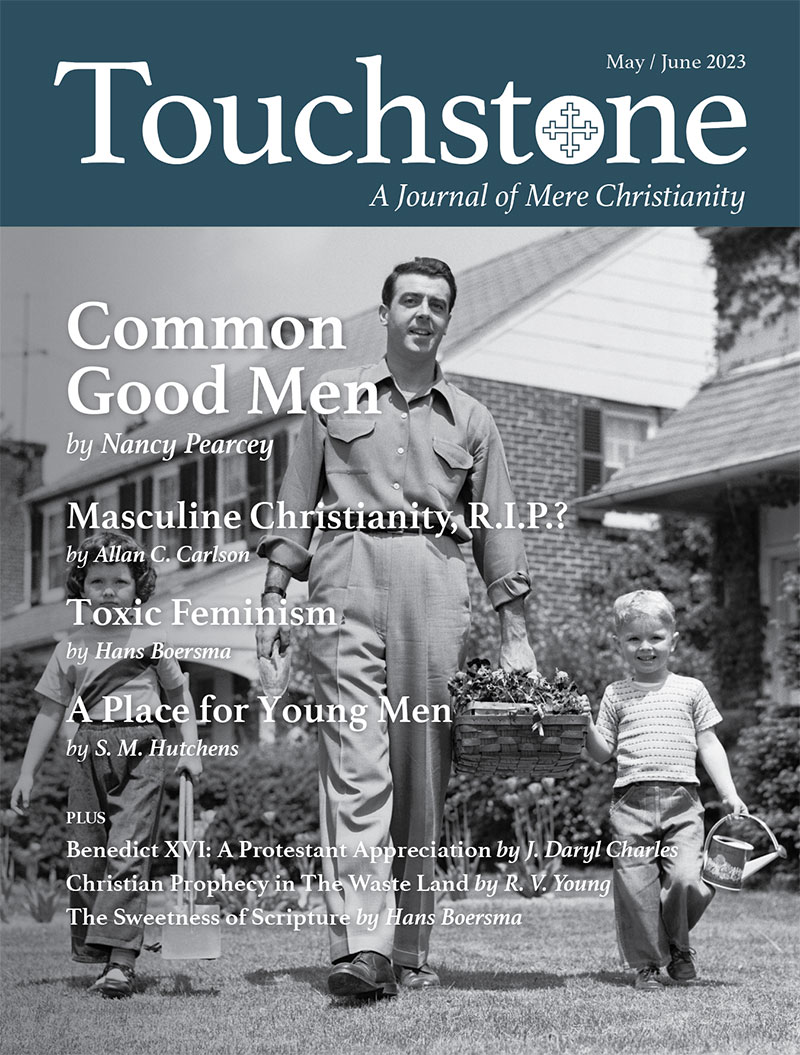
Toxic Feminism
The Genesis of Gender: A Christian Theory by Abigail Favale
Ignatius Press, 2022
(251 pages, $17.95, paperback)
The rapid spread of gender dysphoria is an urgent problem—not just because of the tidal wave of teenagers, most of them girls, struggling with their sexual identity, but particularly because our medical establishment generally avoids asking the hard questions and instead has decided simply to affirm our kids’ self-identification. Parents are often without recourse when, to their own spiritual and physical detriment, their girls insist on testosterone treatment followed by a double mastectomy and other surgical steps deforming their growing female bodies.
Truth be told, once kids have decided that they want a medical transition, parents are mostly powerless. Indeed, children get overwhelming support—socially and medically—affirming them in their so-called new-found identity. Parents often feel bewildered, wondering what happened to confuse their children so thoroughly as to reject their sexual identity.
All too often, answers to this question are hard to come by, leaving parents who oppose their children’s physical mutilation fearful and frustrated, while the parent-child relationship gets strained and often breaks down.
Still, the search for answers need not be elusive. Abigail Favale’s page-turner, The Genesis of Gender: A Christian Theory, explains how it is that children are tempted to make their ill-fated choice of transgender surgery. The answer is twofold—feminism and bodily self-hatred. As we will see, the two responses are linked, even though the first is a broad philosophical stance originating in the nineteenth century and the second is a social media-driven pathology that takes the form of negative self-perception.
Favale brilliantly exposes transgenderism as the successor to anorexia and bulimia. Just like anorexia, so transgenderism is a rejection of the body, resulting from hyper-sexualization, especially of girls—heavily promoted through internet and social media. Both girls suffering from anorexia and girls that undergo transgender surgery have rejected their female bodily identity. “These young women,” states Favale, “are rebelling, understandably, against the hyper-sexualization of the female body, but in doing so, they are turning against the body itself.” Sadly, whereas one can turn to a psychologist to find healing from anorexia, the medical profession mostly affirms those seeking transition in their self-destructive path.
Feminism’s Offspring
Favale writes as a scholar of feminism who has undergone a twofold conversion: from evangelicalism to Catholicism and from feminist dogma to a recognition of its inherent flaws. Her academic background gives a feel of authenticity to the book that makes it difficult to ignore or discount. Favale speaks both from personal experience and with scholarly expertise—a winsome combination that will, I suspect, win over many initially skeptical readers.
Perhaps Favale’s most remarkable claim is that feminism naturally led to the so-called “gender paradigm.” Feminists often oppose transgender activists because the latter, by destabilizing gender, undermine the gains made by feminism—or so it is often thought. The truth, however, is more complex and more unsettling. The self-loathing of transitioning young girls can be traced to feminist theorists. Margaret Sanger insisted that women are oppressed by their own bodies. Simone de Beauvoir resented the oppression of women, not just by social forces but also by their biology. As a student, Favale was drawn to feminism because she wanted to embrace her dignity as a woman. She found out, however, that for feminism, dignity could be found only by rejecting the idea of womanhood altogether. The ironic truth, as Favale points out, is that “the gender paradigm is feminism’s offspring.”
Favale has not lost all sympathy for feminism. Using the well-known classification of feminism in three waves, she still maintains that the first wave, which was tied to the Temperance Movement and gave women the right to vote, corrected certain patriarchal excesses. I remain unconvinced. Favale admits that even early feminism suffered from a weak metaphysic. Indeed, we should perhaps face the truth that universal voting rights reflect an atomizing of human beings, shorn of all organic connection—the natural outcome of the nominalist metaphysic that Favale rightly scorns. The organism of the family is much more than the sum total of its individual members; traditional household votes recognize families as real unities and are, therefore, superior to purely individual votes, which strip people of the organic links that shape their identities.
Hans Boersma is the Saint Benedict Servants of Christ Professor in Ascetical Theology at Nashotah House Theological Seminary.
A Journal of Mere Christianity—Delivered to Your Door
- Essays on theology, culture, and the Church
- Contributors from across the Christian traditions

Six print issues (one year) of Touchstone, plus full online access and PDF downloads for only $39.95.

Get a one-year full-access subscription to the Touchstone online archives for only $19.95.
bulk subscriptions
Order Touchstone subscriptions in bulk and save $10 per sub! Each subscription includes 6 issues of Touchstone plus full online access to touchstonemag.com—including archives, videos, and pdf downloads of recent issues for only $29.95 each! Great for churches or study groups.
Transactions will be processed on a secure server.
more on feminism from the online archives

14.6—July/August 2001
Three Bad Ideas for Women & What to Do About Them by Frederica Mathewes-Green
33.1—January/February 2020
on the Consequences of One Birth Before Roe v. Wade by Craig Kellogg Galer
more from the online archives
30.5—Sept/Oct 2017
The Critical History Before, During & After Martin Luther by James Hitchcock

29.5—Sept/Oct 2016
on Past & Present Atheism & the Invention of Happiness by Jordan Bissell

calling all readers
Please Donate
"There are magazines worth reading but few worth saving . . . Touchstone is just such a magazine."
—Alice von Hildebrand
"Here we do not concede one square millimeter of territory to falsehood, folly, contemporary sentimentality, or fashion. We speak the truth, and let God be our judge. . . . Touchstone is the one committedly Christian conservative journal."
—Anthony Esolen, Touchstone senior editor
