




One Hundred Years in the Unreal City
Christian Prophecy in The Waste Land
“We dwell in the Unreal City,” writes Anthony Esolen. “We all dwell there. We have all been dulled and deadened by the unreal. But if God is real, then to turn away from God is to leap into unreality, and that is pretty much the definition of evil” (Sex and the Unreal City, 2020, 8). The phrase “unreal city” is not Professor Esolen’s coinage. It originates in T. S. Eliot’s The Waste Land, first published a century ago, in October 1922. It immediately became a literary sensation because of its arrestingly innovative techniques and its grimly ironic vision of the modern world, and it remains the most famous and influential poem of the twentieth century. It is notoriously difficult to understand, and for many readers, since its initial publication down to our own time, its elusive discourse and apparently incoherent structure are simply an expression of disillusionment and disgust in the face of a sterile, meaningless world.
When a Christian reads Eliot’s landmark poem today, however, he is likely to marvel at how prescient the poet was in describing the decadence of Western society as it has degenerated in the course of the following century. Few readers saw this, however, until, six years after the publication of The Waste Land, Eliot announced that he was “a classicist in literature, a royalist in politics, and an Anglo-Catholic in religion.” Not until then did critics begin to suspect—some with dismay—that the scriptural allusions and other Christian references in the poem might be something more than random fragments shorn of context and Christian meaning.
A consideration of the relationship between Eliot’s poem and orthodox, historical Christianity is, then, not only a compelling topic in its own right; it also offers an opportunity to reflect upon the place of poetry in the spiritual and intellectual life of the Christian faithful; for the role of The Waste Land in Western culture suggests how a poem, even a poem by a man who is not yet committed to the Christian faith, can have an effect analogous to scriptural prophecy.
The Artist’s Self-Sacrifice
Sensible critics and poets will not, of course, regard poetry as “prophetic” in the scriptural sense of emerging from direct divine revelation, as did such Romantics as Blake and Shelley. Poetry is not a substitute for the Bible, for the actual Word of God. It can, nonetheless, be a means of seeing the world more clearly and recognizing the creation as a reality independent of our assumptions and desires. Imaginative literature demands that we step outside the enclosed circle of our self-absorption and regard the human experience from a different perspective. In the case of a genuine literary artist, this alternative is not merely the view of another individual, expressing his own self-interested viewpoint. What defines literary excellence is precisely the talent to represent general human experience rather than the idiosyncratic preoccupations of the author.
“Talents,” as we know from the New Testament parable, are God-given. And in this respect, literature can be analogous to prophecy, which, as St. Thomas Aquinas points out, is not a “habit”; that is, an acquired faculty or skill that can be deployed at will: “Someone cannot make use of prophecy when he wishes” (Summa Theologia II-II.171). In parallel fashion, although a man must use the skill, knowledge, and wisdom at his disposal when he sets out to produce a poem, a play, or a novel, he cannot be sure in advance where his literary efforts will lead—not, that is, if he is true to the vision of human experience with which the work begins.
Eliot himself lays out the basis for this view of literary creation in an essay, “Tradition and the Individual Talent.” In the composition of a work of literature, Eliot suggests, the role of the writer is not to project his opinions or his personality. “What happens is a continual surrender of himself as he is at the moment to something which is more valuable. The progress of an artist is a continual self-sacrifice, a continual extinction of personality” (The Sacred Wood 1920, 52–53). “The more perfect the artist,” he adds, “the more completely separate in him will be the man who suffers and the mind which creates” (54); and, most crucial, “the difference between art and the event is always absolute” (56). Although Othello is a profound and edifying tragedy, we should not care to be present for the actual events the drama depicts. Similarly, the Iliad and the Odyssey are compelling works that capture the attention of a vast array of readers more than two and a half millennia after their composition, but we know nothing about Homer’s political opinions.
To be sure, we know a good deal more about T. S. Eliot, and much has been written, often disapprovingly, about his opinions—political, religious, and literary. Nevertheless, it would be folly to assume that The Waste Land is a compendium of the poet’s opinions, much less the mere “personal grouse” that he called it years later, when he was weary of being identified as the spokesman for the disillusionment of the “lost generation.” His willing submission of successive manuscripts to the often severe, howbeit astute, editing of Ezra Pound confirms that he regarded his work as something more than self-expression. It is because Eliot was willing to sacrifice his personality—the demands of his ego—to the integrity of the poem as a work of art that The Waste Land provides a representation of reality transcending the conscious individual intentions of the poet who wrote it.
Overview of the Poem
The title of the poem derives from Eliot’s reading of Sir James G. Fraser’s The Golden Bough (1911–1915) and, especially, Jessie L. Weston’s From Ritual to Romance (1920). These two works of early anthropology deal, respectively, with pagan notions of the dying and rising god and the sacrifice necessary to assure the fertility of the land, and with the Christian legend of the quest for the Holy Grail, which Weston associates with a wounded king, who must be healed for fertility to be restored to his land. The Grail is, of course, the Chalice used at the Last Supper and subsequently by Joseph of Arimathea to catch the blood flowing from the wound in our Lord’s side as he hung upon the Cross.
The title of the poem thus suggests that Eliot’s world in the wake of the Great War has been laid waste and rendered sterile, and that this wasted land is an image of spiritual sterility: of a culture and society that has lost meaning and purpose until the Grail has been recovered. For anthropological thinkers like Fraser and Weston, the Christian account of Christ’s Incarnation, Passion, Death, and Resurrection is merely a romantically idealized version of crude heathen fertility rites and human sacrifice, but Eliot’s poem does not affirm this shallow, secular view.
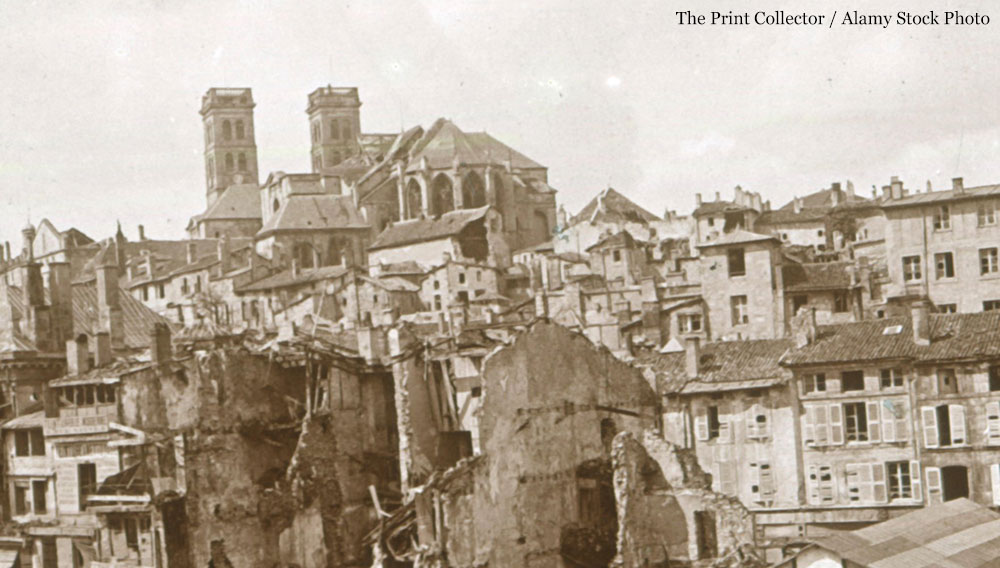
The Waste Land comprises five sections and, in the first book versions of the poem and all subsequent editions, a set of notes, added by Eliot himself, which identify some of his sources. The first three sections, “The Burial of the Dead,” “A Game of Chess,” and “The Fire Sermon,” consist largely of vividly imagined episodes depicting a failure of love and communication between men and women and various other examples of anxiety, boredom, and anomie. These initial parts of the poem take place within the “Unreal City.” It serves as the capital, as it were, of the Waste Land. The very brief Section IV, “Death by Water,” is the hinge on which the poem turns, since the fifth section, “What the Thunder Said,” takes place outside the fog-shrouded walls of the metropolis of illusion. It represents a journey through a rocky, drought-stricken, war-torn desert to the Chapel Perilous, the putative location of the Holy Grail.
It is impossible in the space allotted for this discussion—even had I the ability—to explain every obscure image, symbol, or character in the poem; but its overall meaning and method of narration are sufficiently accessible, once the reader has grasped the joint techniques of allusion and stream of consciousness narration. The “plot” of The Waste Land unfolds in an apparently random series of scenes involving diverse characters and actions. Eliot seems thus to have anticipated the montage technique of contemporary cinematic directors, whose films move among various characters and settings without establishing clear temporal or causal relationships between them. Like the modern cinema-goer, the reader of Eliot’s poem is obliged to await patiently, as he makes his way through the text, the eventual disclosure of how these various persons, places, and events fit together.
Although there are a great variety of dramatic voices in the poem, there is also a single narrative perspective which moves from scene to scene, sometimes merely commenting, sometimes seeming to participate. In his own note to line 218, where Tiresias appears, Eliot identifies this narrative perspective with the blind Greek seer: “What Tiresias sees, in fact, is the substance of the poem.” Nevertheless, it would be futile to project the character or personality of Tiresias into each scene.
Section I
Two features of the poem that produce its initial formidable difficulty—constant allusion to other works of literature as well as to works of learned speculation, and the absence of clear narrative transitions—are also the keys to its interpretation. The first of The Waste Land’s five sections, “The Burial of the Dead” (the Prayer Book rubric for the funeral service of the Church of England), begins abruptly with what is surely a counter-intuitive assertion:
April is the cruellest month, breeding
Lilacs out of the dead land, mixing
Memory and desire, stirring
Dull roots with spring rain.
Winter kept us warm, covering
Earth in forgetful snow, feeding
A little life with dried tubers. (1–7)
The shock of this surprising distaste for April and its stirrings of natural rebirth is intensified if the reader is immediately reminded of another famous English poem, composed more than 500 years earlier:
Whan that Aprill with his shoures soote
The droghte of March hath perced to the roote,
And bathed every veyne in swich licour,
Of which vertu engendred is the flour;
Whan Zephirus eek with his sweete breeth
Inspired hath in every holt and heeth
The tendre croppes. . . . (1–7)
This is the beginning of Chaucer’s Canterbury Tales: the melody of these lines alone manifests their significance: the rich, tremulous delight that all creation naturally takes in the energy of spring, borne on the sweet breath of the west wind and descending in showers from the heavens. The contrast with the anxious shrinking from the lusty energy of spring, which opens The Waste Land, could not be sharper. That is precisely the point of the allusion: to jar the reader’s sensibility by incongruous juxtaposition.
This startling rejection of what ought to be joyous rejuvenation is an emblem of decadence. We hear first a representative denizen of Europe’s idle aristocratic class just before World War I, which would shatter their world forever. Her voice is a synecdoche for a luxuriant, but restless and doomed existence:
And when we were children, staying at the archduke’s,
My cousin’s, he took me out on a sled,
And I was frightened. He said, Marie,
Marie, hold on tight. And down we went.
In the mountains, there you feel free.
I read, much of the night, and go south in the winter. (13–18)
And down we went—an ominous line that gives way to a passage recalling minatory verses from Ezekiel, with additional references to Ecclesiastes and Isaiah.
In the century after the poem’s first publication, scholars have uncovered a vast array of actual or possible allusions, some of which Eliot acknowledged as intentional, some of which had never occurred to him; but the overwhelming effect of the images—at least for those with ears to hear and eyes to see—is to evoke some of the most somber passages in Sacred Scripture:
What are the roots that clutch, what branches grow
Out of this stony rubbish? Son of man,
You cannot say, or guess, for you know only
A heap of broken images, where the sun beats,
And the dead tree gives no shelter, the cricket no relief,
And the dry stone no sound of water. (19–24)
This is a key passage in the first part of The Waste Land. The echoes of Isaiah and Ezekiel recall the prophets’ admonition of the Hebrews who have abandoned fidelity to their covenant with the one, true God for idolatry; and Ecclesiastes proclaims the meaninglessness of life without grace. The prophetic warning is succeeded by three apparently random episodes that further dramatize the disintegration of Marie’s world of blasé privilege.
Just as the use of the allusions reminds us that our society rests upon a great tradition of Western civilization, so the suppression of the narrative connections between the various episodes dramatizes how we have lost the sense of historical connectedness. In the essay, “Tradition and the Individual Talent,” Eliot calls this “the historical sense,” which “involves a perception, not only of the pastness of the past, but of its presence” (49). His procedure of moving from scene to scene in The Waste Land without apparent transitions, insofar as it occurs in the mind of the narrator, may be called stream of consciousness. The technique is not per se incoherent; rather, it represents incoherence, evoking verbally the disorientation of a people that has lost its sense of grounding in a cultural and religious tradition.
As “The Burial of the Dead” draws to a close, we encounter the first evocation of the master image of the poem:
Unreal City,
Under the brown fog of a winter dawn,
A crowd flowed over London Bridge, so many,
I had not thought death had undone so many.
Sighs, short and infrequent, were exhaled,
And each man fixed his eyes before his feet,
Flowed up the hill and down King William Street,
To where Saint Mary Woolnoth kept the hours
With dead sound on the final stroke of nine. (60–68)
These lines comprise allusions both to the nineteenth-century French symbolist Charles Baudelaire and to Dante. Eliot’s note directs us to the opening lines of Baudelaire’s poem “The Seven Old Men”: “Teeming city, full of dreams, / Where the ghost in broad daylight accosts the passerby!” Eliot’s crowd that flows over London Bridge thus comes from Baudelaire’s macabre vision of Paris; the “brown fog” that engulfs this throng doubtless derives from the third stanza of “The Seven Old Men,” which begins, “A dirty, yellow fog seeped everywhere.” Baudelaire thus provides a classic image of the claustrophobically swarming, polluted modern city, whose crowds suffer the eclipse of their physical vision because of the thickened toxic air, and of their spiritual vision because of grimy fog in their souls. The city, then, is “unreal” because it blinds men to reality.
A few lines later, Eliot closes this first section of The Waste Land by simply quoting a famous line from the introductory poem to Baudelaire’s collection, The Flowers of Evil: “Hypocrite reader,—my fellowman,—my brother!” In this way, Eliot, like Baudelaire, reminds us that we are part of the decadence that he brings before our eyes.
Again, in his own notes to The Waste Land, Eliot points out that the line, “I had not thought death had undone so many,” comes from the third canto of Dante’s Inferno (l. 57), describing those in the vestibule of hell, whose lives were not sufficiently virtuous for heaven, nor sufficiently vicious for the depths of hell. The phrase, “sighs, short and infrequent,” alludes to the next canto (4:26), where the souls of the unbaptized are not actively punished, but pine eternally for the beatific vision. It is worth noting as well that Virgil tells Dante that in descending into hell, they enter “into the blind world” (nel cieco mondo, 4:13).
By bringing Baudelaire’s disturbing vision of modern Paris together with Dante’s depiction of souls too indifferent even for damnation, Eliot suggests that the social and political problems of his own London, and of the modern world generally, are not essentially different from the moral and spiritual failings that have always afflicted mankind and are not amenable to the technical and economic solutions favored by the modern world. A dozen years later, in Choruses from the Rock (1934), the poet writes of men “dreaming of systems so perfect that no one will need to be good” (VI).
Section II
The second part of The Waste Land, “A Game of Chess,” takes its title from two plays by the Jacobean dramatist Thomas Middleton. The significance here is the reduction of sexual love to the moves in a competitive game. It consists of two long episodes, the first in an aristocratic boudoir, with overtones from Shakespeare’s Antony and Cleopatra, the second in a working-class pub. In the first scene, a neurotic woman frantically seeks to provoke some response from a husband sunk in torpid apathy:
“What shall I do now? What shall I do?
“I shall rush out as I am, and walk the street
“With my hair down, so. What shall we do tomorrow?
“What shall we ever do?”
The hot water at ten.
And if it rains, a closed car at four.
And we shall play a game of chess,
Pressing lidless eyes and waiting for a knock upon the door. (131–138)
What is remarkable in these lines is that Eliot has endowed an exchange of meaningless banality with such unsettling overtones. Surely, most readers will think that the eventual knock on the door will be that of death. Consider the parallel in Horace: “Pale death kicks equally upon the cottages of the poor and palaces of kings” (Odes I.iv.13–14).
Immediately the poem transitions to the scene in the pub. A woman is gossiping maliciously about the marital troubles of her woebegone friend Lil, whose husband has just been “demobbed” after four years in the army and “wants a good time.” Poor Lil, however, faces the prospect with dread:
You ought to be ashamed, I said, to look so antique.
(And her only thirty-one.)
I can’t help it, she said, pulling a long face,
It’s them pills I took, to bring it off, she said.
(She’s had five already, and nearly died of young George.)
The chemist said it would be all right, but I’ve never been the same. (139, 148, 156–161)
The anticipation of the ominous knock on the door in the preceding scene is here paralleled by the repeated cry of the bartender, “HURRY UP PLEASE ITS TIME,” reminding patrons that closing time has arrived—that time is running out.
Both of these painful scenes are familiar enough today: in the first, the relationship between a man and a woman is drained not only of affection but also of meaning; in the second, it is reduced to coarse exploitation and sensual gratification. In fact, the situation today has become more dire: men and women are marrying later and later in life, if at all, with addiction to pornography displacing, in some circles, the ordinary sin of fornication; and “them pills I took, to bring it off,” have become an indispensable part of the “right” to “reproductive health care.” What were troubling signs of social decay a hundred years ago, when Eliot wrote, have become social institutions, and emergency pregnancy centers, confronted by increasing hostility from the powers of this world, deal with increasing numbers of Lil and her sisters.
Section III
The title of the third section of The Waste Land, “The Fire Sermon,” is also the title of a discourse by the Buddha directed against life lived in the realm of time and matter, where the senses are depicted as on fire with pleasure and pain, ambition and anxiety, and the lust for sensual gratification. The images of desolation that the poet evokes are, however, distinctly Western. The “Unreal City” appears again, this time “Under the brown fog of a winter noon” (207–208)—the fog is always there, no matter the time of day. This is followed by an invitation to a weekend of unnatural vice at a fashionable hotel. Particularly notable in this section is the seduction of a bored, weary typist by a “small house agent’s clerk.” She yields to him with indifference, and when he has departed, she “Paces about her room again, alone, / She smooths her hair with automatic hand, / And puts a record on the gramophone” (254–256). Nowadays she would, doubtless, listen to Taylor Swift or “Pink” on her cell phone.
“The Fire Sermon” ends, not with Buddha, but with an evocation of the young St. Augustine:
To Carthage then I came
Burning burning burning burning
O Lord Thou pluckest me out
O Lord Thou pluckest
burning (308–311)
This is, of course, an allusion to the first sentence of the third book of the Confessions: “To Carthage I came and all around me crackled a skillet of shameful loves.” But we also ought to recall the closing sentences of Book II: “I slipped away from you and wandered, my God, exceedingly far from your steadiness in my youth, and became to myself a waste land” (regio egestatis).
The images of physical desolation in the poem are symbols of moral and spiritual degeneration among the men and women of a decadent world who have succumbed to untrammeled lust, boredom, anxiety, and listless indifference. Eliot seems to have prophesied, perhaps unconsciously at the time, the condition of our world, in which the aged outnumber infants and almost no nation on earth is reproducing itself. Journalists, bureaucrats, politicians, pundits, and billionaire “philanthropists” continue to fret about “overpopulation,” stubbornly ignoring the reality of the “birth dearth,” the “demographic implosion.”
Section IV
The very brief fourth section, “Death by Water,” is, essentially, Eliot’s translation of the closing lines of his own poem, “Dans la Restaurant,” written in French in 1918. The tone of paradoxical irony is, nonetheless, intensified. On the one hand, the death at sea of Phlebas the Phoenician as he worries about profit and loss appears to be the perdition of a man caught hopelessly on the spinning wheel of fortune:
A current under sea
Picked his bones in whispers. As he rose and fell
He passed the stages of his age and youth
Entering the whirlpool. (315–318)
But Phlebas’s death is at least a monitory negative exemplum:
Gentile or Jew
O you who turn the wheel and look to windward,
Consider Phlebas, who was once handsome and tall as you. (319–321)
The peremptory address to “Gentile or Jew” irresistibly invokes the language of St. Paul and the setting of the New Testament among Jewish Christians and Gentile converts of the early Church. With that in mind, the reader is invited to recall that “Death by Water” can also be death to the old corrupt Adam in baptism and resurrection as a new creation in Christ. Thus, the hauntingly ambiguous “Death by Water” opens the way for the phantasmagoric account of the quest for the Holy Grail in the Chapel Perilous, which occupies section V, “What the Thunder Said.”
Section V
Despite Eliot’s reading in anthropological books that treat the Grail legend as pagan myth, the story stubbornly retains its Christian associations. The opening lines unmistakably allude to the Agony in the Garden of Gethsemane, our Lord’s torment and Crucifixion, and the aftermath:
After the torchlight red on sweaty faces
After the frosty silence in the gardens
After the agony in stony places
The shouting and the crying
Prison and palace and reverberation
Of thunder of spring over distant mountains (322–327)
Then comes an account of a terrible grinding journey through a waterless, rocky waste among frightening, sinister characters who menace the quest for the Grail:
In this decayed hole among the mountains
In the faint moonlight, the grass is singing
Over the tumbled graves, about the chapel
There is the empty chapel, only the wind’s home. (385–388)
Readers of Tolkien may be reminded of Frodo and Sam struggling through the Dead Lands around Mordor on their way to Mount Doom.
Even as the hobbits’ quest seems hopeless, so also the desolate chapel of this waste land seems to offer no redemption. But the terrifying journey also alludes to the disciples’ encounter with the risen but hidden Christ on the road to Emmaus, although he does not reveal himself in The Waste Land. Still, what has been “dry sterile thunder without rain” (342) gives way to “a flash of lightning. Then a damp gust / Bringing rain” (393–394). The voice of the thunder is then rendered in three Sanskrit verbs in the imperative, which Eliot renders “give,” “sympathize,” “control”; and a final line consisting only of the word “shantih,” repeated three times, which Eliot says means something like “the Peace which passeth understanding.”
Why, if The Waste Land is a Christian poem, does it conclude with Hindu wisdom in Sanskrit? Because it was not Eliot’s conscious intention to write a Christian poem. It is, rather, a symbolic dramatization of the moral and spiritual chaos brought on by a collapsing society in a degenerate civilization. It is a civilization that has forgotten its Christian origins and hears what are, in fact, injunctions quite compatible with Christian teaching but in a foreign language. Indeed, what the confused, despairing modern man hears is a threatening noise: what the thunder said. There is hope, but very little assurance. After all, “a damp gust bringing rain” is hardly the “sweet showers” invoked by Chaucer at the beginning of The Canterbury Tales.
Best Diagnosis, Best Cure
Eliot was not a Christian in 1922 when he published The Waste Land. The poem, however, makes ample use of Christian materials, and, whatever the poet’s personal intention, these Christian elements shape its perspective. To be sure, the poem’s striking—for many, shocking—modernist techniques at first dominated discussion. It was only after Eliot identified himself as a Christian in 1928 that a reassessment of the meaning of The Waste Land discovered and established the powerful Christian vision it embodies.
It is reasonable to suppose that the poet himself, responding to the desperate condition of the West in the wake of the First World War, and finding many Christian sources that suited his compositional purposes, came to realize that Christianity, offering the best diagnosis of the human condition, might very well offer the best cure. We may surmise that Eliot wrote his way into the Christian Church, that composing The Waste Land led him to see the world in a different light. It is certainly true that many men and women of literary inclinations over the course of the following decades, finding themselves enchanted by Eliot’s poetic vision, were led to consider seriously, perhaps for the first time, the claims of Christianity. This is a persuasive poetic analogue to prophecy insofar as it calls men to see the world through different eyes and to move in a different direction in their lives—that is, to repent.
R. V. Young is Professor of English Emeritus at North Carolina State University, a former editor of Modern Age: A Quarterly Review, and the author of Shakespeare and the Idea of Western Civilization (Catholic University of America Press, 2022). He and his wife are parishioners at St. Ignatius of Antioch Church in Tarpon Springs, Florida. They have five grown children, fifteen grandchildren, and three great-grandchildren. He is a senior editor of Touchstone.
A Journal of Mere Christianity—Delivered to Your Door
- Essays on theology, culture, and the Church
- Contributors from across the Christian traditions

Six print issues (one year) of Touchstone, plus full online access and PDF downloads for only $39.95.

Get a one-year full-access subscription to the Touchstone online archives for only $19.95.
bulk subscriptions
Order Touchstone subscriptions in bulk and save $10 per sub! Each subscription includes 6 issues of Touchstone plus full online access to touchstonemag.com—including archives, videos, and pdf downloads of recent issues for only $29.95 each! Great for churches or study groups.
Transactions will be processed on a secure server.
more on literature from the online archives

30.5—Sept/Oct 2017
on Costly Grace in Breece D'J Pancake's Flyover Country by Casey Chalk

30.2—March/April 2017
on Reading Don Quixote in Its Original Christian Context by Luis Cortest
more from the online archives

37.5—Sept/Oct 2024
The Death of Conservatism & the Negative World by J. Douglas Johnson
17.4—May 2004
The Unhappy & Abusive Marriage of Liberalism & Modernism by James Hitchcock
calling all readers
Please Donate
"There are magazines worth reading but few worth saving . . . Touchstone is just such a magazine."
—Alice von Hildebrand
"Here we do not concede one square millimeter of territory to falsehood, folly, contemporary sentimentality, or fashion. We speak the truth, and let God be our judge. . . . Touchstone is the one committedly Christian conservative journal."
—Anthony Esolen, Touchstone senior editor
