




The Italian Chapel
In February 1941, the Italian Tenth Army was defeated by the British in the Battle of Beda Fomm in North Africa, and thousands of Italian troops were taken prisoner. They were treated very poorly in captivity. Coupled with the intense heat, there was a lack of food and water. Rumors about the prisoners' fate abounded, with India being spoken of as possibly their final destination.
Meanwhile, far to the north, a German U-boat under the command of Gunther Prien slipped undetected into Scapa Flow, a natural bay created by several of the larger Orkney Islands, and torpedoed the British battleship HMS Royal Oak, killing 834 British sailors. Following this disaster, Winston Churchill, then the First Lord of the Admiralty, called for barriers to be built in the channels between four of the southern islands to protect the bulk of the British naval fleet anchored in the Flow.
The task was formidable. Materials had to be brought into the remote area. The slabs of stone and concrete that would be dropped into the water to form the barriers had to be salt-waterproof. Engineers and oceanographers had to calculate the movements of the tides, among other things. But most difficult of all, perhaps, was getting and keeping laborers for the massive job. Most able-bodied young British men were in the military, and it was hard to recruit others to a desolate area where the weather was unpredictable, the far north's patterns of daylight and darkness played havoc with men's body clocks, and the living conditions in the Nissen huts (also known as Quonset huts) were primitive at best.
Then it was decided that the Italian prisoners in North Africa would be sent to the Orkneys to build what became known as the Churchill barriers. Having feared that India would be their final destination, the Italian soldiers at first rejoiced upon hearing they would be transferred to Great Britain instead. But upon their arrival at the little island of Lamb Holm, where they would be stationed, they found themselves in the most desolate place they had ever seen. The landscape was gray and foreboding, and constantly buffeted by rain, wind, and fog. The prisoners shivered both from lack of proper clothing and from an inner desolation brought on by an often sunless sky.
The prisoner-of-war camp was a mini gulag. The Italians were mistreated by camp officials, and the locals jeered at and insulted them, having no use for foreigners with a different culture and religion. Their huts were dank, dark, and muddy. The barbed wire surrounding the camp reminded the Italians that they were mistrusted and living in enemy territory. They were often dragged out of their meager bunks several times nightly, allegedly for inspection but actually for intimidation. The prison uniforms had large red or yellow circles covering the wearer's vital organs, making an easy target for the guards to shoot at should a prisoner attempt to escape. The Italians seemed to have gone from the hell of North Africa to the hell of the North Atlantic.
An Easing of Their Trials
Eventually, as if in answer to their prayers, a new commander, Major Thomas Pyres Buckland, was put in charge of the prisoner-of-war camp. Buckland had spent time in Italy in his youth and later on his honeymoon, and he loved the country, especially its art. He even spoke a fractured form of the language, facilitating communication.
Major Buckland instituted a system of "piece work," under which each prisoner had to complete a certain number of work units each day, but once his quota was met, he would be free to rest or enjoy some recreation. With time to themselves, the prisoners soon fashioned pool tables and bowling alleys from concrete. They also created musical instruments from materials they scavenged and eventually put on concerts, which Orcadians from other islands in the archipelago traveled to Lamb Holm to hear. The prisoners also put on plays, for which they painted their own scenery, and even performed an opera.
Their one restriction was that they could only have access to materials that could be found on Lamb Holm. But because of the construction project, there was an abundance of concrete, and the Italians could also scavenge derelict ships for whatever materials they could rework.
Although the Churchill Barriers were mainly intended for the protection of the British naval fleet, the Orcadians also reaped benefits. For them, travel between the largest and principal island, called the Mainland, and the outer islands could only be done by boat, and so access to medical help, education, food, and supplies had always been difficult and at times was impossible. The causeways formed from the construction of the barriers connected four of the islands with the Mainland, which made travel between them much easier. Building the causeways resonated with the prisoners as well, making them feel less like they were assisting the "enemy."
Inspiration for a Chapel
The usual dull grayness of the Orkney landscape was sometimes relieved by the beauty and luminosity of the sky when the Aurora Borealis danced in the heavens, shooting off rays of gold, red, green, yellow, and violet. The sight awed all the Italian prisoners, but no one was more filled with wonder at the Northern Lights than Domenico Chiocchetti. He was a gifted and trained artist, having studied with Viktor Pitscherder in the technique of restoring great artworks found in Italian churches. He had also mastered the style of trompe l'oeil.
Inspired by the beauty of God's creation, Chiocchetti decided to sculpt a statue of St. George the Dragon Slayer, the patron saint of England as well as of soldiers and prisoners. He fashioned his statue from iron rods, barbed wire, and concrete. In Italy, such a statue might stand in the center of a great piazza or beside the sheltering walls of a church. On Lamb Holm, it stood facing the turbulent sea, which was the prisoners' daily view. Chiocchetti hoped the statue would encourage and inspire his fellows and help exorcise their fears and demons.
But the prisoners needed more than a statue; they also needed a place for prayer and worship. When they brought the idea of building a church before Major Buckland, he voiced no objections. Thus was born the project of creating a chapel dedicated to Our Lady Queen of Peace on Lamb Holm. Its construction would have the dual effect of providing spiritual solace for the prisoners and giving them a common goal to achieve. Working together would help them forget their internecine squabbles.
When the rumor that a Catholic chaplain was going to be assigned to the prison camp was realized with the arrival of Father Gioachino Giacobazzi, the prisoners were further incentivized to complete the church. And so Chiocchetti made sketches for the design of what would eventually become known as the Italian Chapel.
Mundane Things Transformed
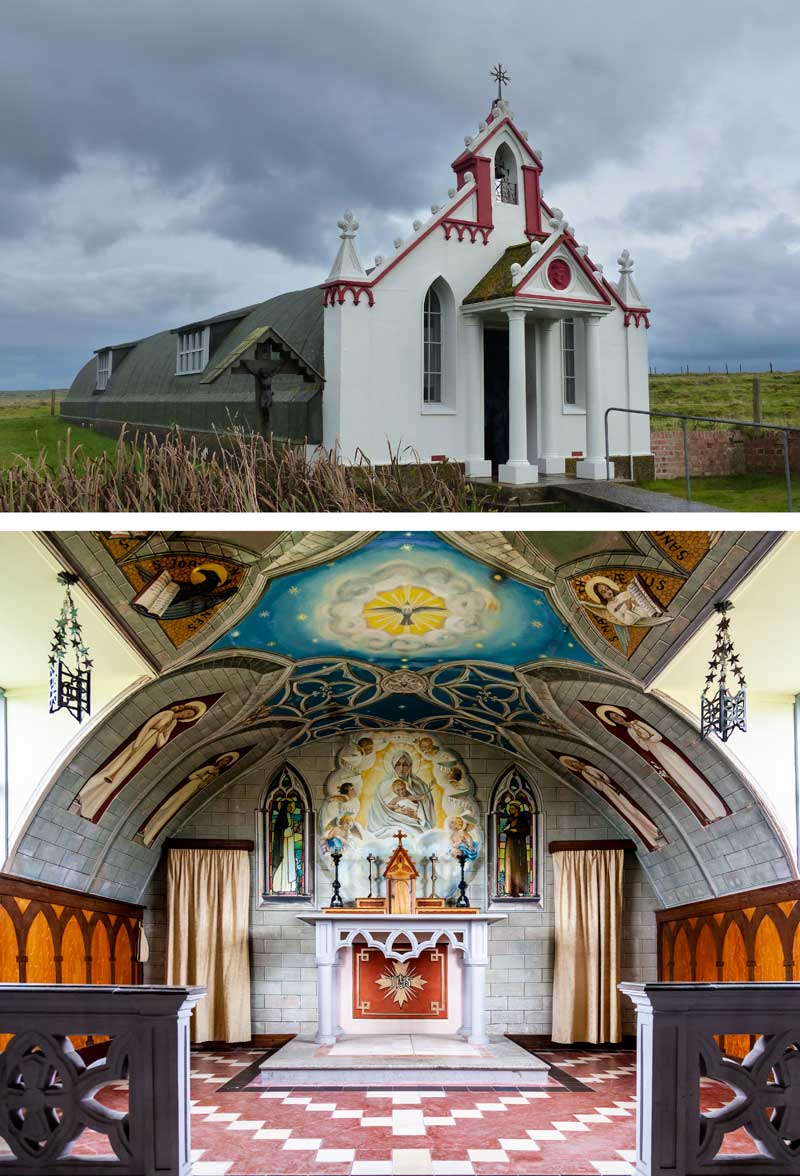
The prisoners began by putting two Nissen huts together to form the main body of the church. They then scavenged derelict ships for whatever materials they could salvage and transform.
The Italians reinforced the outside of the two huts with wire nets and concrete to protect them from the weather. They used tiles from the bathrooms of derelict ships for the interior walls and floor, and they salvaged stair rods from these ships to make candlesticks. The baptismal font was fashioned from a spring from a dump truck, which gave its supporting column a spiral shape. The altar lamps were fashioned from corned-beef tins that the prisoners polished to a silvery glow. "Stained glass" windows depicting St. Francis of Assisi and St. Catherine of Siena were made by painting clear windows in the colors and style of real stained glass, complete with faux lead stripes.
The facade was beautified with patterned concrete blocks and included a belltower, from which an old ship's bell was hung. This was the work of Prisoner Buttapasta, who was an expert in cement. The facade was trimmed with terracotta, and Prisoner Pennisi crafted from the same material a relief sculpture of the face of Christ, which was positioned above the door. Prisoner Palumbi, a blacksmith who had learned the art of wrought iron, created a magnificent, intricate rood screen. Prisoner Micheloni, an electrician, wired the chapel for electricity. The tabernacle was made from the wood salvaged from sunken ships.
Perhaps the most striking feature of the chapel was its altarpiece, a painting by Chiocchetti of the Madonna of the Olive Branch. It depicts the Virgin holding the Christ Child, who extends an olive branch in his left hand toward the viewer. Clouds and cherubs surround the Madonna and Child. Chiocchetti's mother had given him this image of the patroness of their village when he first left home for military service. He had kept it with him throughout his ordeal, and now he reproduced it in a breathtaking mural behind and above the chapel altar. On the ceiling of the sanctuary, Chiocchetti painted stars in a deep blue sky and a large picture of the Holy Spirit in the form of a dove.
Everything in the chapel spoke of peace. It was a combined effort of the artists, artisans, craftsmen, and others among the prisoners, who were men of faith and of many talents. Together they created a place of beauty and a respite for quiet and prayer.
Testament to Hope
When the war ended, the Italian prisoners were repatriated, but a part of their souls was left behind on Lamb Holm, where they had created a thing of beauty out of unlikely materials. It has been said, "He who works with his hands is a laborer. He who works with his hands and his head is a craftsman. He who works with his hands and his head and his heart is an artist." By this standard, the builders of the Italian chapel were all artists.
Most of the Nissen huts on the Orkney Islands were eventually torn down, but the Orcadians insisted that the Italian Chapel remain. Time and weather have left their marks, but repairs have been made as necessary, and the chapel still stands on Lamb Holm as a testimony to faith and endurance. It is a tourist attraction to be sure, but more importantly it is the site of pilgrimages, marriages, and baptisms, and a reminder of the prisoners of war from another country.
G. K. Chesterton once said that "the more hopeless is the situation, the more hopeful must be the man." Hope is what the Italian prisoners held on to: hope that the war would end, hope that they would return to their homes and families, hope that there would be no more wars, and, finally, hope that those who were once enemies could become friends. This last hope was realized, almost eighty years ago, on an uninhabited, windswept, desolate island in the North Atlantic off of Scotland.
And let the beauty of the Lord our
God be upon us,And establish Thou the work of our
hands for us—Yea, establish the work of our hands.
(Ps. 90:17)
Clara Sarrocco is the longtime secretary of The New York C. S. Lewis Society. She has taught classes on C. S. Lewis at the Institute for Religious Studies at St. Joseph's Seminary and is the president of the Long Island Chapter of University Faculty for Life. Her articles and reviews have appeared in numerous publications, including Touchstone, New Oxford Review, Gilbert, The Chesterton Review, St. Austin's Review, and The International Philosophical Quarterly.
A Journal of Mere Christianity—Delivered to Your Door
- Essays on theology, culture, and the Church
- Contributors from across the Christian traditions

Six print issues (one year) of Touchstone, plus full online access and PDF downloads for only $39.95.

Get a one-year full-access subscription to the Touchstone online archives for only $19.95.
bulk subscriptions
Order Touchstone subscriptions in bulk and save $10 per sub! Each subscription includes 6 issues of Touchstone plus full online access to touchstonemag.com—including archives, videos, and pdf downloads of recent issues for only $29.95 each! Great for churches or study groups.
Transactions will be processed on a secure server.
more on history from the online archives
15.6—July/August 2002
Things Hidden Since the Beginning of the World
The Shape of Divine Providence & Human History by James Hitchcock
14.6—July/August 2001
The Transformed Relics of the Fall
on the Fulfillment of History in Christ by Patrick Henry Reardon
31.1—January/February 2018
on Ragnarök, an Extreme Weather Event & the Paths to Conversion by Timothy J. Burbery
more from the online archives
36.4—Jul/Aug 2023
Our Political Void & the Disintegration of Truth by Michael Hanby

33.2—March/April 2020
Christian Pro-Family Governments?
Old & New Lessons from Europe by Allan C. Carlson
calling all readers
Please Donate
"There are magazines worth reading but few worth saving . . . Touchstone is just such a magazine."
—Alice von Hildebrand
"Here we do not concede one square millimeter of territory to falsehood, folly, contemporary sentimentality, or fashion. We speak the truth, and let God be our judge. . . . Touchstone is the one committedly Christian conservative journal."
—Anthony Esolen, Touchstone senior editor
