




Pelosi at Canossa?
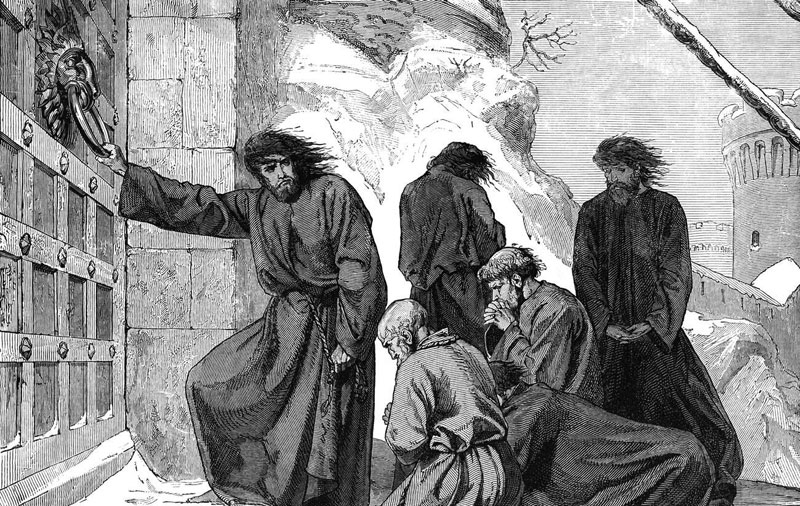
Christians are often frustrated by the secularism of the modern world, a world that has relegated the transcendent dimensions of human life to the realm of private opinion, while at the same time establishing the State and the Market as the absolutes that rule our lives, and that permit no rivals. The "separation of Church and State" has led to the absolutizing of the State and marginalizing of the Church. Some have responded to this situation by calling for its reversal, by making the state subordinate to the Church. They look back fondly at an age when princes would tremble at the frown of a pope, and even an emperor would dress in sackcloth and wait barefoot in the snow outside the pope's palace, pleading for his forgiveness.
This is the vision of the so-called integralists, and while it might be a somewhat idealized view of the past, it is not without some real basis in our history. What the integralists want is summarized by Father Edmund Waldstein, a leader of this movement:
Catholic integralism . . . holds that political rule must order man to his final goal. Since, however, man has both a temporal and an eternal end, integralism holds that there are two powers that rule him: a temporal power and a spiritual power. And since man's temporal end is subordinated to his eternal end, the temporal power must be subordinated to the spiritual power.
This is clear enough, but exactly how it should be implemented in a constitutional republic is not so clear, and Fr. Waldstein is reluctant to get down to cases, contenting himself with general principles. So, should there be a "Supreme Council" of bishops holding veto power, in the manner of the Islamic Republic of Iran, where a Council of Ayatollahs can intervene whenever it wills? Most integralists are reluctant to say. But not all. Adrian Vermeule, for example, is very specific about what integralism means in the American circumstance: it means a strong executive, able to rule by decree. In Vermeule's view:
As for the structure and distribution of authority within government, common-good constitutionalism will favor a powerful presidency ruling over a powerful bureaucracy, the latter acting through principles of administrative law's inner morality with a view to promoting solidarity and subsidiarity.
Vermeule is merely reflecting the views of his adopted mentor, Carl Schmitt, the Nazi jurist whose ruling allowed the Enabling Act of 1933 to go forward, the act of the Reichstag that gave the German Chancellor at the time, one Adolf Hitler, the right to rule by decree.
Regardless of how it is to be implemented, one can well imagine that integralists share a dream of a chastened Nancy Pelosi, repenting of her support of liberalism in general and abortion in particular, dressed in sackcloth and pleading for forgiveness in the snow outside the bishop's palace.
The Gelasian "Dyarchy" & Its Aftermath
Even if Madame Speaker decides that sackcloth is not a good look on her, there is no question that the integralists have a good deal of history on their side. It is a history that goes back at least to the fifth-century Pope Gelasius, who decreed, "There are two powers, august Emperor, by which this world is chiefly ruled, namely, the sacred authority of the priests and the royal power." On this beginning, the claims of papal power only got more extravagant as time went on. Gregory VII (1073–1085) claimed the power to depose emperors, and Innocent III (1198–1216) would claim a "plentitude of power," saying that "just as the moon derives its light from the sun and is indeed lower than it in quantity and quality, in position and in power, so too the royal power derives the splendor of its dignity from the pontifical authority."
These claims of papal power reached their height with the Bull Unam Sanctam of Pope Boniface VIII (1294–1303). Giving a rather tendentious reading of the "two swords" in Luke 22:38, Boniface held that both "are in the power of the Church, that is to say, the spiritual and the material sword, but the former is to be administered for the Church [and] the latter by the hands of kings and soldiers, but at the will and sufferance of the priest" (italics added).
But whatever one thinks of the papal pretensions to power, the truth is that these claims did not take place in a vacuum, and they could generally be considered a boon to the political development and security of Europe.
Larry Siedentop notes that after the breakup of the Carolingian Empire, when power became localized, "the experience of centralized control—and the confidence bred by exercising it—passed from the secular sphere to the church." The newly "localized" powers had difficulty defending Europe from the triple threat of Saracens to the South, Magyars from the East, and Vikings from the North. Nor could they defend themselves from the marauding bands of mounted thugs who "roamed the countryside, looking for plunder. Neither peasants nor church property were immune. Unpunished violence became almost the norm."
But the Church was able, through long efforts, to impose a "Peace of God" and transform the milites into "knights." And she was able to redirect the growing military might of Europe towards a foreign enemy with the Crusades. As François Guizot noted, "Prior to the crusades, Europe had never been excited by one sentiment, or acted in one cause; there was no Europe. The crusades revealed Christian Europe."
Furthermore, the Church was possessed of a reforming and "egalitarian" spirit, especially centered around Cluny, which brought a monastic spirit to the reforms and raised the level of the higher clergy. This egalitarian spirit was essential to the creation of canon law, and to our whole concept of "natural rights." Prior to canon law, there were no national law codes. Jurists relied on local custom and Roman law, which made sharp class distinctions, and treated each class differently. But the canonists sought a law that transcended custom and was rooted in reason and the natural equality of all men.
"In effect, canon lawyers purged Roman law of hierarchical assumptions surviving from the social structure of the ancient world," Siedentop notes. While this may seem obvious to us today, it was wholly novel at the time. The American Declaration of Independence, the French Declaration of the Rights of Man, and the United Nations Declaration on Human Rights all depend on the work of medieval canonists. For medieval man, the involvement of the Church was often a liberating, indeed liberal force.
So it would seem that the integralists are on firm doctrinal, historical, and practical grounds. Papal power—political power—was the great force shaping Europe, and shaping it to the good. They appear to be correct, and it seems that all we need to do now is to regain what we have lost, and assert, once again, the Church's authority over temporal rulers. But as is usual in such disputes, the case is not quite that clear and simple; there is more to the history, and more to the lessons to be drawn from it, than the integralists will allow.
The Power of Truth & the Danger of Power
The mistake begins with a misunderstanding of Pope Gelasius; indeed, even referring to a "Gelasian dyarchy" misstates his position, since "dyarchy" implies two coercive powers. But that is not what that pope had in mind at all. As D. C. Schindler notes, in defining the two "powers," Gelasius "makes a crucial distinction: The state has power (potestas) and the Church has authority (auctoritas)," that is, the authority of truth, so that the role of the Church is to "bear witness to the truth of things, but she does not regulate them directly in the political sphere."
The state needs authority, if it is not to be a mere exercise of arbitrary power, for as Hannah Arendt notes, "When authority leaves, power enters." And while truth possesses a certain undeniable authority, it is effective in the political sphere only when it is widely recognized. That is why "the greatest enemy of authority is contempt, and the surest way to undermine it is laughter."
The easiest way for any institution to be brought into contempt is for it to come into power. The issues that first brought the Church into conflict with the kings—investiture—was certainly an area in which the Church could clearly claim her rights, but as she became more involved in the dynastic wars and territorial disputes, these claims became more obscure. And as war is an expensive business, the Church's need for revenues grew exponentially, to the point where even salvation was commodified and monetized through the sale of indulgences.
Moreover, as the Church came to own one-third of the property, the foundation of medieval wealth, it is not surprising that princes began to see the Church as a rival to the state, indeed a state within the state, and to covet its wealth and power. It is by such means that authority deteriorates even as power increases. As the palaces of the bishops grew higher, and even their tombs became more opulent, their separation from the people became more evident.
Dubious Doctrines
For all that, cannot the integralist claim that the papal record is clear enough, that the claims to power are doctrinal and binding on all faithful Catholics? Once again, it is not that simple. The "Gelasian dyarchy" meant no more (to put it in contemporary jargon) than that the Church must speak truth to power, but this becomes more difficult to do when the Church herself becomes the power. And the claims of Unam Sanctam, the claim that kings receive their power directly from the pope, are simply not in continuity with church tradition and were never accepted by all the bishops, the minimum threshold for inclusion in the ordinary magisterium. Aquinas held that both the pope and the king received their titles directly from God. Robert Bellarmine, the great interpreter of Aquinas, held that, "It is for the will of the people to set up a king, consuls, or other magistrates. And if good cause comes, the people may exchange monarchy for aristocracy or democracy, and vice versa; history tells us that it happened so at Rome."
But perhaps the biggest problem with integralism is that it reduces the Church's political presence to coercive power—a reduction indeed—and is an overreaction to liberalism that ends up reinforcing that same liberalism. Instead of countering the secular/religious dualism that is at the heart of liberalism, it gives it religious sanction. But it is this very dualism itself that is at the heart of the modernist error. For in truth both Church and State are concerned with man's last end, "in the manner appropriate to each," as Schindler states.
And the effectiveness of the political authority of the Church depends totally on its acceptance by the people; that is, it depends totally on evangelization. And this evangelization is not concerned only with the hereafter, but with the here-and-now. The Church has well-developed social doctrines and has had them from the beginning. We cannot accept the modernist dualism, which confines us to "other-worldly" concerns; we speak to man's condition in the temporal order as well.
Evangelism is hard work, and the real problem with integralism is that it is lazy. Having failed to convince the people, the integralists want the Church to co-opt the power. But what always happens is precisely the reverse: the powers end up co-opting the Church. The dangers of a "throne and altar" theology is that it inevitably makes the altar a prop for the aristocracy and drives a wedge between the Church and the people.
The integralists think that, having failed to convince the people about, say, the evils of abortion, they will just hand the issue over to the powerful and get it outlawed. But criminalizing abortion will not end it, any more than criminalizing cocaine has ended drug use. If we really wish to end it, rather than just outlawing it, we must both convince people that it is wrong and set up social and economic systems in which women do not feel forced to choose between making a living and making a baby.
The Church's authority in the political order has always been democratic, in the broadest sense of the term; it depends on the tacit approval of the public. King Henry went to Canossa not because the Church had the power but because the Church had the people, and if we wish to see Speaker Pelosi, and all the other powers that be, make the same journey, we must use the same method.
John C. Médaille is a retired businessman who has been teaching at the University of Dallas for the past 16 years. His primary course deals with Catholic social teaching and is a required course for the business degree. He is also the author of three books: The Vocation of Business: Social Justice in the Marketplace (Continuum, 2008); Toward a Truly Free Market: A Distributist Perspective (ISI Books, 2011); and, with Thomas Storck, Theology: Mythos or Logos; A Dialogue on Faith, Reason, and History (Angelico Press, 2020).
A Journal of Mere Christianity—Delivered to Your Door
- Essays on theology, culture, and the Church
- Contributors from across the Christian traditions

Six print issues (one year) of Touchstone, plus full online access and PDF downloads for only $39.95.

Get a one-year full-access subscription to the Touchstone online archives for only $19.95.
bulk subscriptions
Order Touchstone subscriptions in bulk and save $10 per sub! Each subscription includes 6 issues of Touchstone plus full online access to touchstonemag.com—including archives, videos, and pdf downloads of recent issues for only $29.95 each! Great for churches or study groups.
Transactions will be processed on a secure server.
more on Culture from the online archives

33.1—January/February 2020
Do You Know Your Child’s Doctor?
The Politicization of Pediatrics in America by Alexander F. C. Webster
18.2—March 2005
On Conservatism as Vexation, Vanity & Near Impossibility by Graeme Hunter
35.2—Mar/Apr 2022
on Fatigued Christians Deciding to Engage the Culture by Keith Lowery
more from the online archives
31.2—March/April 2018
How Best to Face the Total War of the Anti-Culture by R. J. Snell
32.1—January/February 2019
The Diabolical Failure of Leaders in the Present Crises by James M. Kushiner

31.2—March/April 2018
The Transmission of Christianity Is Not a New Task by Nathanael Devlin
calling all readers
Please Donate
"There are magazines worth reading but few worth saving . . . Touchstone is just such a magazine."
—Alice von Hildebrand
"Here we do not concede one square millimeter of territory to falsehood, folly, contemporary sentimentality, or fashion. We speak the truth, and let God be our judge. . . . Touchstone is the one committedly Christian conservative journal."
—Anthony Esolen, Touchstone senior editor
