Minority Warning
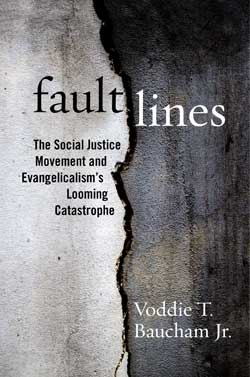
Fault Lines: The Social Justice Movement
and Evangelicalism's Looming Catastrophe
by Voddie T. Baucham Jr.
reviewed by Allan C. Carlson
Black pastor and seminary dean Voddie T. Baucham Jr. argues that a theological and moral catastrophe within American Evangelicalism is now "unavoidable." It comes, he maintains, from a new Gnostic heresy—complete with its secret wisdom—every bit as dangerous as that which almost destroyed the early Christian Church 1,800 years ago. Already, he says, the ground is shaking, reputations are tarnished, pastoral and teaching careers are being destroyed, and whole denominations stand at risk of "being derailed."
The specific danger, he argues, rises from the contemporary Christian Social Justice Movement, especially through its ties to Critical Race Theory and Intersectionality. The former concept holds, in the words of one authority, "that racism is engrained in the fabric and system of the American society." Individual racists or actions are not the issue because "institutional racism is pervasive in the dominant culture." White Privilege exists everywhere, within and without the church. The sin of racism is collective, not personal, and marks all whites. Black victims have, as a consequence, lower incomes and net worth, worse housing, more sickness, shorter life expectancy, and a host of other relative ills. Intersectionality rests on the argument that oppression also derives from discrimination on the basis of gender and sexual orientation, forms of bias that "intersect" to sustain a racist, sexist, heteronormative social order. Social justice, many Christians now believe, requires that this system be confronted and crushed.
Baucham gathers a remarkable array of Christian testimonies to the validity of these arguments. These include affirmations of varied intensity from leaders within the Southern Baptist Convention, from the editors of Christianity Today, and from other surprising Protestant voices. They are presented, as far as this reviewer can tell, in an honest way. As Baucham summarizes, the influence of the Critical Social Justice Movement "is broad and deep within evangelical circles."
Promulgation & Marginalization
What's wrong with this? To craft an answer, Baucham joined in June 2018 with fifteen other men gathered by the prominent pastor John MacArthur. The result was "The Dallas Statement on Social Justice and the Gospel." Some of its affirmations are not especially surprising: "the Bible is God's Word, breathed out by him . . . inerrant, infallible, and the final authority for determining what is true"; "God created every person equally in his own image"; and "God requires those who bear his image to live justly in the world."
Paired denials, however, cut directly and deeply into Critical Social Justice claims. The statement denies that ideologies derived from Critical Race Theory and Intersectionality "are consistent with biblical teaching." The group denies as well that "any person is morally culpable for another person's sins" and also rejects the claim that "one's ethnicity establishes any necessary connection to any particular sin." And the statement further denies "that political or social activism should be viewed as integral components of the gospel or primary to the mission of the church."
Frantic efforts to marginalize and bury the Dallas Statement followed. Baucham maintains that the "leaders of many SBC entities pleaded with and warned their personnel not to sign" the document. When its arguments took abbreviated form as proposed Resolution 9 at the 2019 SBC annual meeting, a "deliberate act of duplicity" saw the contents "gutted" and nearly inverted. The controversy continues.
The Real White Privilege
What are its broader implications? To begin with, and in an especially devilish way, I believe that there is a contemporary form of "White Privilege" that continues to claim victims, primarily among African-Americans. However, with monstrous irony, this process actually occurs within the Social Justice Movement itself. Its strange genesis can be traced to a single day: February 8, 1964. The U.S. House of Representatives was debating the proposed new Civil Rights Act, Title VII of which would ban discrimination in private employment "on the basis of race, color, religion, or national origin." Facing a surge in the number of father-absent black families alongside demands for an end to racist union rules and invisible promotion ceilings, the openly acknowledged (if only legally implicit) goal was to strengthen the prospects for African-American men as husbands, fathers, and breadwinners.
Allan C. Carlson is the author of numerous books, including Family Questions: Reflections on the American Social Crisis and The American Way: Family and Community in the Shaping of the American Identity. He attends St. Paul Lutheran Church in Rockford, Illinois. He is a senior editor of Touchstone.
A Journal of Mere Christianity—Delivered to Your Door
- Essays on theology, culture, and the Church
- Contributors from across the Christian traditions

Six print issues (one year) of Touchstone, plus full online access and PDF downloads for only $39.95.

Get a one-year full-access subscription to the Touchstone online archives for only $19.95.
bulk subscriptions
Order Touchstone subscriptions in bulk and save $10 per sub! Each subscription includes 6 issues of Touchstone plus full online access to touchstonemag.com—including archives, videos, and pdf downloads of recent issues for only $29.95 each! Great for churches or study groups.
Transactions will be processed on a secure server.
more from the online archives

calling all readers
Please Donate
"There are magazines worth reading but few worth saving . . . Touchstone is just such a magazine."
—Alice von Hildebrand
"Here we do not concede one square millimeter of territory to falsehood, folly, contemporary sentimentality, or fashion. We speak the truth, and let God be our judge. . . . Touchstone is the one committedly Christian conservative journal."
—Anthony Esolen, Touchstone senior editor