




Splendid Uselessness
Lost in Thought: The Hidden Pleasures of an Intellectual Life by Zena Hitz
Even before the depredations and indignities of Covid slouched into our lives, American colleges and universities were in a bad way. Leaving soaring tuition and unconscionable levels of student debt aside, progressives have felt that they've sold their souls to "neo-liberalism," peddling status and prestige, engorged with inflated rhetoric, and beholden to the bottom line, while conservatives have decried unhinged "wokeness": lefty professors and diversity bureaucrats forever sniffing out "microaggressions" and enabling "cancel culture."
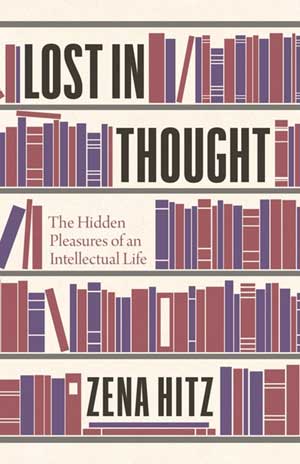
Both criticisms perhaps contain elements of truth, but the canker might be deeper still: an ingrained inability, in schools and society at large, to articulate compellingly why education matters in the first place and what visions of human flourishing best nourish it. Offering considered, bracing, often passionate answers to both questions is the upshot of Zena Hitz's Lost in Thought: The Hidden Pleasures of an Intellectual Life. A committed Catholic, Hitz wears her faith lightly throughout in an effort to reach a wide audience.
Trained in ancient philosophy, a wounded lover of the university as it now stands, Hitz yawns at modern educational theorists, drawing inspiration instead from Plato, Aristotle, and Augustine, among others, to argue unapologetically that serious learning—the life of the mind, the examined life, the vita contemplativa—pulses with intrinsic value; it is right and good and beautiful in and of itself apart from whatever instrumental uses to which it might be put.
Cognoscenti will detect a version of an older argument: a defense of the superiority of the artes liberales—the kinds of "useless" learning (art, philosophy, history, literature) that free our minds and souls—over the artes serviles—the training necessary for specific jobs that provide useful functions in society. To a certain degree, Hitz's stance mirrors this argument, but the book actually, perhaps in part unwittingly, complicates the distinction between the intrinsic and the instrumental by redefining the latter and ordering it to the goods necessary for a dignified, soulful life shared meaningfully with
others.
Admittedly, Hitz plainly states that she is defending the "intrinsic value of learning," its worth apart from any "visible or outward results." Yet throughout she's keen to show the myriad salutary results derived from serious learning, arguing that it is "fundamental to human happiness, as far from pointless wheel spinning as are the forms of tenderness we owe our children or grandchildren." Still, the right sequence and a kind of paradox stand at the heart of her vision: "If intellectual life is not left to rest in its splendid uselessness, it will never bear its practical fruit." The skill of an Olympic swimmer, one might analogize, might be put to many uses, but these should not cloud our ability to see the grace and beauty of the thing itself.
What, then, are the practical fruits of splendid uselessness?
Practical Fruits
For starters, the demands of serious learning can puncture what Iris Murdoch once called "the fat, relentless ego" or what theologians sometimes speak of as homo incurvatus in se, the person curved in upon himself—that calculating inner Gollum in us all. The time and discipline necessary to encounter a world outside our heads, Hitz avers, can chip away at "the hard accretions of wishful thinking" harbored by every individual. "Everyone with even a passing interest in the life of the mind has felt the collision with reality," she elaborates; "the term paper begins with dreams of academic conquest and ends in lowly entanglements with the real problems the topic presents." Struggling with these problems can in turn induce a salutary humility, a mental sobriety, helping us confront one of life's most fundamental lessons: "reality is not up to us."
Cultivating an intellectual life, moreover, helps ordinary people from various backgrounds gain a sense of dignity and worth. Hitz reminds toffee-nosed critics that the Great Books movement was for and significantly embraced by members of the working class. And she makes nice use of Jonathan Rose's delightful The Intellectual Life of the British Working Classes (2001) to disabuse readers of the notion that only elites care about the questions of liberal education. "The coloured world flashed out and entranced my fancy," she conveys one laborer's encounter with Tennyson's poetry; "they drew pictures in my mind. . . . My dormant imagination opened like the sun." Do the educated, Hitz seems to whisper throughout the book, habitually underestimate the rich capacity for reflection among those who repair their cars and ring up their groceries?
Further, artfully drawing from Mona Achache's 2009 film The Hedgehog, Hitz recounts how three unlikely characters—Renée (a pedestrian, middle-aged cleaning woman), Paloma (a suicidal twelve-year-old), and Kakuro (a wealthy Japanese man living in the building where all three live)—come together around shared intellectual pursuits, making "connection with one another at the depths" and not on the basis of wealth, status, or trivialities. These sorts of deep friendships—the opposite of those defined by Aristotle as based on utility alone—enrich our inner lives, enhance our capacities for communication, and create the conditions of possibility for mature, lasting relationships.
Thomas Albert Howard is Professor of Humanities and holder of the Phyllis and Richard Duesenberg Chair in Christian Ethics at Valparaiso University.
A Journal of Mere Christianity—Delivered to Your Door
- Essays on theology, culture, and the Church
- Contributors from across the Christian traditions

Six print issues (one year) of Touchstone, plus full online access and PDF downloads for only $39.95.

Get a one-year full-access subscription to the Touchstone online archives for only $19.95.
bulk subscriptions
Order Touchstone subscriptions in bulk and save $10 per sub! Each subscription includes 6 issues of Touchstone plus full online access to touchstonemag.com—including archives, videos, and pdf downloads of recent issues for only $29.95 each! Great for churches or study groups.
Transactions will be processed on a secure server.
more on education from the online archives


24.5—Sept/Oct 2011
on Wondering or Wandering Through College Education by Anthony Esolen

more from the online archives

31.6—November/December 2018
on the Church's Response to the Anti-marriage Tide by Diane Woerner

22.8—November/December 2009
on the Real Men Behind the Christmas Carol by Michael Baum
calling all readers
Please Donate
"There are magazines worth reading but few worth saving . . . Touchstone is just such a magazine."
—Alice von Hildebrand
"Here we do not concede one square millimeter of territory to falsehood, folly, contemporary sentimentality, or fashion. We speak the truth, and let God be our judge. . . . Touchstone is the one committedly Christian conservative journal."
—Anthony Esolen, Touchstone senior editor
