




Saint from the Danube Delta
Patrick Henry Reardon on Saint John Cassian
Among the world's natural boundaries, few have exercised greater political significance over the centuries than the Danube River. This second-largest waterway of Europe (after the Volga), taking its rise in the Black Forest in southwestern Germany, meanders in a mainly easterly direction toward the Black Sea some 1,750 miles away, its volume constantly augmented by some 300 tributary streams. Thus, it separated the classical Mediterranean lands of the lower Balkans from the more migratory peoples to the north. Indeed, the Roman Empire regarded the Danube as its northern border. Today it partially forms the national boundaries separating Hungary, Slovakia, Croatia, Serbia, Bulgaria, and Romania.
Besides separating them, however, the Danube has also served to unite various peoples of Europe. Once it becomes navigable at Ulm, this vital traffic artery links together such important cities as Regensburg (where one may still cross it on the oldest stone bridge in Europe), Passau, Linz, Vienna, Bratislava, Esztergom, Budapest, Belgrade, Galati and Izmail. Thus, the Danube's place in history is secure and pervasive. As a traditional conduit for both commerce and culture, it stands second to no other river in the world.
Once the Danube passes through that narrow, mountainous gorge called the Iron Gate, its waters begin to spread out until, at Galati, it becomes hardly more than a marshy delta. In antiquity this delta region was known as Dacia, and, until the fall of Constantinople to the Turk in 1453, it was the site of a small but important outpost of Byzantine Christianity.
The Traveling Monk
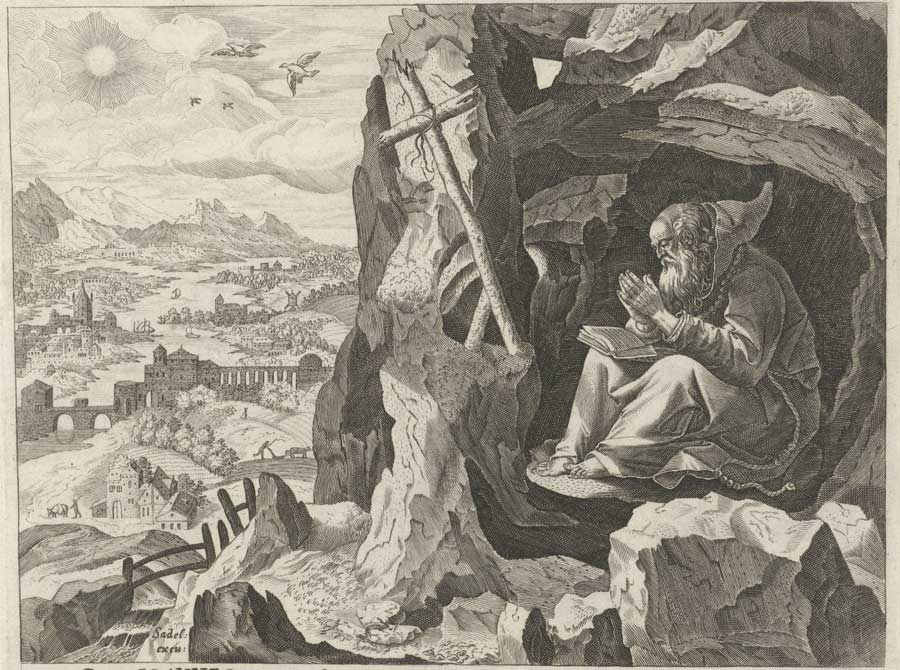
One of the most important Christians to arise in this region was a man named John Cassian. Born around 360, Cassian was educated in both Latin (the local language at that time) and Greek. Drawn to monastic life but finding no monasteries in the vicinity, young Cassian went to the Holy Land and became a monk in Bethlehem. Some time later, he and another monk, Germanus, took to traveling around the eastern shores of the Mediterranean and visiting monastic centers in order to learn more about the monastic life. They spent extensive time doing this in Syria and more especially in Egypt, where they interviewed some of the more famous monks of that day, particularly the hermits. On two trips, Cassian and Germanus seem to have spent about ten years in Egypt all together.
Cassian, evidently intending to visit his homeland in Dacia, stopped at Constantinople, the new capital of the Roman Empire, where another John, an Antiochian monk and priest, had recently become archbishop. This was the John now known to history as Saint John Chrysostom. He ordained Cassian a deacon and joined him to his cathedral staff.
When political forces of the Byzantine court forced John Chrysostom into exile in Armenia in 404, a group of his friends, including four bishops, went to Rome to appeal his case to the pope. Cassian was part of that delegation. In Rome, Cassian was ordained a priest, apparently never returning east again. Eventually he journeyed to the south of France, where he founded two monasteries at Marseilles.
The Literary Figure
Before his death at Marseilles in 435, Cassian wrote the three works that make him a major literary figure of Latin culture: The Institutes, The Conferences, and The Treatise on the Incarnation. The last-named was written against the heresy of Nestorius, who was condemned at the Ecumenical Council of Ephesus in 431.
Of these works, the more important are the Institutes and Conferences, in which Cassian distilled for Latin-speaking monks and nuns the inherited wisdom of the Egyptian monastic fathers. Indeed, it would be difficult to overestimate the importance of these two works in the spiritual thought of later Western history. In the following century, these two works were recommended by name in the final chapter of The Rule of Saint Benedict, the major text of Western monasticism, and they became the favorite spiritual reading of many Western saints, such as Gregory the Great, Bernard of Clairvaux, Thomas Aquinas, and Teresa of Ávila.
Cassian's reputation has been even higher in Eastern Christianity, where he is known as Saint John Cassian. When, in the seventeenth century, the Philokalia, a large collection of major ascetical texts, was assembled for the monastics of the Orthodox Church, Cassian's Institutes and Conferences were the only two Latin works included.
Patrick Henry Reardon is pastor emeritus of All Saints Antiochian Orthodox Church in Chicago, Illinois, and the author of numerous books, including, most recently, Out of Step with God: Orthodox Christian Reflections on the Book of Numbers (Ancient Faith Publishing, 2019).
A Journal of Mere Christianity—Delivered to Your Door
- Essays on theology, culture, and the Church
- Contributors from across the Christian traditions

Six print issues (one year) of Touchstone, plus full online access and PDF downloads for only $39.95.

Get a one-year full-access subscription to the Touchstone online archives for only $19.95.
bulk subscriptions
Order Touchstone subscriptions in bulk and save $10 per sub! Each subscription includes 6 issues of Touchstone plus full online access to touchstonemag.com—including archives, videos, and pdf downloads of recent issues for only $29.95 each! Great for churches or study groups.
Transactions will be processed on a secure server.
more on church history from the online archives
33.1—January/February 2020
on a Saint's Charism That Cures Toxic Perfectionism by Colleen Carroll Campbell
more from the online archives
15.6—July/August 2002
Things Hidden Since the Beginning of the World
The Shape of Divine Providence & Human History by James Hitchcock

31.6—November/December 2018
Victimhood Culture Scapegoats Its Very Source by Michael P. Foley
calling all readers
Please Donate
"There are magazines worth reading but few worth saving . . . Touchstone is just such a magazine."
—Alice von Hildebrand
"Here we do not concede one square millimeter of territory to falsehood, folly, contemporary sentimentality, or fashion. We speak the truth, and let God be our judge. . . . Touchstone is the one committedly Christian conservative journal."
—Anthony Esolen, Touchstone senior editor
