




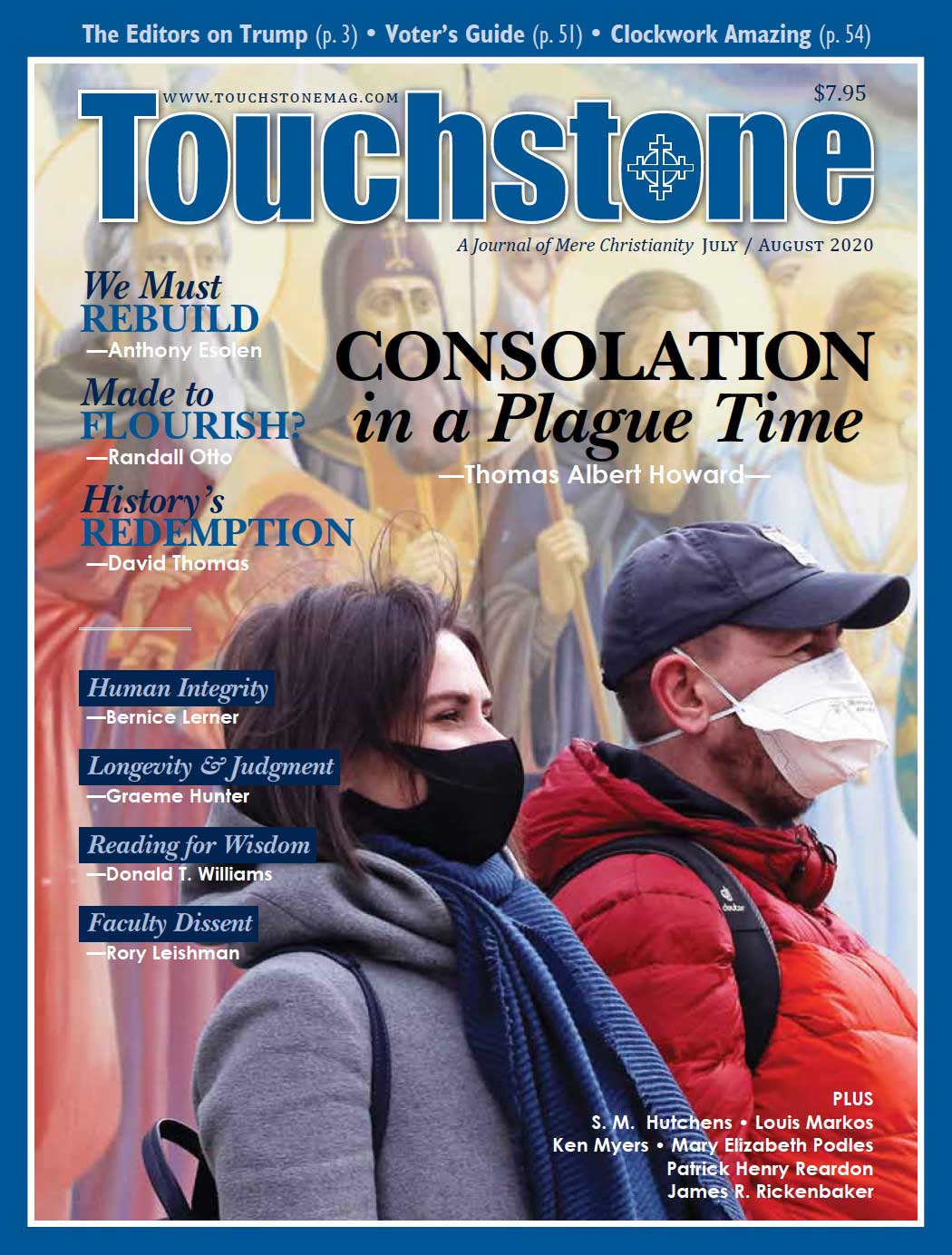
Illuminations
Pantocrator Lite
Whenever I write about the bad poetry or the un-poetry of contemporary hymnals, someone inevitably will call me an "elitist." The charge is strange. I have spent all my adult life bringing the beauty and glory and power of poetry to young people in college, urging them to remember that, until our own poor time, poetry was the universal human art—for the Inuit in his ice-hut on the Mackenzie delta just as for the pipe-smoking don on the banks of the River Cam.
I know one of the reasons for the charge. It is that nobody knows the art anymore. People who shrug at bad poems or un-poems in the hymnal would not shrug at silly or incompetent paintings on the walls of their churches—or on the walls of their homes, for that matter. They would not shrug at a bad violinist flaying a cat. Their eyes would cross and their ears would sting. But poetry appeals first to the eyes and ears of the mind, and theirs have never been awakened. People who call themselves poets are much to blame, writing doggerel and gibberish, as if it can't be poetry if it makes any sense.
So we have hymn writers and editors who know nothing about poetry in general, or about the special qualities of poetry meant to be sung by ordinary people. We don't sing about abstractions, or committee work. We sing about elemental things. Green grow the rashes, O! • Far away, you rolling river. • The pipes, the pipes are calling. • The Lord is my shepherd. • As the deer longs for the running streams. • I am an owl among ruins. • My soul cleaves to the dust. • He teacheth my hands to war. • The stone which the builders rejected has become the cornerstone. These are words of might, because they name realities that appeal immediately to the imagination and the heart.
A Mighty Hymn
Of course, they do not alone make for strong poetry. All the good will and wisdom in the world will not make a man a good artist if he has not been blessed with talent, and if he has not disciplined his talent with care and study. But we should look out for these words, these images, and not let editors efface them because of some passing political agenda. Look at the last three stanzas of Caroline Noel's mighty hymn, "At the Name of Jesus"
(cf. Phil. 2:10):
Name him, brothers, name him
With love strong as death,
But with awe and wonder,
And with bated breath;
He is God the Savior,
He is Christ the Lord,
Ever to be worshiped,
Trusted, and adored.In your hearts enthrone him;
There let him subdue
All that is not holy,
All that is not true;
Crown him as your captain
In temptation's hour;
Let his will enfold you
In its light and power.Brothers, this Lord Jesus
Shall return again,
With his Father's glory,
With his Angel train;
For all wreaths of empire
Meet upon his brow,
And our hearts confess him
King of glory now.
Nothing in those stanzas is vague or recondite. The words name things that an intelligent child can take hold of. Miss Noel appeals to brothers, twice, with all the pulses of blood that the personal word can stir. The love is not a fine or filmy sentiment, but "strong as death." We name our Lord Jesus in a moment charged with dramatic power: we name him with "bated breath." Why? Simply because "He is God the Savior, / He is Christ the Lord," and if we are alive to that reality, we can feel the hitch in our voices as we utter his holy name.
We are to make our hearts a sacred throne for Christ. Or he assumes the throne and makes it worthy of himself: we let him subdue "all that is not holy, / all that is not true." That will be much indeed! But in the hour of temptation we do not rely upon the reed of our own strength. "Crown him as your captain," says the poet. She means exactly what her words suggest. The crown is for the head, and the captain, literally, is the chief, the head, as Christ is the head of the Church, and we members of the body are alive only by virtue of Christ, and we have only the power that Christ gives us. Not as we will, then, but as Christ wills—that is what we must do. His will must enfold us, in the light that shows us what must be done, and in the power that makes us capable of doing it.
Miss Noel brings the poem to its triumphant climax by anticipating the Second Coming of Christ, of "this Lord Jesus," the very same, but now with the glory of the Father and with his angelic train. What shall we see then? The poet gives us a powerful and startling image: "For all wreaths of empire / Meet upon his brow." It is Christ the Pantocrator, the All-Ruler of the Apocalypse. Let every bay wreath fall from the Augusti and Napoleons of the world; the leaves wither, and the bones they once graced are resolved into dust. Christ is the commander, his is the imperium. And that is why, even before that final judgment, "our hearts confess him / King of glory now." The final word, now, is not there just for rhyme. It is urgent, insistent. The last unveiling is not yet. But Christ is our king of glory nonetheless, our king of glory right now.
A Mighty Hymn Ruined
How do you ruin a work of art? Set a committee to it, made up of people who would soften and blur your way to the everlasting fire and not feel any trouble about it, so long as you go with a smile. Not that they want you to go there; they feel nothing so strong as malice. That is part of the problem. They do not feel much at all. The imagination snores away, or is drugged into stupor with the political.
So the editors of the Catholic hymnal Worship got rid of the most dramatic features of the stanzas above. They got rid of the masculine brothers, which Miss Noel wrote not once but twice, and they replace it with Christians, which in the context of the poem is impersonal and abstract. Committees don't do awe very well—forgive me the solecism—so bated breath had to go. They replaced it with life-filled breath, which, aside from being an unsingable clot of consonants, makes no sense. What is breath if not alive? And what does its being alive have to do with the rest of the poem? Nothing.
But they really could not stand those wreaths of empire. They don't fit with Jesus cut down to democratic size, Jesus as mid-level bureaucrat of a welfare state. So they got rid of them and the brow of the Lord, and instead of awe, instead of looking up to our imperator, they have us comfortably look upon ourselves, in language that comes from a Pastoral Care Committee:
Love and faithful service
We his people vow.
What does that have to do with the rest of the poem? Again, nothing. What image does it call up to the mind? None.
But there may be a hidden blessing in it all. Satan and his minions, I guess, can take their Sabbath rest and enjoy a picnic on the shores of the Acheron, trusting that the imaginations of Christians in church will all be nodding off, editors and translators having done their work so
well.
Dear people: do not stand for it anymore.
Anthony Esolen is Distinguished Professor of Humanities at Thales College and the author of over 30 books, including Real Music: A Guide to the Timeless Hymns of the Church (Tan, with a CD), Out of the Ashes: Rebuilding American Culture (Regnery), and The Hundredfold: Songs for the Lord (Ignatius). He has also translated Dante’s Divine Comedy (Random House) and, with his wife Debra, publishes the web magazine Word and Song (anthonyesolen.substack.com). He is a senior editor of Touchstone.
A Journal of Mere Christianity—Delivered to Your Door
- Essays on theology, culture, and the Church
- Contributors from across the Christian traditions

Six print issues (one year) of Touchstone, plus full online access and PDF downloads for only $39.95.

Get a one-year full-access subscription to the Touchstone online archives for only $19.95.
bulk subscriptions
Order Touchstone subscriptions in bulk and save $10 per sub! Each subscription includes 6 issues of Touchstone plus full online access to touchstonemag.com—including archives, videos, and pdf downloads of recent issues for only $29.95 each! Great for churches or study groups.
Transactions will be processed on a secure server.
more on poetry from the online archives
37.5—Sept/Oct 2024
A Battle Plan for Peace While Growing Old by Anthony Esolen
more from the online archives
23.5—September/October 2010
The Loss of a Christian Understanding of Virginity Is Pure Tragedy by Eleanor Bourg Donlon
5.3—Summer 1992
Everything You Need to Know About Morality & the Bible by David Mills
calling all readers
Please Donate
"There are magazines worth reading but few worth saving . . . Touchstone is just such a magazine."
—Alice von Hildebrand
"Here we do not concede one square millimeter of territory to falsehood, folly, contemporary sentimentality, or fashion. We speak the truth, and let God be our judge. . . . Touchstone is the one committedly Christian conservative journal."
—Anthony Esolen, Touchstone senior editor
