




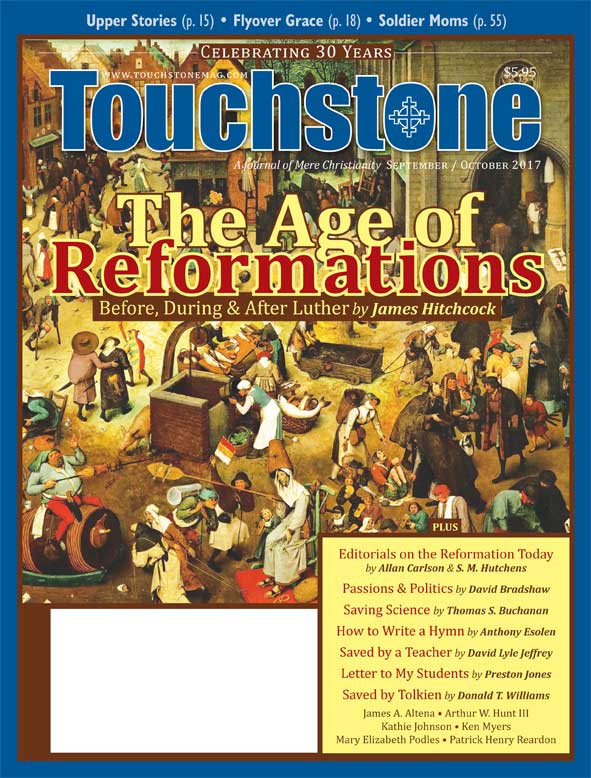
Feature
An Encouraging Book
How Tolkien's Lord of the Rings Saved Me
by Donald T. Williams
I first read The Lord of the Rings in the summer of 1968, the summer between my junior and senior years of high school. (I will never forget the chills running down my spine like the large, black, and angry summer thunderstorm that was rolling toward me across the Georgia piedmont as I first encountered the Black Riders.) I checked the hardback volumes out of the library and devoured every page, including every last word of the appendices. My very next act after that was to buy the old Ballantine paperbacks (which cost a whopping 95 cents each at the time) and repeat the process.
I have read The Hobbit and The Lord of the Rings annually ever since (missing only a couple of years), and The Silmarillion several times as well. The only book to which I have devoted more time and effort as a reader is the Bible, which I also read cover to cover annually. My fellow Christians, even those who are also fans of Tolkien, might well ask why I devote that much time to him. Here is why.
In that summer of 1968 I was going through a spiritual crisis that is familiar to a lot of people who grew up in Fundamentalist or conservative Evangelical churches. I had walked the aisle of a little country Baptist church at the advanced philosophical age of five to accept Christ as my Lord and Savior. That commitment was real and life-changing. But in a healthy, discipling church, it would have been the introduction to a lifetime of learning to follow John Donne's advice: "Employ then this noblest sense [sight] upon the noblest object. See God; see God in everything, and then thou needst not take off thine eye from . . . anything" (Sermon XXIII). Unfortunately, we learned a lot of Bible and even some doctrine, but it did not seem to have anything much to do with how we saw the world beyond driving the necessary crises of getting saved, being baptized, joining the church, and rededicating your life. By the time I was in high school, I had come to realize that not everybody saw things that way, and people were asking questions like, "How do we know this is true?"
It was not so much the lack of answers that almost knocked my faith out of me; it was the attitude toward the questions: "If you were spiritual, you wouldn't ask questions like that. You need to just read your Bible and pray more, and have faith. You need to just believe." Now, on any other topic, if I asked you why I should believe something and your answer was, "You just need to believe it (for no reason I can give you)," I would immediately conclude that this would be a good belief to drop like the proverbial hot potato. Why should this one be different? Nobody seemed able to tell me.
Men Who Knew Joy
Fortunately, Christianity is in fact true, which meant that Jesus was really present in my life, and he wasn't about to let me get away. So I did not abandon the faith, but for a while I ceased being comfortable or at home in it. I had a nagging doubt I could not get rid of. I kept wanting to ask the church, "If you are so insecure in your beliefs that you are threatened by the questions of a half-educated kid, how could those beliefs possibly be true?"
In the providence of God, it was just then that the Tolkien craze of the 1960s hit my high-school campus. I was captivated by the Ring trilogy, partly because it is such a great adventure story so well told, but also because I was seeing in it hints of biblical ideas I was not used to encountering so strongly in "secular" literature. For example: Gandalf tells Frodo that Bilbo was meant to find the Ring, and not by its maker, and that this might be an encouraging thought (The Fellowship of the Ring, 81). Well, if he was meant to find it, there had to be Someone to do the meaning—for only then could it be an encouraging thought. Such passages only made sense in the context of Christian belief. And then somebody said, "If you like Tolkien, you should check out his friend C. S. Lewis." The cure had begun.
These men knew joy, not just as a passing emotion, but as the fountain of life. They gave me answers to my questions. But just as importantly (maybe more so), they showed me that there was such a thing as a Christian mind. It was possible. It was not an oxymoron. And it took all the strength you could muster to receive and understand and embrace that joy.
This did not just mean that there were good reasons to think that Christianity was true. It meant that, once you accepted that truth, it revealed itself as the foundation of all truth and the key to understanding all of life and the whole world. It was the key that opened the door not just to escape from hell but to enter into a life full of meaning and joy, so much so that it was worth living for all of eternity.
The Supreme Story
In the summer of 1968 I was just beginning to realize that Tolkien might be a Christian and that this fact was a key to understanding his work. Still, I did what you do when you find an author who moves you deeply. I proceeded to get hold of every word he had published and devour them all. In 1968, beyond The Hobbit and The Lord of the Rings there wasn't very much. But there was a little collection called The Tolkien Reader, and it contained an essay entitled "On Fairie Stories." My world was about to change forever.
"On Faerie Stories" was an apologia for treating the fairy story as a serious art form, and it contained tantalizing suggestions about the composition of The Lord of the Rings. As such, it was interesting enough. Tolkien was explaining such stories as examples of his notion of "sub-creation"—and suddenly a full rank of Gandalf's fireworks went off inside my head.
Although now long estranged,
Man is not wholly lost nor wholly changed.
Dis-graced he may be, yet is not de-throned,
And keeps the rags of lordship once he owned:
Man, Sub-creator, the refracted Light
Through whom is splintered from a single White
To many hues, and endlessly combined
In living shapes that move from mind to mind. . . .
Used or misused, that right has not decayed:
We make still by the law in which we're made.
(Tolkien Reader, 54)
My hands still shake with excitement when I read the note I scribbled in the margin here: "I.e., Tolkien's theory is inherently Christian and assumes the imago Dei [image of God]." And as if he had known that such a revelation might seem too good to be true, Tolkien confirmed the poetry in plain prose only one page later: "We make . . . because we are made: and not only made, but made in the image and likeness of a Maker" (Tolkien Reader, 55). At the end of the essay he speaks even more explicitly: the gospel is a fairy story (with a supremely happy ending). "But this story has entered History and the primary world." In other words, "There is no tale ever told that men would rather find was true, and none which so many skeptical men have accepted as true on its own merits. . . . This story is supreme and it is true" (71–72).
It was one of those rare moments of white-hot insight that illuminates the whole dark world like a lightning bolt at midnight, drives away the shadows, and etches the true shape of things in your consciousness forever. There was only one thing to do: I slammed the book shut and went for a walk to reorganize my entire mental landscape.
Tolkien was a Christian! He not only accepted a very specific Christian doctrine, the creation of humanity in the image of God, as true; he based his entire literary theory on that truth. And he said, very publicly, that the gospel was true and historical and of supreme importance and was the grounds for hope in the best Happy Ending ever. Therefore, all the hints of Christian truth and meaning I had seen in the trilogy were not accidents or figments of my imagination after all, but flowed from the author's own deepest convictions about the world. Not that he had written it as a kind of religious propaganda—it was too good a story for that—but his biblical way of seeing the world had naturally found expression in his greatest work. That such a thing could happen was, to me, good news only second to that of the gospel itself.
An Explicitly Theistic World
Further confirmation was on its way. Not quite a decade later the long-awaited prequel to The Lord of the Rings came out. The Silmarillion is not a finished work. Edited by Tolkien's son from his father's notes, it is not as well developed or as polished as the Ring trilogy, and it lacks the anchoring of the high and noble in a recognizably human world, like that inhabited by the hobbits. It is not the masterpiece that the trilogy is, but those who love Middle Earth value it for its own sake and for the way it fleshes out the hints in the trilogy's appendices. It also contains "The Ainulindale," the creation story of Middle Earth, which is one of the most beautiful and profound passages Tolkien ever wrote.
There was Iluvatar, the One, and the Ainur, the children of Iluvatar (roughly corresponding to the angels). Iluvatar sings to them a great theme of music and asks them to form it into a symphony, with each of them, according to his stature, contributing notes and elaborations. But Melkor (Satan) decides to make his own music, a harsh and braying sound not in harmony with the rest. There is a great war in heaven between these versions of the music until Iluvatar introduces a second and then a third theme which take up the notes of Melkor and dovetail them back into the work, overcoming the cacophony in a final resolution. Then, while everyone is looking around and wondering, "What just happened?" Iluvatar says,
Mighty are the Ainur, and mightiest among them is Melkor; but that ye may know . . . that I am Iluvatar, those things that ye have sung, I will show them forth, that ye may see what ye have done. And thou, Melkor, shalt see that no theme may be played that hath not its uttermost source in me, nor can any alter the music in my despite. For he that attempteth this shall prove but mine instrument in the devising of things more wonderful, which he himself hath not imagined.
(Silmarillion, 17)
The music as thus shown forth then becomes the history of the world. Melkor becomes known as Morgoth, the great Enemy of the First Age of Middle Earth. Sauron, the super-villain of the Third Age, is a servant of Morgoth. And thus, all the hints of The Lord of the Rings are revealed, not as hints but as solid signposts. For now we know not only that Tolkien is a believer in God as the Father of Jesus Christ, but also that Middle Earth is an explicitly theistic world. Now we know that the hints in the trilogy are not just accidental resemblances to Christian ideas but are foundational to the very existence and significance of Middle Earth. Now we know that the One who meant Bilbo to find the Ring is most definitely a Person with a name: Eru Iluvatar, the One. And now we know why that fact is an encouraging thought.
The Real Truth About the World
In the summer of 1968 I did not know that there was such a thing as a Christian worldview. (I would learn that phrase from Francis Schaeffer in the following year.) But reading The Lord of the Rings and "On Fairie Stories" got me started in the process of acquiring one. For I realized that it was possible to think Christianly about the world. In other words, Christian doctrines were not just things—Creation, the Fall, the birth, death, and Resurrection of Christ—that we believed had happened in the past. They are also descriptions of the way the world is, of what reality is like. We live in the kind of world that would be created by that kind of God, the God who is a Trinity, the God who would enter into that world's history in the Person of his Son and redeem it through his own sacrificial death. The Christian faith is not just a story we tell ourselves on Sunday to make us feel better; it is the real truth about the world. If it isn't, it's worthless.
The realization that Christianity is not just a religion but also a worldview does two things. First, it confirms our faith, because we can see that looking at the world as if the Christian story is actually true is the key to finding better answers to the philosophical problems raised by life in this world than rival belief systems can give. (If you are interested in exploring this, I recommend three books: Francis Schaeffer's The God Who Is There and He Is There and He Is Not Silent, and my Reflections from Plato's Cave.) Second, it helps us understand the world we live in—not just our "religion" but the world itself.
This discovery hit me hard when I read "On Faerie Stories." Tolkien didn't just believe the gospel on Sunday. He treated it as true the rest of the week and applied it to the literary phenomenon he was studying as a scholar, and it produced tremendous insights. "You can do that?" I thought at the time; "I want to do that!" Pretty soon Tolkien's friend Lewis, whose Christianity was even more up-front and conspicuous in his writings, and then a little later Francis Schaeffer, would show me more about how it was done. But it was Bilbo, Frodo, Aragorn, and Gandalf who first showed me that it could be done. That changed everything.
Three Good Reasons
In other words, Christianity doesn't just take the secular world science reveals and then add God to it as a big magical being who is hiding out there in it somewhere. It starts by asking, "What is the origin of all things? Does an impersonal physical world just happen to exist for no reason, or was the world created on purpose by a personal and purposeful God?" How you answer that question determines how you will see everything else. If everything just goes back to matter, energy, time, and chance—to the impersonal—then good and evil, right and wrong, are just names we attach arbitrarily to things we happen to like or not like. They have no ultimate meaning. Meaning and purpose are just concepts you make up to distract yourself from the reality that things just happen for no reason; and nobody, therefore, has the right to tell you that you should have made up those concepts differently if they work for you.
That way of looking at the world has become increasingly dominant over the last couple of generations, but there are at least three good reasons not to look at it that way. First, nobody can actually live as if life were meaningless. People who believe life has no meaning or purpose and that objective truth is a delusion will take great pains to convince you of that; indeed, convincing the likes of you that there is no truth or meaning is the purpose that gives meaning to their lives! This is not just ironic. It is also self-contradictory. It can't be true. They simply cannot be right.
Second, the world itself is full of clues that it is not just a mindless chance occurrence. For instance:
(1) The physical universe has not been here forever, but came into existence out of nothing at a definite point of time in the finite past. What could have caused that? You can't cause yourself to exist if you don't exist already. Yet nothing can "pre-exist" itself.
(2) The universe has been amazingly fine-tuned to make life possible. There are multiple physical constants (such as the mass density of the universe, its expansion rate, and its initial entropy, among other factors) that could not vary from what they are by more than an infinitesimal amount without making it impossible for life to exist. It would be a pretty strange coincidence if that just happened by chance.
(3) Living organisms contain information—for example the code embedded in DNA. Information is not something that nature can produce by random physical processes. If you are walking on the beach and see sand dollars arranged to spell out the English sentence "Beware of shark!" you do not conclude that random wave action washed them up into that pattern. Why not? Because waves don't know English phonics, English words, or English grammar. The odds of any one of those systems being produced randomly are vanishingly small. For them all to come together by chance? Not going to happen. Some person—some intelligent agent—had to have arranged those sand dollars for a reason, whether to warn you of the presence of sharks or just to mess with your mind. DNA also conveys messages. So who wrote that code? Hmmm.
The world makes more sense, then, if you see it as the creation of a personal God. But the third and most important reason to see it that way is that God has revealed himself in history through the incarnation of his Son as the man Jesus Christ. This is indicated by the fulfillment of many prophecies and by God's having raised him from the dead. And if that is true, it changes everything. If a personal, intelligent, and purposeful God created the world and still cares for it enough to be involved with it, then good and evil are not just arbitrary values, and meaning and purpose can be more than wishful dreams. Bilbo was meant to find the Ring, and not by its maker—and that is indeed an encouraging thought.
A Corrective Lens
One reason believers have loved The Lord of the Rings is that it reminds them of the way the world is. They feel it instinctively even when they don't make all of the connections that I made as a youth and have tried to bring out here. In a world that has lost confidence in those values, they need all the reminders they can get. And one reason I think many non-believers love the book is that it gives them an escape from a secular and meaningless world into a place where meaning and purpose not only exist but are also believable. For that is a world in which their own natures are not frustrated but fulfilled. Even if they don't believe that such a place can be real, they instinctively feel their need for it to exist. Tolkien awakens their homesickness and longing for a world in which meaning and purpose are not illusions. And they cannot get enough of it.
Middle Earth is a world of meaning because it was sung into existence by Iluvatar and was not abandoned by him despite its corruption by evil. Thus, Tolkien's writings are a corrective lens that helps bring our own world into clearer focus. In The Hobbit and The Lord of the Rings the Christian worldview is not on the surface where it's hard to miss, the way it is in C. S. Lewis's Narnia chronicles. But it is definitely there, as I have shown here and as Tolkien himself confirmed: "The Lord of the Rings is of course a fundamentally religious and Catholic work; unconsciously so at first, but consciously in the revision" (The Letters of J. R. R. Tolkien, 172).
Tolkien was a devout Roman Catholic, and he says that his story is not only Christian but Catholic. And there are specifically Catholic elements for those who wish to look for them. But fortunately, the main Christian motifs, rooted in the biblical worldview, are common to all faithful Christians of every denomination. As I put it once before, "Tolkien's book is as profoundly Christian as was the man himself. The Christian worldview of The Lord of the Rings is buried . . . below the surface, but its roots go down to the foundations of that world" (Mere Humanity, 116).
In other words, Bilbo was meant to find the Ring, and not by its maker. If you need an encouraging thought, that is a good one to start with.
Donald T. Williams is Professor Emeritus of Toccoa Falls College. He stays permanently camped out on the borders between serious scholarship and pastoral ministry, between theology and literature, and between Narnia and Middle-Earth. He is the author of fourteen books, including Answers from Aslan: The Enduring Apologetics of C. S. Lewis (DeWard, 2023). He is a contributing editor of Touchstone.
A Journal of Mere Christianity—Delivered to Your Door
- Essays on theology, culture, and the Church
- Contributors from across the Christian traditions

Six print issues (one year) of Touchstone, plus full online access and PDF downloads for only $39.95.

Get a one-year full-access subscription to the Touchstone online archives for only $19.95.
bulk subscriptions
Order Touchstone subscriptions in bulk and save $10 per sub! Each subscription includes 6 issues of Touchstone plus full online access to touchstonemag.com—including archives, videos, and pdf downloads of recent issues for only $29.95 each! Great for churches or study groups.
Transactions will be processed on a secure server.
more on J. R. R. Tolkien from the online archives
more from the online archives


31.1—January/February 2018
Getting Sex Wrong Is a Foundational Error by James M. Kushiner
32.5—September/October 2019
Some Trivial Thoughts on the Study of Philosophy by Graeme Hunter
calling all readers
Please Donate
"There are magazines worth reading but few worth saving . . . Touchstone is just such a magazine."
—Alice von Hildebrand
"Here we do not concede one square millimeter of territory to falsehood, folly, contemporary sentimentality, or fashion. We speak the truth, and let God be our judge. . . . Touchstone is the one committedly Christian conservative journal."
—Anthony Esolen, Touchstone senior editor
