




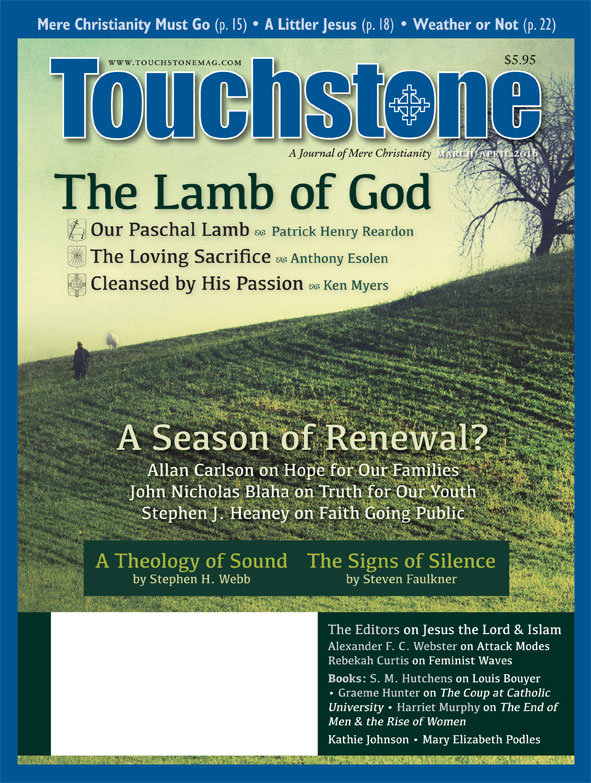
Going Public
The Reasonable Role of Religious Faith in Law & Society
by Stephen J. Heaney
The current state of the relationship between faith and reason in the law seems to be this: there are a lot of people who think there is absolutely no place in the law for faith. Three objections to giving faith a place are commonly given:(1) For those with a positivist leaning, law cannot be based on anything outside of itself, like, say, a natural law or anything grounded in "nature and nature's God." Power is the only relevant factor.
(2) Even for those who are not explicitly positivist, faith is frequently seen as simply an emotional response, something reducible to a matter of taste, or fear, or whimsy. One is reminded of that line from Miracle on 34th Street: "Faith is believing in things when common sense tells you not to." Who wants to live under laws that are supposed to govern everyone, but are based on the emotional responses of rule-makers who have abandoned reason?
(3) A related idea holds that even if you do not think of faith as a purely emotional response, it is nonetheless based on "reasons" which are "private." Laws, on the other hand, must be based only on "publicly accessible reasons." Proponents of this view admonish not only those who hold office to keep their religious beliefs private; they frequently discourage citizens from acting for the public good based on their faith, even in that sanctuary of conscience, the voting booth.
In this essay, we will not concern ourselves with objection 1. Whether or not law is based solely on power requires an argument about the nature of law. Objections 2 and 3, on the other hand, take it as a given that law is not just about power, but has to be reasonable. These two objections, because they engage the rationality of law, also engage the rationality of the believer: they assume that what religious adherents believe is alien and weird and, ipso facto, irrational.
Let me state up front that this essay is not about the truth of any of the various faith propositions. The arguments stated here apply equally to all faiths. By way of full disclosure, I claim Roman Catholicism as my own faith. The arguments I am about to employ, however, do not apply only to Catholics or even just to Christians.
Kinds of Evidence
A profitable approach to the problem raised here, I think, would be to ask a question—a kind of question (since we are talking about the law) we should ask ourselves if we had to act as judge or juror in a courtroom: When do we say that we are operating from reason?
To say that we are acting from reason is to say that we are acting in accordance with logic: that is, our conclusion follows from our premises, and the premises are true. It could be that the conclusion follows necessarily from the premises, but it can also be the case that the conclusion follows from the premises with a certain probability; i.e., it is more likely than not that the conclusion is true. It might also be the case that we find ourselves admitting that the premises themselves are at best probably true. This will be the case when the premises from which one argues are the probable conclusions of earlier arguments.
The corollary for thinking logically—and perhaps this is rather obvious—would be that we actually have reasons—that is, evidence—for our conclusions. This is of particular interest with respect to the problem we have raised, because the claim that an argument from faith is inadmissible in law or in the public square is ultimately a claim that people of faith do not really have reasons for their conclusions at all, at least not reasons that correspond to any facts about the world. An emotional response or flight of fancy may well constitute an explanation for an action, but it would not count as evidence leading logically to the conclusion of an argument.
A Journal of Mere Christianity—Delivered to Your Door
- Essays on theology, culture, and the Church
- Contributors from across the Christian traditions

Six print issues (one year) of Touchstone, plus full online access and PDF downloads for only $39.95.

Get a one-year full-access subscription to the Touchstone online archives for only $19.95.
bulk subscriptions
Order Touchstone subscriptions in bulk and save $10 per sub! Each subscription includes 6 issues of Touchstone plus full online access to touchstonemag.com—including archives, videos, and pdf downloads of recent issues for only $29.95 each! Great for churches or study groups.
Transactions will be processed on a secure server.
more from the online archives

37.5—Sept/Oct 2024
A Battle Plan for Peace While Growing Old by Anthony Esolen
calling all readers
Please Donate
"There are magazines worth reading but few worth saving . . . Touchstone is just such a magazine."
—Alice von Hildebrand
"Here we do not concede one square millimeter of territory to falsehood, folly, contemporary sentimentality, or fashion. We speak the truth, and let God be our judge. . . . Touchstone is the one committedly Christian conservative journal."
—Anthony Esolen, Touchstone senior editor
