Feature
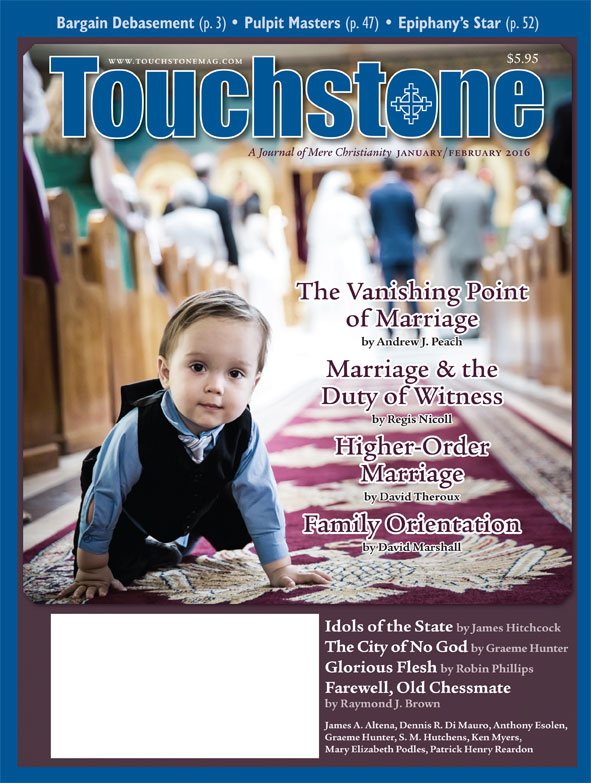
Idols of the State
Secularists Want All Religion Out of the Public Square, Except Theirs
The great historian Christopher Dawson claimed that every culture has a religion at its core, a claim that has been borne out by virtually all empirical studies. Thus, the most significant historical eras are those in which one religion is being superseded by another, as in the late Roman Empire.
The social-science definition of religion is so vague as to be almost useless, but it means any system of beliefs that are in some sense ultimate—those which, as the United States Supreme Court once said, "occupy the place that belief in God occupies in the life of a believer."
Historically, religion has sometimes underlain the whole social and cultural order in such a way as to sacralize that order, rendering it at least potentially totalitarian, as a resurgent Islam now appears to be in some places. For a number of complex reasons, that has not been true of Christianity, as the centuries of conflict between "church and state"—especially during the Ages of Faith themselves—demonstrate.
Assaults on Christianity
The Enlightenment was the first frontal assault on Christianity in the West, but for the most part, the philosophes rejected atheism and continued to consider religion necessary for a virtuous society. In Protestant cultures, the Enlightenment even made a kind of peace with Christianity, in the form of what came to be called liberal religion.
The same did not happen in France, probably because, after well over a thousand years, the Catholic religion had permeated the culture so completely that its enemies found it necessary to tear it out root and branch. But given the tenaciousness of religion, a substitute had to be found. The French Revolution was perhaps the first attempt to make the state itself a religion, employing the trappings of holy days, hymns, saints, and catechisms, demanding absolute fidelity from the citizens, and severely punishing all signs of heresy. While it employed terror to enforce its faith, that was considered merely a temporary expedient, until the citizens—enlightened by the enlightened state—would freely give their whole selves to that state.

Fascism and Communism carried to the farthest extremes this attempt to exterminate traditional religion and substitute a divine state in its place, but in a sense, the two came from opposite directions. Communism built on a profoundly religious Russian culture, while Fascism made its principal appeal to a modernized secular culture that had been brought close to nihilism by the First World War. But both found that a religion of some kind was necessary even in an atheist society.
The United States, with its official espousal of separation of church and state, might seem like the first major departure from Dawson's thesis, but most of the Founding Fathers entered into the Enlightenment bargain, with all its ambiguities. In a sense, the religion of the elite Founders was even irrelevant, as Evangelical Protestantism spread rapidly and massive Catholic immigration reinforced a Christian, largely Protestant, culture, even if that was not officially enshrined.
The task of legally defining America as secular was taken up by the Supreme Court only in 1947, and the actual secularization of the culture began to occur rapidly only after about 1965. Meanwhile, paradoxically, cultural secularization was occurring even more rapidly in those Western European countries that had retained official churches.
James Hitchcock is Professor emeritus of History at St. Louis University in St. Louis. He and his late wife Helen have four daughters. His most recent book is the two-volume work, The Supreme Court and Religion in American Life (Princeton University Press, 2004). He is a senior editor of Touchstone.
A Journal of Mere Christianity—Delivered to Your Door
- Essays on theology, culture, and the Church
- Contributors from across the Christian traditions

Six print issues (one year) of Touchstone, plus full online access and PDF downloads for only $39.95.

Get a one-year full-access subscription to the Touchstone online archives for only $19.95.
bulk subscriptions
Order Touchstone subscriptions in bulk and save $10 per sub! Each subscription includes 6 issues of Touchstone plus full online access to touchstonemag.com—including archives, videos, and pdf downloads of recent issues for only $29.95 each! Great for churches or study groups.
Transactions will be processed on a secure server.
more from the online archives

calling all readers
Please Donate
"There are magazines worth reading but few worth saving . . . Touchstone is just such a magazine."
—Alice von Hildebrand
"Here we do not concede one square millimeter of territory to falsehood, folly, contemporary sentimentality, or fashion. We speak the truth, and let God be our judge. . . . Touchstone is the one committedly Christian conservative journal."
—Anthony Esolen, Touchstone senior editor