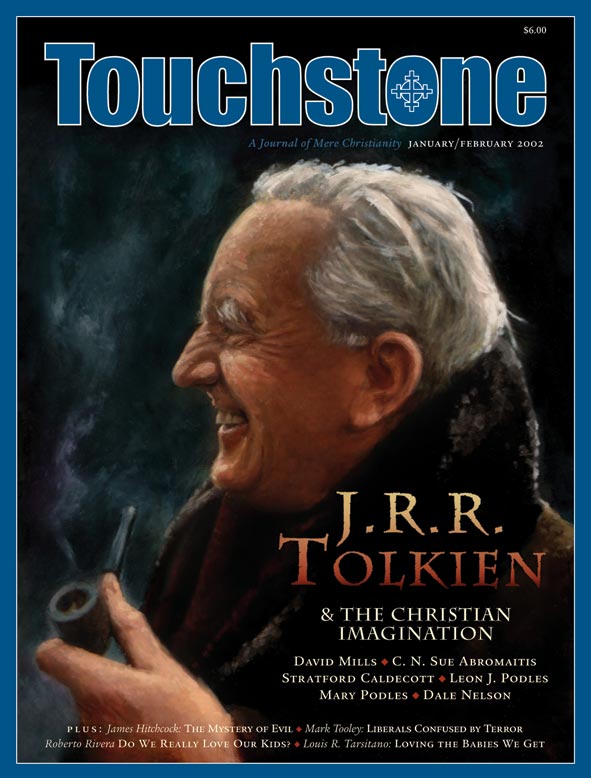
The Lord & Lady of the Rings
The Hidden Presence of Tolkien’s Catholicism in The Lord of the Rings
by Stratford Caldecott
With the release in December 2001 of The Fellowship of the Ring, the first of a three-movie series based on J. R. R. Tolkien’s The Lord of the Rings, public interest in the Oxford don whose private hobby has entranced millions has been rekindled. Yet how many of those who see the film will detect its original author’s Christian inspiration?
For once, this is not a criticism that can be directed against Hollywood for having bowdlerized the text. The author himself, though no admirer of popular American culture, did his best long before his own death in 1973 (as we know from his published Letters) to disguise or extirpate virtually all references to religious practice, and most to religious belief, in his imaginary world. And yet there remains a strong religious presence throughout the written work. Whatever we may think of the movie (and I have not seen it at the time of writing), this hidden Christian presence is worth investigating.
Tolkien’s friend, drinking partner, and fellow “Inkling” C. S. Lewis is well known as a Christian convert and a writer of apologetics. J. R. R. Tolkien’s Roman Catholicism is less familiar to us, partly because he did not see himself as a religious writer in the same sense. He did not feel called to enter the lists as a writer on Christian themes, let alone as a theologian or philosopher of religion. Nevertheless, with the posthumous publication in 1981 of his Letters, this side of his life was exposed to view, and it became clear that Catholic belief and sensibility permeated every aspect of his life1—including the writing of the fantasies that were so derided by many of his academic colleagues and that have proved so enduringly popular.
The Letters make interesting reading, also, because of the close integration that is evident there between the author’s faith and his intelligence. Pope John Paul II once famously said, “A faith that does not become culture is a faith that has not been accepted in its fullness, which has not been totally reflected upon, or faithfully lived.” Tolkien may not have been a professional theologian, may not even have seen himself as a religious thinker, but in him we see faith becoming culture, as I hope to demonstrate.
Creation & Temptation
The Lord of the Rings is not a book about religion, but it is the expression of a religious soul working under God. It is an act of “sub-creation,” as Tolkien put it in his famous essay “On Fairy-stories”: It involves the creation of an imaginary world as much as possible along the lines God might have used, had he decided to create it.2 At one point Tolkien describes this as “a tribute to the infinity of [God’s] potential variety.”3
Creativity is indeed one of the major themes of Tolkien’s fiction, including many of the minor stories such as “Leaf by Niggle,” which will not be examined in this essay. The vast, rambling literary tapestry that forms the backdrop for Tolkien’s major work, much of which was only published posthumously in The Unfinished Tales, The Silmarillion, and the multi-volume History of Middle Earth after collation and editing by his son Christopher Tolkien, begins with a creation myth: the “Ainulindalë.” The creation of the Ainur (Angels) by Ilúvatar, the One God, is followed by the proposal of a “musical theme,” which the Ainur then embellish. One of their number, Melkor, jealous of the creative powers of the One, attempts to subvert the theme. Ilúvatar shows the music to the Ainur in the form of a vision of earthly history, and finally brings it into actuality. Entering into it, the Ainur become Valar—gods or guardians—and descend to play the parts they have chosen within it, contending from the outset against the chaos introduced by the dark Angel.
In an unfinished letter,4 Tolkien describes this as “differing” somewhat from most Christian accounts of the Creation, in that the Angelic Fall takes place before the creation of the material world, and consequently a tendency to evil is able to enter into the world “already when the Let it Be was spoken” by Ilúvatar. However, Tolkien has no intention of writing in contradiction to Christian orthodoxy. He is a devout and well-instructed Catholic, a daily communicant. Whether the Angelic Fall takes place before or after the creation of matter (and the Christian tradition is, after all, ambiguous or silent on this point), Tolkien has no doubt that evil is the result of free decisions by a created nature that was good at the outset. Furthermore, while the evil that is done by Melkor may destroy the original design of the Creator and mar the creation at every level, the eventual victory of Ilúvatar is certain, for even the work of the Fallen will somehow prove “a part of the whole and tributary to its glory.”5 In Tolkien’s perspective, history is a “long defeat,” but it ends in a great healing, when “the themes of Ilúvatar shall be played aright.”
The motif of creation and temptation continues within the history of Arda (the Earth). After the coming into the world of the Firstborn of Ilúvatar, the Elves, a second great Fall takes place. The elvish craftsman Fëanor fashions three great jewels called “Silmarils” and places within them a portion of the light from the two Trees that at that time illuminate the world. The Trees are subsequently destroyed by the Evil One, but Fëanor refuses to yield up the jewels, which alone can heal the Trees and restore their light. Subsequent history revolves around the fate of the Silmarils. They are stolen by Morgoth, who is pursued by Fëanor and his sons. The quest for the jewels and the conflicts it creates among the Elves themselves are the engine that drives much of the early history. The events of subsequent ages, after the jewels themselves are lost in the fires of the earth, in the deeps of the sea, and among the stars, are an echo and a consequence of these great events—the continuation (as Sam observes to Frodo near the end of their particular adventure) of one story that goes on and on, as the free will of creatures is caught up in a music that was conceived before the beginning of time.
A Journal of Mere Christianity—Delivered to Your Door
- Essays on theology, culture, and the Church
- Contributors from across the Christian traditions
Six print issues (one year) of Touchstone, plus full online access and PDF downloads for only $39.95.
Get a one-year full-access subscription to the Touchstone online archives for only $19.95.
bulk subscriptions
Order Touchstone subscriptions in bulk and save $10 per sub! Each subscription includes 6 issues of Touchstone plus full online access to touchstonemag.com—including archives, videos, and pdf downloads of recent issues for only $29.95 each! Great for churches or study groups.
Transactions will be processed on a secure server.
more on J. R. R. Tolkien from the online archives
more from the online archives

calling all readers
Please Donate
"There are magazines worth reading but few worth saving . . . Touchstone is just such a magazine."
—Alice von Hildebrand
"Here we do not concede one square millimeter of territory to falsehood, folly, contemporary sentimentality, or fashion. We speak the truth, and let God be our judge. . . . Touchstone is the one committedly Christian conservative journal."
—Anthony Esolen, Touchstone senior editor