




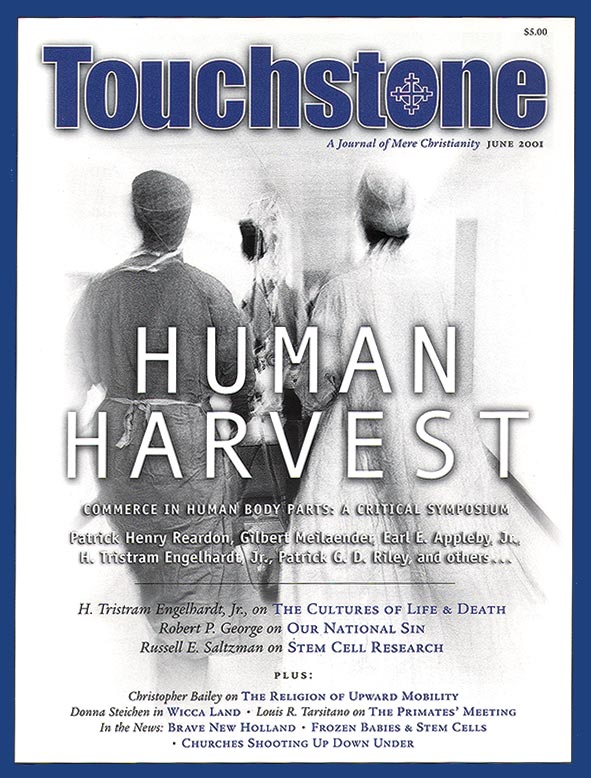
The Wiccan Myth
Goddess Unmasked: The Rise of Neo-Pagan Feminist Spirituality
by Philip G. Davis
Dallas, Texas: Spence Publishing Co., 1998
(350 pages; $17.95, paper)
reviewed by Donna Steichen
In what is deemed a scientific age, in an incontestably materialistic society, the fastest-growing religion is one built on pure fantasy. Where is this movement coming from, and what does it believe? What can be attracting educated, politically correct, technologically proficient men and women, and their adolescent offspring, to a belief system that is intentionally irrational, even anti-rational? What is the goal of their spiritual search? Many parents, pastors, and educators in society’s mainstream are asking these questions, as the phenomenon of “neo-paganism” spills out of the local New Age bookstore and the weekend Renaissance Fair to the city high school, the parish youth group, and the retreat house staff.
The most popular form of neo-paganism seems to be Goddess Wicca or witchcraft, spelled with a capital W to distinguish its devotees from the traditional Shakespearean image of hags who cast evil spells in satanic rituals. Across the English-speaking world, people—especially but not exclusively adolescent girls unattached to traditional churches—are reportedly lining up to join local units of the Covenant of the Goddess. It has surfaced in some unlikely places: Wiccan services are now held on request at US military bases. Some scholars estimate the number of self-identified neo-pagans in the United States today at more than 200,000.
With this timely, intelligent book, Philip G. Davis offers invaluable aid to readers anxious about the goddess phenomenon. The author is a professor of Religious Studies at the University of Prince Edward Island in Canada. His Goddess Unmasked is a work of solid scholarship that tracks goddess worship from Stone Age times through the Enlightenment and nineteenth- and twentieth-century occult movements rooted in European Romanticism, all the way to the writings of people like Carol Christ, Matthew Fox, Zsuzsanna Budapest, and Starhawk Simos, now living near me in California.
With careful clarity, Davis deconstructs the foundational myth of Goddess Wicca: that in Paleolithic times there existed a peaceful, idyllic civilization dominated by women who worshipped a single Great Mother Goddess, until it was overthrown by invading tribes of violent patriarchs. This legend at the heart of the counterfeit religion is not supported by archeology, anthropology, or the literary records of ancient times.
Archeological interpretation is a necessarily limited and often tentative business, but all the evidence indicates that ancient cultures worshiped multiple gods and goddesses. There is no available evidence that the presence of goddesses in their pantheon meant that women were dominant or even regarded as equal. This information is not new. In a 1980 article in Christian Century (9-80), even one prominent Catholic feminist, Rosemary Radford Reuther, cautioned her ideological fellows against embracing Goddess Wicca because ancient cultures with goddesses did not create “a feminist religion,” and medieval records provide “not the slightest evidence” that anyone regarded witchcraft as “centered in a female deity.” Later, under heavy peer pressure, Reuther ceased to mention these objections.
Promoters of Goddess Wicca do not draw on authentic archeological or anthropological data but on relatively recent speculations about ancient traditions. The story of the Great Mother is a fantasy rooted in the nineteenth-century Romantic reaction to the Enlightenment.
Eighteenth-century Enlightenment philosophy proposed a “religion of reason” to replace the old authorities of society and religion, pitting belief in human perfectibility against the doctrine of Original Sin. When the Enlightenment culminated in the violence of the French Revolution and the Napoleonic wars, Enlightenment politics lost credibility, yet its individualistic empiricism survived among many intellectual and artistic elites.
Disillusioned about the possibility of constructing a rationally ordered society, yet shunning the constraints of religion, the Romantics embraced a new ideology. Romanticism held that emotional experience is the purpose of life, rejected “dead materialism” in theory if not in practice, and sought authentic community in the “blood ties” of primitive ethnicity. This was the seedbed of the neo-paganism expressed in both the contemporary New Age movement and Goddess Wicca.
Davis uncovers all the ideological and organizational strands involved in the fabrication of modern witchcraft, and they turn out to be those that traditional Christian believers have always blamed. Masonry, Rosicrucianism, Goethe and the German Romantic (and eventually, Nazi) search for a “pure Aryan race,” the Order of the Golden Dawn, satanist Aleister Crowley, Margaret Murray, Carl Jung, Robert Graves, and Theosophy, combined with Frederick Engels’s vision of feminism as an agenda for class warfare, led finally to the ideological feminist politics of the past 30 years, with its anti-rational “feminist spirituality.”
A Journal of Mere Christianity—Delivered to Your Door
- Essays on theology, culture, and the Church
- Contributors from across the Christian traditions

Six print issues (one year) of Touchstone, plus full online access and PDF downloads for only $39.95.

Get a one-year full-access subscription to the Touchstone online archives for only $19.95.
bulk subscriptions
Order Touchstone subscriptions in bulk and save $10 per sub! Each subscription includes 6 issues of Touchstone plus full online access to touchstonemag.com—including archives, videos, and pdf downloads of recent issues for only $29.95 each! Great for churches or study groups.
Transactions will be processed on a secure server.
more from the online archives

28.1—January/February 2015
on State Impositions & Church Acquiescence by Stephen Baskerville
21.6—July/August 2008
Benedict XVI on the Crisis of Faith & Reason by Samuel Gregg
calling all readers
Please Donate
"There are magazines worth reading but few worth saving . . . Touchstone is just such a magazine."
—Alice von Hildebrand
"Here we do not concede one square millimeter of territory to falsehood, folly, contemporary sentimentality, or fashion. We speak the truth, and let God be our judge. . . . Touchstone is the one committedly Christian conservative journal."
—Anthony Esolen, Touchstone senior editor
