




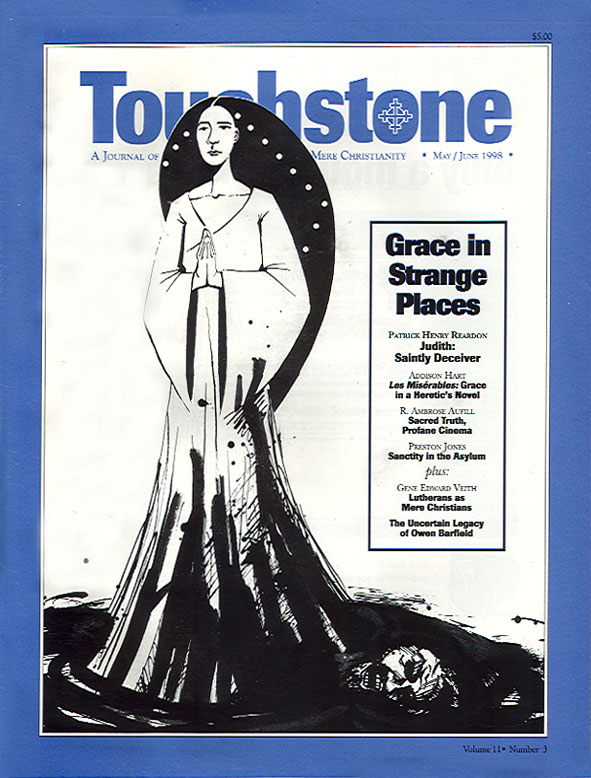
Apocryphal Judith, Saintly Deceiver
Judith, Tradition, & the Christian Reader
by Patrick Henry Reardon
Even though the Book of Judith, being relatively short, can be quickly read,1 rather few Christians in America nowadays seem actually to have read it, a circumstance arising mainly, of course, from the fact that most Protestant Bibles published in America, as distinct from those published in England, simply do not contain it.
This situation is rather new. While the Reformers denied Judith’s canonicity, they most certainly read the book and spoke about it. Nowadays, however, except among those who use the standard Roman Catholic translations or otherwise have access to the noncanonical biblical literature,2 the narrative of Judith is not so widely known to Christians as was the case in times past.
I am among those persuaded that this situation is lamentable, and the present article intends, as its chief purpose, to offer some suggestions for a more fruitful Christian reading of Judith’s story. I will do this in three stages: first, examine how Christians in the past have actually read the Book of Judith and see what lessons they learned from it; second, explore plausible reasons why the book failed to gain a more popular following throughout Christian history; and third, indicate what I hope will be some useful avenues to a properly Christian reading of Judith.
Virtuous Judith in the Tradition
I will begin with earlier Christian approaches to Judith. On those occasions when believers during former times appealed to the Book of Judith, it was normally to advance some fairly simple moral or ascetical theme. Almost invariably it was a matter of holding up some edifying aspect of the character of Judith for Christian emulation. That is to say, the book’s interest seems to have been limited almost exclusively to the moral example of its heroine.
Among the virtuous aspects of the character of Judith especially emphasized as ethical, ascetical standards were her courage and self-sacrifice, her prayer and fasting, her sobriety and level-headedness, and the chastity of her consecrated widowhood, all of which features made her a ready instrument in the workings of God’s salvific Providence.
Our earliest Christian reference to Judith’s courage is early indeed. Addressing the church at Corinth about the year 96, Clement of Rome wrote: “Blessed Judith, during the siege of her city, begged of the elders that she might be permitted to go out into the camp of the enemies. So, exposing herself to peril, she went forth out of love for her fatherland and her people in the siege, and the Lord delivered Holofernes into a woman’s hand.”3 Clement then went on to compare Judith to Esther who likewise risked her life for her people. God used both women, said this third bishop of Rome, to deliver the nation from destruction by specific threatening individuals, Haman in the instance of Esther, Holofernes in the case of Judith.
Clement’s ideas on Judith were to become common themes in the traditional exegesis of that book. First, there was the example of Judith’s courage that inspired her to place her life at risk for the sake of others. Other Christians, particularly Ambrose of Milan and Isidore of Seville, picked up this theme: “She did not fear death”; a model of fortitude, she showed herself to be “stronger, by ignoring danger and despising death.” In all of this, Judith was motivated by “an attractive contempt for her own safety.”4
Second, there was Judith’s striking similarity to Esther. Since the heroines in both stories were used by God to overcome cruel enemies in circumstances of great danger, it is not surprising that the two books were almost always named sequentially in the traditional lists of biblical literature, even in those instances where Judith was regarded as uncanonical.5 Both women, after all, defeated and destroyed specific enemies of God’s people; the stories of their exploits were explicitly compared by Clement of Alexandria and others.6
Patrick Henry Reardon is pastor emeritus of All Saints Antiochian Orthodox Church in Chicago, Illinois, and the author of numerous books, including, most recently, Out of Step with God: Orthodox Christian Reflections on the Book of Numbers (Ancient Faith Publishing, 2019).
A Journal of Mere Christianity—Delivered to Your Door
- Essays on theology, culture, and the Church
- Contributors from across the Christian traditions

Six print issues (one year) of Touchstone, plus full online access and PDF downloads for only $39.95.

Get a one-year full-access subscription to the Touchstone online archives for only $19.95.
bulk subscriptions
Order Touchstone subscriptions in bulk and save $10 per sub! Each subscription includes 6 issues of Touchstone plus full online access to touchstonemag.com—including archives, videos, and pdf downloads of recent issues for only $29.95 each! Great for churches or study groups.
Transactions will be processed on a secure server.
more from the online archives

24.1—January/February 2011
How Planned Parenthood's Founder Played the Christians, and Won by Allan C. Carlson
27.2—March/April 2014
on C. S. Lewis & the New State Paganism by W. E. Knickerbocker

calling all readers
Please Donate
"There are magazines worth reading but few worth saving . . . Touchstone is just such a magazine."
—Alice von Hildebrand
"Here we do not concede one square millimeter of territory to falsehood, folly, contemporary sentimentality, or fashion. We speak the truth, and let God be our judge. . . . Touchstone is the one committedly Christian conservative journal."
—Anthony Esolen, Touchstone senior editor
