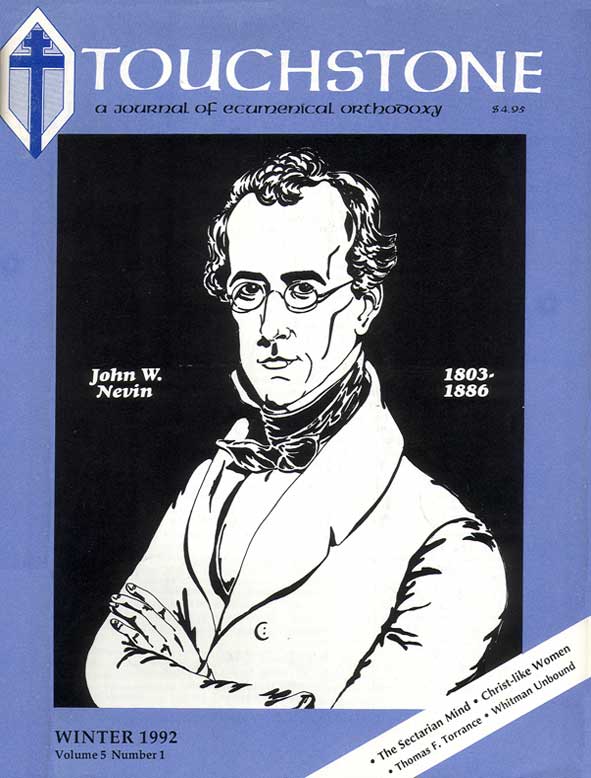
J. W. Nevin on the Sectarian Mind
Lessons from Mercersburg for Modern Evangelicals
by S. M. Hutchens
Mercersburg is still there, but there is little about it to show its importance in the theological history of America. It is a town of sixteen hundred or so about ten miles southeast of McConnellsburg and twenty miles southwest of Chambersburg, Pennsylvania. The seminary of the German Reformed church it once contained has long since moved and merged with the one in Lancaster now belonging to the United Church of Christ. Given the character of that denomination, one would expect the Mercersburg of the mid-nineteenth century to hold little more than antiquarian interest for its institutional heirs, and not even much of that. It is no surprise that the six projected volumes of the Lancaster Series on the Mercersburg Theology to have been published by the United Church Press was begun more than twenty-five years ago but has never been finished.
Despite this, no student of American church history has ever treated Mercersburg lightly, for in the 1840s and 1850s this little seminary housed two of the most powerful and provocative minds in America. Marching against the broad stream of revivalism and "puritan" theology that held sway in the majority of American churches, they held up a catholic standard for the reformation of a Protestantism that had lost touch with history and forgotten the Church. John Williamson Nevin summarized this standard in three precepts:
(1) Jesus Christ, in his person, is the Principle of Christianity.
(2) The Creed is the regula fidei of the Christian world.
(3) The Church as the Body of Christ in the world is objective and historical.1
As unremarkable as these may sound to the catholic ear—or, may I say, to Protestants who have profited from the work of Karl Barth—American Protestantism of the mid-nineteenth century found them profoundly unsettling, especially when advanced by men with the depth and breadth of Mercersburg’s principal teachers, J. W. Nevin and Philip Schaff. From rural Pennsylvania Nevin and Schaff addressed the American churches with a message that has not and should not be forgotten.
I have found that the attempt to assert these principles among modern Evangelicals meets with the same resistance that Nevin and Schaff encountered from their nineteenth-century forebears. This is evidence that many of the changes in American Evangelical Protestantism in the last century and a half have not touched its deeper structure. While busy building the righteous kingdom, evangelizing, and resisting the grosser heresies, it has shown great reluctance to consider a more catholic form of Christianity such as that embodied in the three Mercersburg principles. Perhaps this is because the movement senses its debt to its distinctive eccentricities. Where would it be without revivalism and rationalistic biblicism? One need not deny reason or the experience of grace in conversion to insist, as did the Mercersburg theologians, that Christianity rests upon the person of Christ, the Church as the pillar and foundation of his truth, and the Creed as the universal symbol of the Church’s faith. Christian theology and practice call for a consuming interest in these things, merely for the truth’s sake. Where the message of Mercersburg is resisted it bears repeating until it is finally heard.
II.
When Nevin said that Jesus Christ, in his person, is the principle of Christianity, he was pointing to a distinctly sacramental idea that he knew had been lost to most of his American Protestant contemporaries. It had become foreign to revivalism because the coming of Christ in the experience of salvation was almost entirely equated with evangelical conversion, and to the Scholastics because personal categories were perceived as less decisive and satisfactory than the logical and propositional. The preaching of the revivalists and the theology of the Scholastics complemented each other nicely. Both had a strong tendency to subjectivize Christian experience, to make the sinner the principal actor in the drama of salvation—the visceral man in the case of the revivalists, the intellectual in the case of the theologians. These two men combined to make the "puritan"—surprisingly enough, a distinctively modern man—who had forgotten too much, a man who, in a sense similar to that of which C. S. Lewis spoke in The Abolition of Man, has a large belly and brain, but nothing between them. Christ, to be sure, was professed to be the founder, object, and content of faith. But the faith itself, perceived subjectively as possession of a set of experiences and beliefs, was being identified as the goal and meaning of Christian life rather than phenomena that arise from the life of Christ within and among us—who is in his person the goal and meaning of life.
S. M. Hutchens is a senior editor and longtime writer for Touchstone.
A Journal of Mere Christianity—Delivered to Your Door
- Essays on theology, culture, and the Church
- Contributors from across the Christian traditions

Six print issues (one year) of Touchstone, plus full online access and PDF downloads for only $39.95.

Get a one-year full-access subscription to the Touchstone online archives for only $19.95.
bulk subscriptions
Order Touchstone subscriptions in bulk and save $10 per sub! Each subscription includes 6 issues of Touchstone plus full online access to touchstonemag.com—including archives, videos, and pdf downloads of recent issues for only $29.95 each! Great for churches or study groups.
Transactions will be processed on a secure server.
more from the online archives

calling all readers
Please Donate
"There are magazines worth reading but few worth saving . . . Touchstone is just such a magazine."
—Alice von Hildebrand
"Here we do not concede one square millimeter of territory to falsehood, folly, contemporary sentimentality, or fashion. We speak the truth, and let God be our judge. . . . Touchstone is the one committedly Christian conservative journal."
—Anthony Esolen, Touchstone senior editor