|
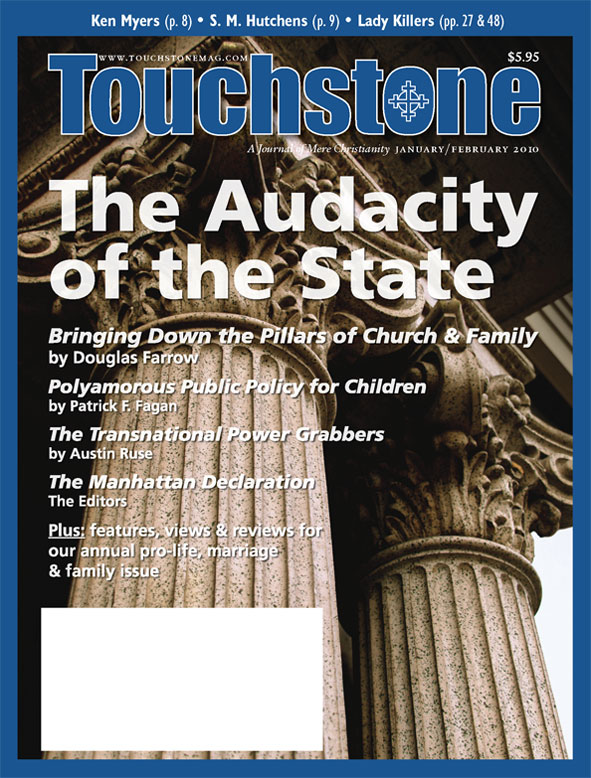
Rulers Without Borders by Austin Ruse
Friends of CFAM, click here for a special offer on Touchstone. Save 30% off of the regular subscription price!
Rulers Without Borders
The Global Governance Strategy of the Transnational Progressives Marches
On
by Austin Ruse
For many years, those of us in the UN pro-life and pro-family movement have
focused on the documents under negotiation, and you might say we have missed
the forest for the trees. We have focused on the details of negotiating dozens
of individual documents but have missed the larger picture.
It is true that we have been successful in stopping abortion from becoming
an international human right, and we have largely stopped the homosexual movement.
As large as these issues are, there are still larger issues at the UN that
we have almost missed, and these larger issues will be used to undermine the
right to life and a proper understanding of marriage and family.
The larger picture is that UN radicals in alliance with radical lawyers,
judges, and other advocates around the world are attempting the greatest power
grab the world has even known. They seek to decide for all mankind the most
intimate details of people’s lives, and they are determined to do this
from their lofty and elite perches at the UN in New York, at the European Union
in Brussels, and at other centers of international power.
In order to achieve this, they must remake the international system. Where
once international relations meant relations between and among states, it now
means international bodies interfering with the lives of individuals. Where
once sovereign states determined what was best for the people within their
borders, the transnational progressives seek to usurp this power from the states
and from the people.
What we face is a tsunamic change in social policy and in the international
system. The result of this is a monumental democratic deficit. Ask yourself,
who is your representative at the United Nations? The fact that hardly anyone
knows the answer points up this huge democratic deficit because it is these
people at the UN who have taken it upon themselves to direct your intimate
lives.
This is the big picture, and it strikes at all families all over the world,
and at all countries, too—north and south, east and west, rich and poor.
We are all in this fight together.
The Fight Begins
The pro-life and pro-family coalition at the UN began its work during the
preparatory phase of the 1994 Cairo Conference on Population and Development.
Our opponents began at that time to advance a “right” to abortion
in UN documents. At first, they tried to get an explicit right to abortion
stated in the documents. They were defeated at Cairo and at subsequent UN conferences
by a coalition of Christians and Muslims that was created by Pope John Paul
II.
After this great alliance defeated their radical efforts to make abortion
a universal right, they began an extended effort to advance their agenda through
lying and trickery. They created code words such as “reproductive health.” From
the time of Cairo to this very day, they have successfully placed “reproductive
health” or “reproductive rights” into countless UN documents.
The most important thing to know about this phrase is that it has never been
defined by the UN General Assembly or any international treaty to include a
right to abortion. Nevertheless, it is not an innocuous term.
Our sophistication on this question has grown significantly over the years,
and we have come to know the radicals’ intentions in adding this phrase
to non-binding UN documents. It is part of what we call the “soft law
strategy.”
Soft Law Strategy
Soft law refers to efforts by international radicals to advance an idea known
as “customary international law.” Customary international law is
law that is not necessarily written down but that is understood over time to
bind states nonetheless.
In order for customary law to emerge, three things must be present. First,
there must be uniform, universal state practice. This means that all countries
must practice the measure. Second, the practice must have gone on for a very
long time—longer than a few years or even several decades. Third, the
states must practice the measure based on their understanding that they have
a legal obligation to do so. This is a very high bar, and it explains why so
few items are considered as falling under customary international law. One
such item is the safe passage of diplomats.
Proponents of abortion make the case that the if the phrase “reproductive
health” is repeated enough times in non-binding UN documents, then a
customary international law has been achieved. Let me make clear that this
is false and that our opponents know it is false.
Customary international law cannot be established from non-binding documents,
and neither can it be established in only fifteen years. It takes decades and
even centuries. So our opponents have not been successful in any court of law
or parliament with their arguments from customary international law.
So they have increasingly turned to what has become a more successful strategy,
one that we call the “hard law strategy.”
Hard Law Strategy
Another thing we noticed over time is the aggressive pro-abortion nature
of the deliberations of various UN committees charged with monitoring compliance
with hard law human rights treaties. Most hard law treaties have committees
before which participating governments’ representatives must appear periodically
to report on how their nations are implementing the treaty.
Twelve years ago, we began monitoring the committee charged with supervising
compliance with the Convention on the Elimination of All Forms of Discrimination
Against Women (CEDAW). What we noticed was that the committee was telling governments
that they had to change their laws on abortion.
This committee has no authority to make governments do any such thing. The
CEDAW treaty does not even mention abortion. In fact, it does not even mention “reproductive
health,” that code word used to mean abortion.
Still, over the years, we have counted that the committee has directed more
than ninety countries to change their laws on abortion. How can they do this
and what is their purpose?
Unbeholden Committee
The CEDAW committee is made up of 22 individuals who are nominated and voted
upon by states that are party to the treaty. They do not represent
governments. Once they are elected, they are beholden to no one but themselves.
The CEDAW 22 come mostly from left-wing groups, and many are also abortion
advocates. What we have here is the specter of sovereign states having to report
to individuals, most of them hard-left advocates for abortion.
Besides berating governments, these individuals—all private citizens—have
taken it upon themselves to rewrite the treaty they are supposed to be monitoring.
Let’s linger on that a moment. CEDAW is a hard law treaty. It is legally
binding on the states that have ratified it. Sovereign states work sometimes
for years to negotiate such treaties. These states generally have to take these
treaties before their parliaments to gain ratification. This is a long, laborious,
and largely democratic process. In the end, the hard-fought treaty binds the
states legally. Yet, with this committee, there is a group of ideologically
driven private citizens who have taken it upon themselves to rewrite a hard
law treaty and then try to enforce their reinterpretation on the sovereign
states that negotiated the treaty in the first place.
Here is specifically what the CEDAW committee has done. CEDAW is silent on
abortion. It does not mention the word. It does not even mention “reproductive
health.” But in something called General Recommendation 24, the CEDAW
committee of private citizens has read abortion into the document and now routinely
tells governments they must change their laws on abortion.
This strikes right at the heart of the democratic process. The citizens of
a sovereign state are generally content to let their government represent their
wishes and their best interests in international matters. They allow their
government to negotiate treaties that are then binding on the state and sometimes
on the citizens themselves, in the knowledge that they at least have a chance
to affect the policies of their own government.
But how does a citizen have any chance to affect the processes of the CEDAW
committee, a largely unknown group of private individuals answerable to no
one but themselves? This is a profound democratic deficit.
Harmful Effects
What is the effect of these rulings by the CEDAW committee? Does anyone listen?
Do their rulings have any effect on the law? Yes, they do. They certainly do.
In recent months, the High Court of Colombia has overturned its country’s
laws outlawing abortion, in the process citing what it considered to be treaty
obligations under CEDAW. Judges of the Mexican Supreme Court have determined
the same thing—that there are treaty obligations under CEDAW to overturn
laws against abortion.
The human rights group Amnesty International, which used to believe otherwise,
now holds this same position, that CEDAW requires that abortion be legalized.
This argument is now on the march across the globe, and it does not come
just with respect to the CEDAW treaty but also the International Covenant on
Economic, Social and Cultural Rights, whose “right to life” clause
is now interpreted by radical lawyers as including a right to abortion.
And all of it is a lie.
Furthermore, it is not just the cause of the unborn that is threatened by
these radical reinterpretations of hard law treaties. Radical homosexual groups,
along with UN representatives, now interpret international treaties as including
sexual orientation and gender identity as categories of nondiscrimination,
just like sex, race, religion, national origin, and the other well-established
categories. UN committees will soon begin directing states to mandate homosexual “marriage,” homosexual
adoption, and the teaching of homosexual propaganda to little children.
One mustn’t think that these outrageous maneuvers affect only countries
in the developing world. They are happening in the developed world, too. In
fact, they have occurred in the United States. A few years ago, the US Supreme
Court made homosexual sodomy a constitutional right. In doing so, the Court
referred to so-called new international norms as well as to rulings of the
European Court of Human Rights.
When the US Supreme Court overturned the death penalty for anyone whose crime
was committed while a juvenile, the Court cited the Convention on the Rights
of the Child, a treaty that the US has not even ratified. Some members
of the Court have pledged to continue this practice of referring to documents
and treaties which the US has not ratified but which they believe contain new
international norms.
This hard law strategy of the hard left is affecting and will affect every
country in the world.
Global Governance
What we are talking about here is something called Global Governance. Through
the use of both soft law and hard law tactics, a lattice of new norms is being
forced upon individual governments and individual persons. These new norms
have never been officially decided or voted upon. They are being implemented
through treachery, lies, deceit, and the exercise of raw power.
These things are being perpetrated by a group of people that confidently
call themselves transnational progressives. They do not believe in the democratic
process. They believe in their own superiority. They believe they know better
than democratically elected officials, and they certainly know better than
mothers and fathers and other citizens around the world.
The big picture is that they are moving on many fronts. They are moving on
the UN front through the drafting of documents, hard and soft, and then through
the interpretation of these documents. They are moving through the court systems
around the world and imposing legal changes based on their own reinterpretations
of hard law treaties and non-binding resolutions.
The Highest Stakes
Why does this matter? A war is being waged against three sacred sovereignties:
the sovereignty of the nation, the sovereignty of the Church, and the sovereignty
of the family. We will each stand alone, as individuals, before the judgment
seat of God, but on this earth he has provided for us certain institutions
whose nearly sole purpose is to teach us his law. These mediating institutions—the
nation, the Church, and the family—are really our sole teachers. If any
one of them goes wrong or is undermined, we may be lost. If all of them go
wrong, we will be utterly lost.
But each of them stands in the way of the radical leftist notion of the complete
autonomy of the self. Therefore the leftists and their allies insist that these
institutions must change, that they must become something different from what
God made them to be. But in the course of so changing, they will be destroyed.
These are the stakes. They cannot get any higher.
Austin Ruse is the President of the Catholic and Family Human Rights Institute (C-FAM). This article was adapted and slightly abridged from a talk given at the World Congress of Families V, Amsterdam, Netherlands, August 12, 2009.
|