




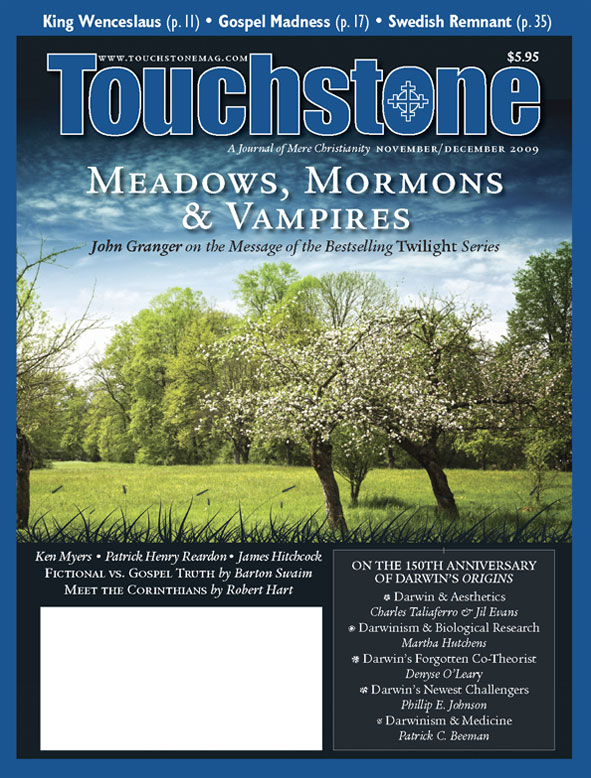
Charles Darwin, M.D.
Patrick C. Beeman on the Healing Arts as an Accessory to Evolution
You normally don’t find panegyrics among reports on randomized-controlled trials and articles on abstruse themes like hyperphosphatemia. Nevertheless, the February 11, 2009 issue of the Journal of the American Medical Association ( JAMA) might just as well have been subtitled “An Encomium to Darwin.” Granted, February was the two-hundredth anniversary of his birth, and he remains an important, if infamous, figure in the history of ideas. But one reads this issue of JAMA with the sense that Darwinism—including all its extra-scientific implications—is just as important to the profession of medicine as molecular genetics, pharmacology, or anatomy. But should it be?
Of course, in the scientific community—medicine included—questioning Darwinism is equivalent to denying the epidemiologic efficacy of vaccination or the antibiotic power of penicillin. They have a word for people who do such things: quacks. A doctor would do better to promote phrenology. Still, does Darwinism—considered as a kind of pan-evolutionary theory of everything—really need to be part of the physician’s armamentarium?
Theory Informs Practice
James P. Evans seems to think so. In “The Voyage Continues: Darwin and Medicine at 200 Years,” in the aforementioned issue of JAMA, he takes up Theodosius Dobzhansky’s maxim, “Nothing in biology makes sense except in the light of evolution,” and substitutes “medicine” for “biology.” He then says that this attitude “explains the increasing relevance of Darwin’s work to modern medicine and mandates a shift in the training of medical students.”
To be sure, calls for changes or shifts in the undergraduate medical curriculum are neither new nor particularly exciting. In fact, they are as common as flu cases during a pandemic, and to some—including this author—just as unwelcome. The distinction of Evans’s proposal lies in its desire for a sweeping adherence to Darwinian thought as a foundation for medical education.
As a medical student—at once an observer of and limited participant in patients’ care—I have come to see and experience how ideology can influence medical practice. I have learned that the act of healing goes beyond what is written on a prescription pad. A patient’s experience is shaped, for good or ill, by the theory of medicine that informs his physician’s practice—whether consciously or unconsciously.
The philosophy that informs medicine can either transform a physician into a healer in a deep and true sense of the word or transmogrify him into an agent of the culture of death and an avowed enemy of human dignity. Which do we get when one’s first principles of medicine are derived from Darwinian philosophy?
Darwinian Dictates
I was recently in clinic while a physician was counseling a teenage patient who had a disease with a strong genetic component. Many of his family members also had the disease. The physician looked at the teenager and said, “Do not pass this gene on to your offspring. You have to end this thing here.” He stopped just short of telling the patient that he had a moral duty not to procreate. As if he had no right to become a parent because he might pass on a particular gene—or as if his children’s lives would not be worth living if they happened to inherit it! I stood there, incredulous. When did enforcing “survival of the fittest” and ensuring that only the strong have children become part of the doctor’s vocation?
I have heard sentiments like this from other physicians and residents too many times to count—statements such as “This person should not have children,” or “People should have to get a license to have kids; some people just aren’t fit to be parents,” or “She should have to get her tubes tied. Five kids are too many.”
Patrick C. Beeman was formerly a lecturer in philosophy at Cleveland State University. He is currently the president of the Catholic Medical Students Association and in 2008 was a Pellegrino Fellow at the Georgetown University Center for Clinical Bioethics. He is a medical student at the University of Toledo and attends Holy Rosary Cathedral with his wife and two children.
subscription options
Order
Print/Online Subscription

Get six issues (one year) of Touchstone PLUS full online access including pdf downloads for only $39.95. That's only $3.34 per month!
Order
Online Only
Subscription

Get a one-year full-access subscription to the Touchstone online archives for only $19.95. That's only $1.66 per month!
bulk subscriptions
Order Touchstone subscriptions in bulk and save $10 per sub! Each subscription includes 6 issues of Touchstone plus full online access to touchstonemag.com—including archives, videos, and pdf downloads of recent issues for only $29.95 each! Great for churches or study groups.
Transactions will be processed on a secure server.
more on evolution from the online archives

22.8—November/December 2009
Looking for Beauty & Justice 150 Years After Darwin’s Classic by Charles Taliaferro
23.6—November/December 2010
Darwin, Design & Thomas Aquinas
The Mythical Conflict Between Thomism & Intelligent Design by Logan Paul Gage

32.2—March/April 2019
Flight from the Absolute: Cynical Observations on the Postmodern West, Volume II by Paul Gosselin by Louis Markos
more from the online archives
29.5—Sept/Oct 2016
on Past & Present Atheism & the Invention of Happiness by Jordan Bissell
33.3—May/June 2020
Bach's Cantata BWV 106, Gottes Zeit ist die allerbesteZeit (God's time is the very best time) by Ken Myers

37.5—Sept/Oct 2024
Why Law Schools Can't Teach Law
A sidebar to How Law Lost Its Way by Adam MacLeod
calling all readers
Please Donate
"There are magazines worth reading but few worth saving . . . Touchstone is just such a magazine."
—Alice von Hildebrand
"Here we do not concede one square millimeter of territory to falsehood, folly, contemporary sentimentality, or fashion. We speak the truth, and let God be our judge. . . . Touchstone is the one committedly Christian conservative journal."
—Anthony Esolen, Touchstone senior editor
