The Restless Evangelicals
Caleb Stegall on Finding the Common Good in an Augustinian Republic
Newsweek proclaimed 1976 the “year of the evangelical.” The following thirty-odd years saw Evangelical Christians become a political force, playing a key role in the Reagan revolution of the 1980s, the 1994 GOP Congressional take-over, the impeachment battles of the late 1990s, and the two-term presidency of George W. Bush.
The year 2008, however, will likely be remembered as the year the Evangelical political consensus—which had cohered so strongly around family values, industrial capitalism, and American exceptionalism—fell apart.
Whig Evangelicals
Recently, their frustration with Republican scandal and corruption, perceived disrespect from party leadership, and failures to restrict abortion and homosexual “marriage” have combined with a renewed interest in social justice to lead many Evangelicals to re-evaluate their commitment to the Republican party. This does not mean, however, that they are undergoing any substantial change of heart. Whether “liberal” or “conservative,” Evangelical political thinking has been remarkably consistent during the American centuries.
Evangelicals have been robust believers in what historian Herbert Butterfield has called the Whig view of history, the tendency to interpret human events as a progressive march through time, to produce a story that ratifies the present and promises an even more glorious future. Because their faith is so dependent on stories of transformation and conversion, it “exists in tension,” as Wilfred McClay put it, “with settled ways, established social hierarchies, customary usages, and entrenched institutional forms.”
This whiggish spirit is the deepest Evangelical commitment, one that crosses political and ecclesial lines. This Evangelical praise song is sounded in the key of world immanent salvation with equal enthusiasm by right and left, by George Bush and Hillary Clinton, by Mike Huckabee and Barack Obama. The claims of liberal theologians like Jim Wallis about the welfare state’s ability to alleviate poverty are topped only by the claims of conservative theologians like Michael Novak that capitalism can end global poverty.
The difficulty is clear. Each faction points the divine arrow of history in the direction it approves. At the same time, Evangelicals’ unmediated individual access to God and the Scriptures leaves them with little more than “What would Jesus do?” as a political argument.
Hence the thicket of Evangelical literature and its tangled appeals to what Jesus actually meant. Hence the increasing hostility between factions, each of which has convinced itself that its demands are the demands of history. Hence their acting as if their political failure equals the defeat of God’s purposes in the world.
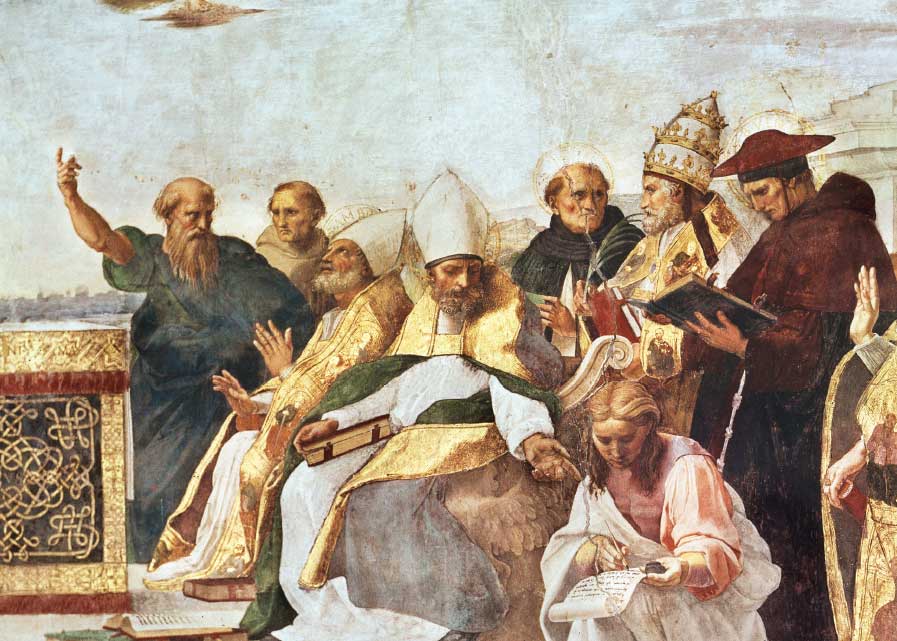
An older Christian political tradition, however, expressed most deeply and originally by St. Augustine, may provide relief to today’s warring Evangelicals. On the first page of his Confessions he writes: “Because thou hast made us toward thyself our heart is restless until it rests in thee.” With that “toward thyself” Augustine expresses the early Christian understanding that man participates in his creation, both individually and collectively, as he either obeys and moves towards God and rest or he rebels and moves away from God into restlessness.
Elsewhere, in City of God, Augustine argues that the Roman concept of a “people” or polis as a group “united by agreement on the right” is inadequate to the task of forming and sustaining a common good. That is because agreement on what is right does not solve or even address the problem of human desire and “drawn-ness.” He thus redefines a people as a group “united by loved things held in common.”
Caleb Stegall is a lawyer and writer in Perry, Kansas. His forthcoming book on the history of prairie populism and the future of American regionalism is due out from ISI Books in 2009. He and his wife Ann have five boys and attend Grace Evangelical Presbyterian Church in Lawrence, Kansas, where Stegall serves as a ruling elder.
A Journal of Mere Christianity—Delivered to Your Door
- Essays on theology, culture, and the Church
- Contributors from across the Christian traditions

Six print issues (one year) of Touchstone, plus full online access and PDF downloads for only $39.95.

Get a one-year full-access subscription to the Touchstone online archives for only $19.95.
bulk subscriptions
Order Touchstone subscriptions in bulk and save $10 per sub! Each subscription includes 6 issues of Touchstone plus full online access to touchstonemag.com—including archives, videos, and pdf downloads of recent issues for only $29.95 each! Great for churches or study groups.
Transactions will be processed on a secure server.
more from the online archives

calling all readers
Please Donate
"There are magazines worth reading but few worth saving . . . Touchstone is just such a magazine."
—Alice von Hildebrand
"Here we do not concede one square millimeter of territory to falsehood, folly, contemporary sentimentality, or fashion. We speak the truth, and let God be our judge. . . . Touchstone is the one committedly Christian conservative journal."
—Anthony Esolen, Touchstone senior editor