The Way We Weren’t by William Murchison

The Way We Weren’t

Churches in the Fifties Were Filled, But Were They Faithful?

by William Murchison

Watching, a little idly, some recent televised reenactment of the Exodus story, I had a recurrent thought: Wasn’t it nice when Americans, by and large, to one degree or another, acknowledged Great Moments in Theological History—the parting of the Red Sea, Samson and Delilah, hungry lions versus stalwart Christians—and shelled out to see the cinematic reenactments of these moments? Wasn’t it nice? Although . . .

Although what? That’s the point. If you have the impression that the 1950s constituted some kind of last frontier of religious conviction and inspiration in the United States, you might wish to reexamine that impression with dispatch.

A Place to Mourn

I say this out of concern for intellectual clarity in the way American Christians address concerns unimaginable not many years ago: Christian moral standards viewed as impositions on personal expression; choice in abortion as the law of the land, with support growing for medical research on living embryos; once-sturdy churches shredded by assertions of a right to practice homosexuality; growing illiteracy among Christians as to the basics of their own faith; a mounting perception that religion is the source more of ignorance and persecution than of perfection in the purposes of Almighty God.

Doesn’t it make you want to close your eyes and relive the era when prayer at school was a human right, as well as a duty, and Bishop Fulton J. Sheen, with wondrous clarity, and on television yet, set forth the case for Christianity? I understand the temptation to look back on pre-Madalyn Murray O’Hair America as a place we do well to mourn, the chances for emulation having all but vanished.

A lot was good back then. Writing of a recent civil libertarian furor in Texas, concerning the Legislature’s doubtless futile attempt to protect “a student’s voluntary expression of a religious viewpoint,” I mentioned how things were done in ye olden times. For instance, prior to football kickoffs, our state’s high schools not only allowed but actually sponsored invocations of divine grace, conveyed by loudspeaker.

I mentioned likewise the pre-school devotionals held weekly in our high-school auditorium under student council auspices. Gasp! Religion on stage, flanked by Old Glory and the Lone Star flag!

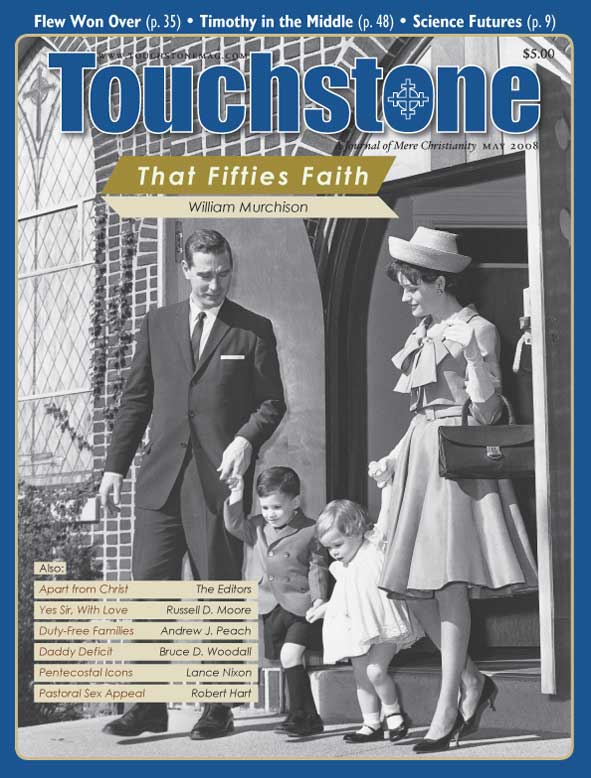
The fifties really were a time when the culture broadly affirmed Christianity as a Good Thing. I was there. I saw it; I heard it.

And yet some kind of demurral is strongly indicated: some sign of recognition that no human society, whatever its good intentions and methods, has lived unburdened, unencumbered by the crushing weight of human fallenness. Good as life may appear to have been in the cities and universities of France and Italy in the thirteenth century, or amid the sweaty fervor of the camp meetings in nineteenth-century America, or among the fierce faith of the emancipators, always human pride and general nuttiness were there to spoil the broth.


William Murchison a syndicated columnist, is author of Mortal Follies: Episcopalians and the Crisis of Mainline Christianity (Encounter Books).

A Journal of Mere Christianity—Delivered to Your Door

  • Essays on theology, culture, and the Church
  • Contributors from across the Christian traditions
Subscribe (Print + Online)

Six print issues (one year) of Touchstone, plus full online access and PDF downloads for only $39.95.

Subscribe (Online Only)

Get a one-year full-access subscription to the Touchstone online archives for only $19.95.


bulk subscriptions

Order Touchstone subscriptions in bulk and save $10 per sub! Each subscription includes 6 issues of Touchstone plus full online access to touchstonemag.com—including archives, videos, and pdf downloads of recent issues for only $29.95 each! Great for churches or study groups.

Transactions will be processed on a secure server.


more from the online archives

22.6—July/August 2009

Unhappy Fault

on the Integration of Anger into the Virtuous Life by Leon J. Podles

29.4—July/August 2016

Naked Truth

on Noticing That Modern Science Has Rendered Atheism Irrational by Harry Biltz

24.1—January/February 2011

Sanger's Victory

How Planned Parenthood's Founder Played the Christians, and Won by Allan C. Carlson

calling all readers

Please Donate

"There are magazines worth reading but few worth saving . . . Touchstone is just such a magazine."
—Alice von Hildebrand

"Here we do not concede one square millimeter of territory to falsehood, folly, contemporary sentimentality, or fashion. We speak the truth, and let God be our judge. . . . Touchstone is the one committedly Christian conservative journal."
—Anthony Esolen, Touchstone senior editor

Support Touchstone

00