





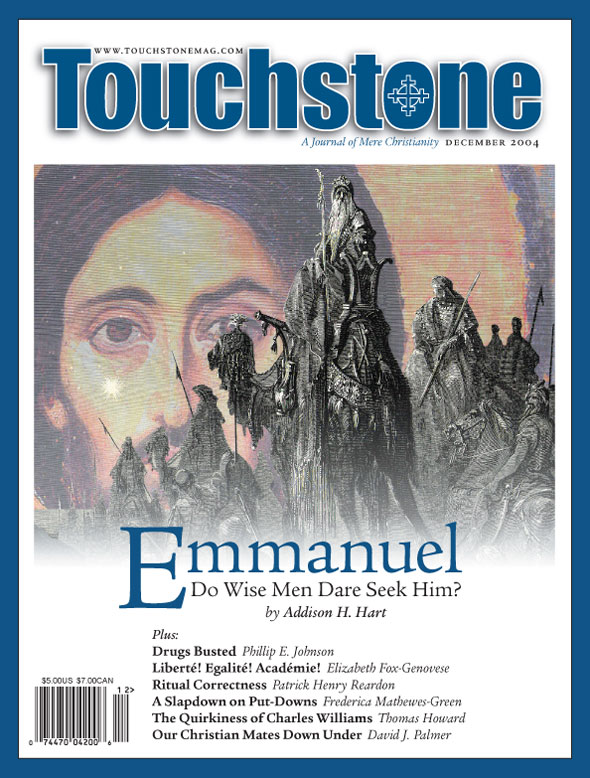
Meet Your Mocker
Frederica Mathewes-Green on Ridicule, Rebuke & Responsibility
Recently a friend drew my attention to an exchange of letters between a mid-twentieth-century novelist and a lady. The lady thought the novelist was naughty and proceeded to lecture him about the unseemly content of his books. The novelist—and we can imagine bright, eager eyes over a mischievous grin—replied by thanking the woman profusely for rescuing him from error, and concluded by begging her to send a photo so he could see what true Christian charity looked like. A very satisfying put-down, in my friend’s opinion.
It got me thinking, though. For one thing, this wasn’t a fair fight. Your average moralizing citizen is no match for a guy who writes comic novels for a living. If the playing field were to be level, he should have voluntarily adopted some kind of handicap, for example, removing the letter E from his typewriter. (Someone made a similar observation when Antioch College instituted its student rule that all sexual encounters must be conducted with permission explicitly requested and conferred at every stage. For the first time in romance history, the verbal nerds had an advantage over the lummoxy jocks.)
THIS ARTICLE ONLY AVAILABLE TO SUBSCRIBERS.
FOR QUICK ACCESS:
Frederica Mathewes-Green is a columnist for Beliefnet.com and a contributor to the Christian Millennial History Project multi-volume series. Her books include At the Corner of East and Now (Putnam), The Illumined Heart (Paraclete Press), and The Open Door: Entering the Sanctuary of Icons and Prayer (Paraclete Press). She lives in Linthicum, Maryland, with her husband Fr. Gregory, pastor of Holy Cross Orthodox Church. They have three children and three grandchildren.
A Journal of Mere Christianity—Delivered to Your Door
- Essays on theology, culture, and the Church
- Contributors from across the Christian traditions

Six print issues (one year) of Touchstone, plus full online access and PDF downloads for only $39.95.

Get a one-year full-access subscription to the Touchstone online archives for only $19.95.
bulk subscriptions
Order Touchstone subscriptions in bulk and save $10 per sub! Each subscription includes 6 issues of Touchstone plus full online access to touchstonemag.com—including archives, videos, and pdf downloads of recent issues for only $29.95 each! Great for churches or study groups.
Transactions will be processed on a secure server.
more from the online archives


24.5—Sept/Oct 2011
on Wondering or Wandering Through College Education by Anthony Esolen
calling all readers
Please Donate
"There are magazines worth reading but few worth saving . . . Touchstone is just such a magazine."
—Alice von Hildebrand
"Here we do not concede one square millimeter of territory to falsehood, folly, contemporary sentimentality, or fashion. We speak the truth, and let God be our judge. . . . Touchstone is the one committedly Christian conservative journal."
—Anthony Esolen, Touchstone senior editor
